• Fri frakt över 249 kr
  • •
  • Snabba leveranser
  • •
  • Billiga böcker
Kundservice

Du är på sajten för privatpersoner.

Företag, bibliotek eller offentlig verksamhet?

Du handlar på classic.bokus.com, där alla dina funktioner finns intakta.
Till classic.bokus.com
Bokus logotyp. Gå till startsidan.
  • Erbjudanden
  • Nyheter
  • Student
  • Topplistor
  • Barn & ungdom
  • Bokus Play
  • E-böcker
  • Pocketböcker
  • Spel & pussel

10% rabatt på allt med kod: NYSTART10 →

Sidfot

Mina sidor

    Hjälp

    • Kundservice
    • Vanliga frågor och svar
    • Frakt och leverans
    • Retur vid ångerrätt
    • Reklamera vara
    • Betalning
    • Köpvillkor
    • Allmänna villkor
    • Information om webbplatsens tillgänglighet

    Om Bokus

    • Om oss
    • Pressrum
    • För studenter
    • För företag
    • För bibliotek och offentlig verksamhet
    • För leverantörer
    • Hållbarhet

    Populärt

    • Aktuella erbjudanden
    • Presentkort
    • Studentlitteratur
    • Nya böcker
    • Topplistor
    • Signerade böcker
    • Engelska böcker

    Inspiration

    • Boktips
    • BookTok
    • Populära bokserier
    • Barnbokskaraktärer
    • Populära författare
    Logotyp för Bokus
    Följ oss på Facebook (extern länk)Följ oss på Instagram (extern länk)Följ oss på YouTube (extern länk)Följ oss på TikTok (extern länk)
    bokus @ CookiesAnpassa cookiesIntegritetspolicyKöpvillkor
    Till Citymail hemsida (extern länk)Till Budbee hemsida (extern länk)Till Postnord hemsida (extern länk)Till Schenker hemsida (extern länk)Till Early Bird hemsida (extern länk)Till Walleys hemsida (extern länk)
    1. Samhälle och politik
    2. Politik och statsskick
    3. Politiska partier

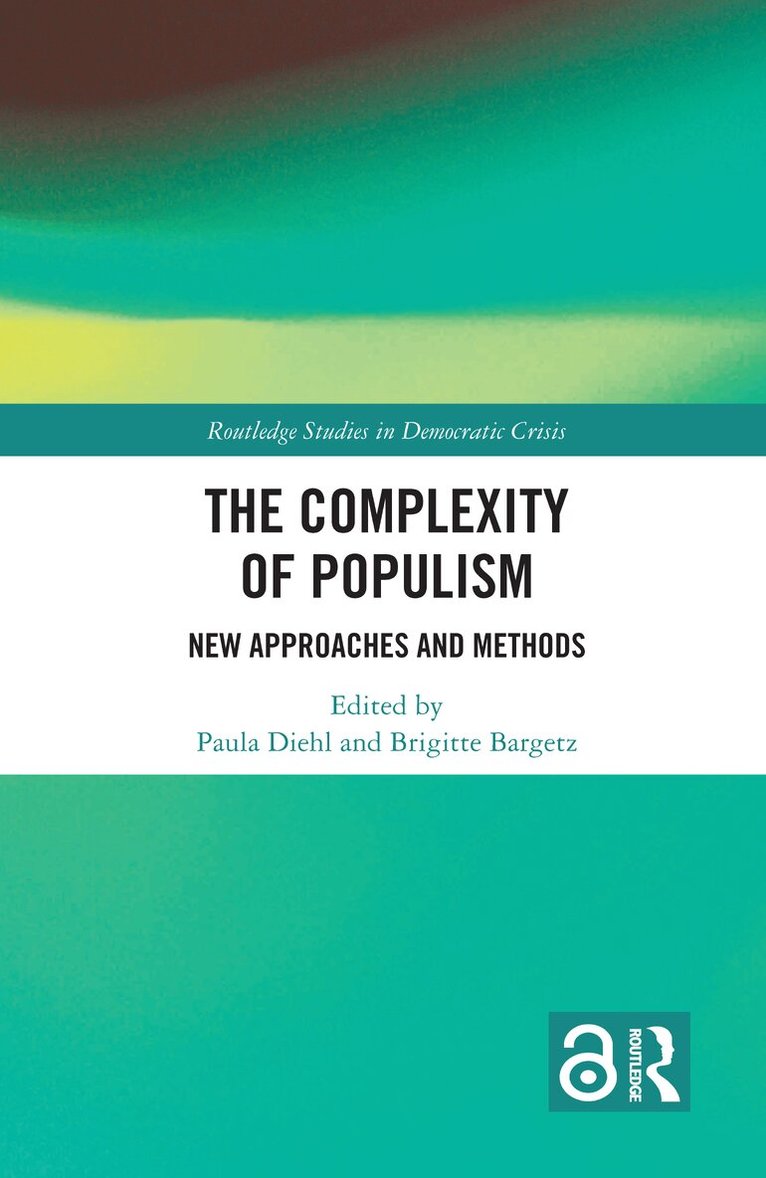
    Complexity of Populism

    New Approaches and Methods

    AvPaula Diehl,Brigitte Bargetz

    Inbunden, Engelska, 2023

    Del i serien Routledge Studies in Democratic Crisis

    1 723 kr

    Skickas . Fri frakt över 249 kr.

    Beskrivning

    This book explores the mechanisms and elements of populism to develop new theoretical and methodological approaches. Much as populism has been researched, it remains a contested notion without coherent definition and methodology and shaped by dimensions such as ideology, communication style, discourse, mobilization, and organization. It has simultaneously mobilized emotions, produced symbols, affected subjectivity and gender relations, and can manifest itself in different ways and appear in hybrid forms, such as in the cases of Silvio Berlusconi, Hugo Chávez, and Donald Trump. International expert contributors explore how such a variety of phenomena can be explained and analyzed, expanding the scope of populism research by proposing a multidimensional and complex understanding of populism. They argue for a greater epistemological differentiation and propose a methodology that integrates different fields of politics. This complex approach makes it possible to analyze populism as a multifaceted phenomenon and to understand how populisms affect politics and society. Aimed at postgraduates and researchers in populism as well as scholars in political science and sociology, media, communication, cultural, gender, and global studies, the volume also contributes to a better understanding of manifestations of right-wing and authoritarian populism in the twenty-first century.

    Produktinformation

    • Utgivningsdatum:2023-07-31
    • Mått:156 x 234 x 19 mm
    • Vikt:453 g
    • Format:Inbunden
    • Språk:Engelska
    • Serie:Routledge Studies in Democratic Crisis
    • Antal sidor:200
    • Förlag:Taylor & Francis Ltd
    • ISBN:9781032226835

    Utforska kategorier

    • Politiska partier inom Samhälle och politik
    • Politiskt ledarskap inom Samhälle och politik
    • Politisk aktivism inom Samhälle och politik

    Mer om författaren

    Paula Diehl (Ph.D., Humboldt University, Berlin) is Full Professor of Political Theory, History of Ideas, and Political Culture and Director of the International Populism Research Network at Kiel University, Germany. She was Guest Professor, among others, at Sciences Po (Paris), Washington University (St. Louis), École des Hautes Études en Sciences Sociales (Paris), and the Institute for Advanced Studies (Bologna). Her current research projects are dedicated to populism, political representation, and the concept of the political imaginary. She is the editor (with Till Weber) of the Symposium Populism: Complex Concepts and Innovative Methods, Polity, Volume 54, Number 3, July 2022.Brigitte Bargetz (Ph.D., University of Vienna) is Senior Researcher in Political Theory, History of Ideas and Political Culture and Coordinator of the International Populism Research Network at Kiel University. She was, among others, Professor of Political Theory (interim), University of Passau, Assistant Professor at the Department of Political Science, University of Vienna, Professor of Diversity Politics (interim), Humboldt-Universität zu Berlin, as well as Visiting Fellow at Charles University, Prague, and The Open University, Milton Keynes. Her current research is about affect theory, populism and democracy, and the welfare state. She is the author of Haunting Sovereignty and the Neurotic Subject: Contemporary Constellations of Fear, Anxiety and Uncertainty, Citizenship Studies, Volume 25, Number 1, 2021, 20–35.

    Recensioner i media

    "Populism's diverse political expressions have long been a source of scholarly debate and confusion. In The Complexity of Populism: New Approaches and Methods, leading scholars provide new analytical tools to explain this diversity by conceptualizing populism's multiple dimensions and exploring different methods for the empirical study of both historical and contemporary populisms. The interdisciplinary focus on populism's ideological, communicational, and organizational dimensions offers a framework for comparative analysis that is sure to be very well-received by other scholars looking for coherence amidst populist complexity."- Kenneth M. Roberts, Professor of Government, Cornell University'Populism is too often portrayed as a simplistic form of politics. However, this clever and vital volume pushes back against this erroneous assumption by taking the complexity of populism seriously. Recognizing the variation of populist phenomena across the globe, the volume acknowledges the multidimensional nature of populism, suggests new and important methodological avenues for its study, and crucially, embraces interdisciplinarity in examining how populism works. It is vital reading for anyone working on or thinking about populism, both from a theoretical and empirical perspective, and will open up new avenues for studying the most controversial political phenomena of the 21st century.'-Benjamin Moffitt, Australian Catholic University'Complexity of Populism is an important contribution for those who want to study populism without taking shortcuts. It recognizes that populism cannot be rendered in a clear and distinct idea and reflects the interpretations of democracy. It shows us that to know populism we must become comparativists and interdisciplinarians, have the patience and humility to get out of comfortable generalizations and go to concrete experiences.'-Nadia Urbinati, Columbia University

    Innehållsförteckning

    • The Complexity of Populism: New Approaches and Methods. An Introduction PART 1: Populism: A Complex Multidimensional and Gradual Phenomenon 2. Rethinking Populism in Complex Terms 3.Differentiating Populism: The Complex Constructions of the Leader and the People PART 2: Epistemological Extensions: Gender, Affects, Subjects 4.Gender as an Analytical Approach to Understanding Authoritarian Right-Wing Populism and Assessing Populism 5.Affect, Populism, Politics: Paradoxical Promises of Agency 6.Towards a Therapeutic Approach to Populism PART 3: Reflecting Populism’s Complexity: Towards a Multidimensional Methodology 7.A Global Historical Perspective on Populism 8.Observing Right-Wing Populists: A Methodological Approach in Populism Research 9.Explaining Populism from the Politolinguistic Perspective 10.Transformations of the Media Sphere: Amplifying Opportunity Structures for Populism 11.Populism by Numbers? Toward a Quantitative Morphology