• Fri frakt över 249 kr
  • •
  • Snabba leveranser
  • •
  • Billiga böcker
Kundservice

Du är på sajten för privatpersoner.

Företag, bibliotek eller offentlig verksamhet?

Du handlar på classic.bokus.com, där alla dina funktioner finns intakta.
Till classic.bokus.com
Bokus logotyp. Gå till startsidan.
  • Erbjudanden
  • Nyheter
  • Student
  • Topplistor
  • Barn & ungdom
  • Bokus Play
  • E-böcker
  • Pocketböcker
  • Spel & pussel

10% rabatt på allt med kod: NYSTART10 →

Sidfot

Mina sidor

    Hjälp

    • Kundservice
    • Vanliga frågor och svar
    • Frakt och leverans
    • Retur vid ångerrätt
    • Reklamera vara
    • Betalning
    • Köpvillkor
    • Allmänna villkor
    • Information om webbplatsens tillgänglighet

    Om Bokus

    • Om oss
    • Pressrum
    • För studenter
    • För företag
    • För bibliotek och offentlig verksamhet
    • För leverantörer
    • Hållbarhet

    Populärt

    • Aktuella erbjudanden
    • Presentkort
    • Studentlitteratur
    • Nya böcker
    • Topplistor
    • Signerade böcker
    • Engelska böcker

    Inspiration

    • Boktips
    • BookTok
    • Populära bokserier
    • Barnbokskaraktärer
    • Populära författare
    Logotyp för Bokus
    Följ oss på Facebook (extern länk)Följ oss på Instagram (extern länk)Följ oss på YouTube (extern länk)Följ oss på TikTok (extern länk)
    bokus @ CookiesAnpassa cookiesIntegritetspolicyKöpvillkor
    Till Citymail hemsida (extern länk)Till Budbee hemsida (extern länk)Till Postnord hemsida (extern länk)Till Schenker hemsida (extern länk)Till Early Bird hemsida (extern länk)Till Walleys hemsida (extern länk)
    1. Naturvetenskap och teknik
    2. Matematik och naturvetenskap
    3. Matematik
    4. Tillämpad matematik

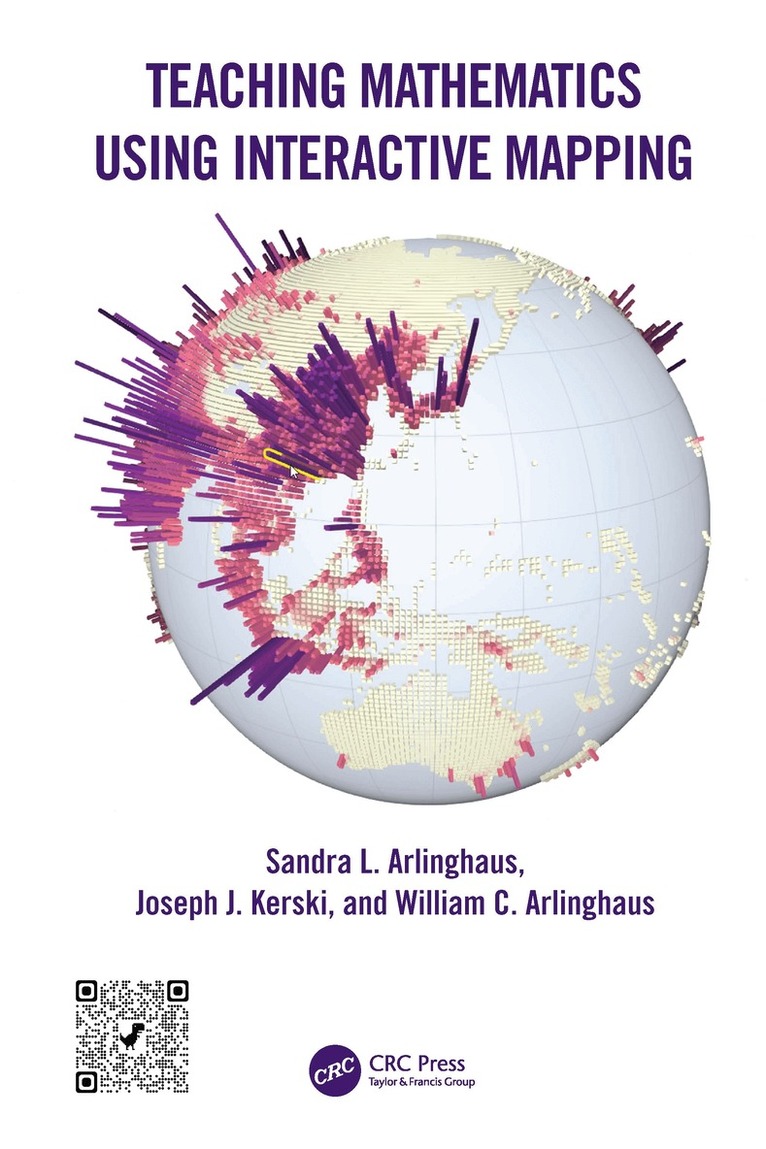
    Teaching Mathematics Using Interactive Mapping

    AvSandra L. Arlinghaus,Joseph J. Kerski

    Häftad, Engelska, 2023

    751 kr

    Beställningsvara. Skickas inom 10-15 vardagar. Fri frakt över 249 kr.

    Fler format och utgåvor

    Inbunden

    1 902 kr

    Beskrivning

    Teaching Mathematics Using Interactive Mapping offers novel ways to learn basic math topics such as simple relational measures or measuring hierarchies through customized interactive mapping activities. These activities focus on interactive web-based Geographic Information System (GIS) and are relevant to today’s problems and challenges. Written in a guided, hands-on, understandable manner, all activities are designed to build practical and problem-solving skills that rest on mathematical principles and move students from thinking about maps as references that focus solely on "where is" something, to analytical tools, focusing primarily on the "whys of where." Success with this transition through interaction permits most readers to master mathematical concepts and GIS tools.FEATURESOffers custom-designed geographical activities to fit with specific mathematical topicsHelps students become comfortable using mathematics in a variety of professionsProvides an innovative, engaging, and practical set of activities to ease readers through typically difficult, often elementary, mathematical topics: fractions, the distributive law, and much moreUses web-based GIS maps, apps, and other tools and data that can be accessed on any device, anywhere, at any time, requiring no prior GIS backgroundWritten by experienced teachers and researchers with lifelong experience in teaching mathematics, geography, and spatial analysisFeatures an accompanying Solution Guide, available on the book's product page, that is beneficial for instructors, students, and other readers as an aid to gauging progress.This textbook applies to undergraduate and graduate students in universities and community colleges including those in basic mathematics courses, as well as upper-level undergraduate and graduate students taking courses in geographic information systems, remote sensing, photogrammetry, geography, geodesy, information science, engineering, and geology. Professionals interested in learning techniques and technologies for collecting, analyzing, managing, processing, and visualizing geospatial datasets will also benefit from this book as they refresh their knowledge in mathematics.

    Produktinformation

    • Utgivningsdatum:2023-12-11
    • Mått:178 x 254 x 16 mm
    • Vikt:540 g
    • Format:Häftad
    • Språk:Engelska
    • Antal sidor:225
    • Förlag:Taylor & Francis Ltd
    • ISBN:9781032305332

    Utforska kategorier

    • Tillämpad matematik inom Naturvetenskap och teknik
    • Lärarutbildning inom Psykologi och pedagogik
    • Geografi inom Naturvetenskap och teknik

    Mer om författaren

    Sandra L. Arlinghaus, PhD, is a mathematical geographer. She holds a PhD in geography from the University of Michigan and has PhD-level training in pure mathematics from the University of Chicago (algebra), the University of Toronto (geometry), and Wayne State University (graph theory). Dr. Arlinghaus has published over 400 books and articles, many in peer-reviewed publications. She is currently Adjunct Professor, School for Environment and Sustainability, University of Michigan, Ann Arbor.Joseph J. Kerski, PhD, is a geographer, educator, and GIS professional who has served in four major sectors of society: government, academia, private industry, and nonprofit organizations. His career focus is the implementation and effectiveness of geotechnologies across all learning domains. Dr. Kerski holds three degrees, all in geography, and has worked extensively with those in career and technology education, earth and environmental science, geography, history, and mathematics.William C. Arlinghaus, PhD, holds a PhD in pure mathematics and is Professor Emeritus of Mathematics and Computer Science at Lawrence Technological University, Southfield, Michigan. He has taught all levels of undergraduate university mathematics and computer science and has extensive administrative experience, including service as Department Chair. In total, he has published over 50 books and articles in the USA and abroad.

    Innehållsförteckning

    • 1. Classifying Numbers and the Distributive Law. 2. Fractions and Decimals. 3. Simple Relational Measures and Measures of Central Tendency and Variation. 4. Earth Measurement: Coordinate Systems and Trigonometry. 5. Data, Variables, and Thematic Maps. 6. Mathematics’ Foundations: Set Theory and Algebra. 7. Mathematics’ Foundations: Dimension and Geometry. 8. Proximity and Adjacency: Measurement. 9. Measuring Hierarchies and Patterns.