• Fri frakt över 249 kr
  • •
  • Snabba leveranser
  • •
  • Billiga böcker
Kundservice

Du är på sajten för privatpersoner.

Företag, bibliotek eller offentlig verksamhet?

Du handlar på classic.bokus.com, där alla dina funktioner finns intakta.
Till classic.bokus.com
Bokus logotyp. Gå till startsidan.
  • Erbjudanden
  • Nyheter
  • Student
  • Topplistor
  • Barn & ungdom
  • Bokus Play
  • E-böcker
  • Pocketböcker
  • Spel & pussel

10% rabatt på allt med kod: NYSTART10 →

Sidfot

Mina sidor

    Hjälp

    • Kundservice
    • Vanliga frågor och svar
    • Frakt och leverans
    • Retur vid ångerrätt
    • Reklamera vara
    • Betalning
    • Köpvillkor
    • Allmänna villkor
    • Information om webbplatsens tillgänglighet

    Om Bokus

    • Om oss
    • Pressrum
    • För studenter
    • För företag
    • För bibliotek och offentlig verksamhet
    • För leverantörer
    • Hållbarhet

    Populärt

    • Aktuella erbjudanden
    • Presentkort
    • Studentlitteratur
    • Nya böcker
    • Topplistor
    • Signerade böcker
    • Engelska böcker

    Inspiration

    • Boktips
    • BookTok
    • Populära bokserier
    • Barnbokskaraktärer
    • Populära författare
    Logotyp för Bokus
    Följ oss på Facebook (extern länk)Följ oss på Instagram (extern länk)Följ oss på YouTube (extern länk)Följ oss på TikTok (extern länk)
    bokus @ CookiesAnpassa cookiesIntegritetspolicyKöpvillkor
    Till Citymail hemsida (extern länk)Till Budbee hemsida (extern länk)Till Postnord hemsida (extern länk)Till Schenker hemsida (extern länk)Till Early Bird hemsida (extern länk)Till Walleys hemsida (extern länk)
    1. Samhälle och politik
    2. Samhälle och kultur
    3. Kultur och medier
    4. Referensverk och tvärvetenskap

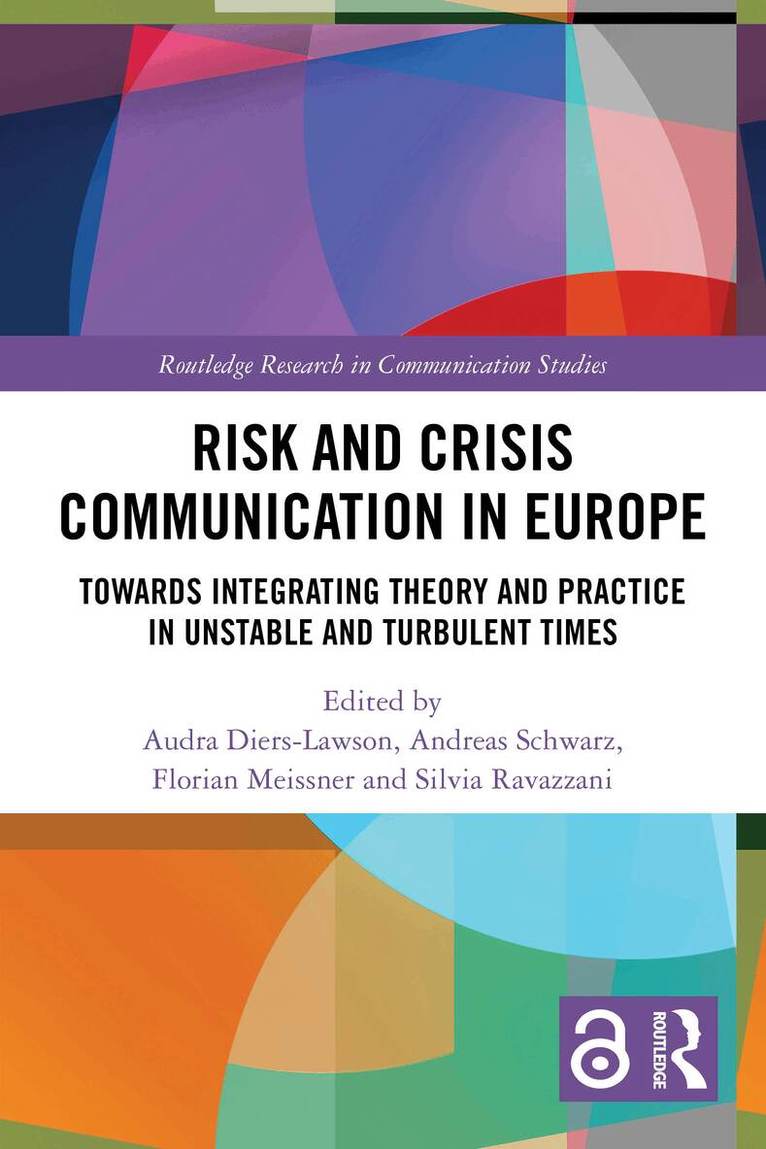
    Risk and Crisis Communication in Europe

    Towards Integrating Theory and Practice in Unstable and Turbulent Times

    AvAudra Diers-Lawson,Andreas Schwarz

    Häftad, Engelska, 2025

    Del i serien Routledge Research in Communication Studies

    681 kr

    Beställningsvara. Skickas inom 10-15 vardagar. Fri frakt över 249 kr.

    Beskrivning

    This timely volume offers an international and cross-disciplinary examination of risk and crisis communication theory and practice in Europe.Placing the rapidly developing field of risk and crisis communication within the context of a Europe in flux – experiencing the amplification of the refugee crisis, Brexit, increasing terrorist attacks, a heightened awareness of the climate crisis, and the COVID-19 pandemic – a cross-continental team of experts explore these developments from a theoretical and practical standpoint. Drawing connections between culture, digital technology, identity, public health, politics, and industry, the analysis offers a multitude of perspectives from across the continent and provides ways ahead for the field of risk and crisis communication.This exciting and innovative volume will interest scholars and students of risk and crisis communication, media studies, political communication, public relations, political studies, and international relations.Chapter 5 of this book is freely available as a downloadable Open Access PDF at http://www.taylorfrancis.com under a Creative Commons [Attribution-Non Commercial-No Derivatives (CC-BY-NC-ND)] 4.0 license

    Produktinformation

    • Utgivningsdatum:2025-12-25
    • Mått:220 x 10 x 150 mm
    • Vikt:590 g
    • Format:Häftad
    • Språk:Engelska
    • Serie:Routledge Research in Communication Studies
    • Antal sidor:346
    • Förlag:Taylor & Francis Ltd
    • ISBN:9781032450803

    Utforska kategorier

    • Referensverk och tvärvetenskap inom Samhälle och politik
    • Medievetenskap inom Samhälle och politik
    • Offentlig förvaltning inom Samhälle och politik

    Mer om författaren

    Audra Diers-Lawson is a Professor of Risk and Crisis Communication and Director of the PhD in Communication and Leadership at Kristiania University College. She wrote Crisis Communication: Managing Stakeholder Relationships and co-edited Pandemic Communication. She has collaborated with colleagues with the Asia Europe Foundation, WHO, and EU and currently serves as a member of the WHO Europe’s Technical Advisory Group for Risk Communication, Community Engagement, and Infodemic Management.Andreas Schwarz (PhD, TU Ilmenau, 2009) is senior researcher in risk and crisis communication at Technische Universität Ilmenau, Germany, is co-director of the International Research Group on Crisis Communication, and founding chair of the Crisis Communication Section of the European Communication Research and Education Association (ECREA), 2011–2018. Schwarz has received research grants to study risk communication of COVID-19, crisis communication of child protective services and nonprofit organizations, and perceptions of artificial intelligence or automated mobility. He is co-editor of the Handbook of International Crisis Communication Research.Florian Meissner is Professor for Media Management and Journalism at Macromedia University of Applied Sciences. He serves as Chair of the Crisis Communication Section of ECREA. His research focuses on crisis and risk communication in both journalistic and social media. As one of the Principal Investigators in the research consortium “DigiFit”, funded by the German Federal Government, he currently focuses on communication about digital security. He has practical work experience as a journalist for public broadcasters in Germany.Silvia Ravazzani, PhD, is Associate Professor in Management at the Department of Business, Law, Economics and Consumer Behaviour at Università IULM in Italy. Her main research interests include crisis communication, social media, and employee communication. Other research areas relate to diversity management and inclusion, sustainability, and related discursive practices.

    Innehållsförteckning

    • IntroductionPart 1: An Evolving Field – Risk and Crisis Communication in EuropeChapter 1: A Multi-Motive Risk Communication Model for “Making” Crisis Preparedness Chapter 2: Marrying Crisis Preparation and Strategic Planning: Definitions and Challenges in Business Practice Chapter 3: “Sharing is Preparing”: The Role of Information-Sharing in Collective Crisis Sensemaking During the July 22 Terror Attack in Oslo Chapter 4: A Caring Framework for Crises and Disasters Chapter 5: The Agents of Resilience: Generativity and Durability of Digital Platforms in Crisis-to-Crisis Transition Chapter 6: Bridging theory and practice through crisis simulation: A framework designed to address the current development of risk assessment and crisis communication in Romania Chapter 7: Coordination in Multi-Crises: The German Aviation Industry Chapter 8: The Arcadia Crisis Postmortem: Lessons Learned for the Fashion Industry in Stakeholder Relationship Management and Value Co-Creation Chapter 9: Managing a Legitimacy Crisis: Airline Sensemaking in the Context of Flight Shame Part 2: Lessons Learned from COVID-19 for Risk and Crisis Communication in EuropeChapter 10: Translating Research to Practice: Identifying Best Practice in Pandemic Communication Chapter 11: Communication Inequality of Ethnic Groups in Public Health Crisis: State of the Art and Model of Community-Based Crisis Response Chapter 12: How to do Evidence-Informed Risk Communication During an Emergency: Experiences from a Pandemic Chapter 13: The Role of Culture in Risk and Crisis Communication Management: The Case of Switzerland and the Governmental Communication during the COVID-19 Pandemic Chapter 14: The Finnish Government’s Strategic Ambiguity in COVID-19 Pandemic Communication: A Case Study Chapter 15: The COVID-19 Pandemic in the Polish and British Media: A Content Analysis Chapter 16: Information Seeking Repertoires in Migrant-Dense Swedish Suburbs During the COVID-19 Pandemic Chapter 17: Understanding What is at Stake: Challenges and Opportunities for Corporate Communication during the COVID-19 Crisis Chapter 18: Internal Crisis Communication and the COVID-19 Pandemic: Heading Towards a New Future? Chapter 19: COVID-19 Communication in Portugal: Exploring the Relationships Between Sources of Information and Citizens’ Trust in Governmental Risk and Crisis Communication