• Fri frakt över 249 kr
  • •
  • Snabba leveranser
  • •
  • Billiga böcker
Kundservice

Du är på sajten för privatpersoner.

Företag, bibliotek eller offentlig verksamhet?

Du handlar på classic.bokus.com, där alla dina funktioner finns intakta.
Till classic.bokus.com
Bokus logotyp. Gå till startsidan.
  • Erbjudanden
  • Student
  • Topplistor
  • Barn & ungdom
  • Bokus Play
  • E-böcker
  • Ljudböcker
  • Pocketböcker
  • Spel och pussel

Skapa nya rutiner – hälsoböcker upp till 50% →

Sidfot

Mina sidor

    Hjälp

    • Kundservice
    • Vanliga frågor och svar
    • Frakt och leverans
    • Retur vid ångerrätt
    • Reklamera vara
    • Betalning
    • Köpvillkor
    • Allmänna villkor
    • Information om webbplatsens tillgänglighet

    Om Bokus

    • Om oss
    • Pressrum
    • För studenter
    • För företag
    • För bibliotek och offentlig verksamhet
    • För leverantörer
    • Hållbarhet

    Populärt

    • Aktuella erbjudanden
    • Presentkort
    • Studentlitteratur
    • Nya böcker
    • Topplistor
    • Signerade böcker
    • Engelska böcker

    Inspiration

    • Boktips
    • BookTok
    • Barnbokskaraktärer
    • Populära författare
    Logotyp för Bokus
    Följ oss på Facebook (extern länk)Följ oss på Instagram (extern länk)Följ oss på YouTube (extern länk)Följ oss på TikTok (extern länk)
    bokus @ CookiesAnpassa cookiesIntegritetspolicyKöpvillkor
    Till Citymail hemsida (extern länk)Till Budbee hemsida (extern länk)Till Postnord hemsida (extern länk)Till Schenker hemsida (extern länk)Till Early Bird hemsida (extern länk)Till Walleys hemsida (extern länk)
    1. Naturvetenskap och teknik
    2. Matematik och naturvetenskap
    3. Biologi
    4. Biovetenskap

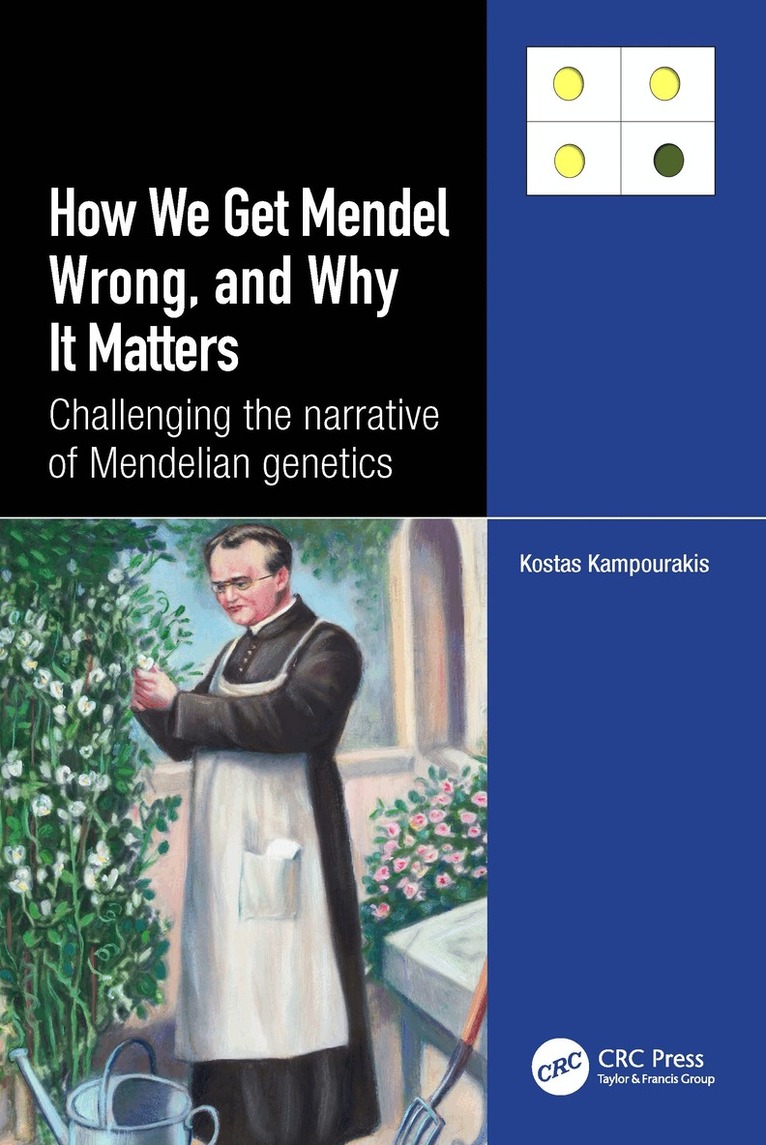
    How we Get Mendel Wrong, and Why it Matters

    Challenging the narrative of Mendelian genetics

    AvKostas Kampourakis

    Häftad, Engelska, 2023

    777 kr

    Beställningsvara. Skickas inom 10-15 vardagar. Fri frakt över 249 kr.

    Fler format och utgåvor

    E-bok

    922 kr

    E-bok

    922 kr

    Inbunden

    2 052 kr

    Beskrivning

    This book illustrates that the stereotypical representations of Gregor Mendel and his work misrepresent his findings and their historical context. The author sets the historical record straight and provides scientists with a reference guide to the respective scholarship in the early history of genetics. The overarching argument is twofold: on the one hand, that we had better avoid naïve hero-worshipping and understand each historical figure, Mendel in particular, by placing them in the actual sociocultural context in which they lived and worked; on the other hand, that we had better refrain from teaching in schools the naive Mendelian genetics that provided the presumed “scientific” basis for eugenics.Key FeaturesCorrects the distorting stereotypical representations of Mendelian genetics and provides an authentic picture of how science is done, focusing on Gregor Mendel and his actual contributions to scienceExplains how the oversimplifications of Mendelian genetics were exploited by ideologues to provide the presumed “scientific” basis for eugenicsProposes a shift in school education from teaching how the science of genetics is done using model systems to teaching the complexities of development through which heredity is materialized

    Produktinformation

    • Utgivningsdatum:2023-12-28
    • Mått:156 x 234 x 17 mm
    • Vikt:340 g
    • Format:Häftad
    • Språk:Engelska
    • Antal sidor:226
    • Förlag:Taylor & Francis Ltd
    • ISBN:9781032456904

    Utforska kategorier

    • Biovetenskap inom Naturvetenskap och teknik
    • Etiska frågor och debatter inom Samhälle och politik
    • Naturvetenskapens historia inom Naturvetenskap och teknik

    Mer om författaren

    Kostas Kampourakis is the author and editor of several books about evolution, genetics, philosophy, and history of science. He teaches biology and science education courses at the University of Geneva. He is the co-editor of Teaching Biology in Schools and What is Scientific Knowledge, both published by Routledge.

    Recensioner i media

    “Gregor Mendel’s bicentenary has rightly made us reassess every aspect of his legacy. Like many I first heard about Mendel at school, but could the way we introduce genetics in formal education constrain rather than encourage thought? Kostas Kampourakis provides a highly accessible but rigorous guide to how the debates at the birth of genetics foreshadow today’s controversies, and raises many fascinating questions about how the framing of some ultimately simple patterns of germline inheritance may influence how we think about how humankind is and how it could be.”George Davey Smith, Professor of Clinical Epidemiology, Bristol Medical School (PHS), University of Bristol“The myths that cling to Gregor Mendel and his legacies do him — and us — a huge disservice. In this superb book, Kostas Kampourakis presents the general reader with a first-rate introduction to the demythologized story, from Mendel’s day to our own. The lessons drawn, especially for the genetics classroom, should be required reading for anyone concerned to make biology education fit for purpose in the twenty-first century.”Gregory Radick, Professor of History and Philosophy of Science, University of Leeds“What if Gregor Mendel and his famous pea experiments were not the foundation of the science of heredity? Kostas Kampourakis provides a lucid, concise guide to a radical shift in how we think about genes and DNA—one that has the potential to radically revise the way we teach, and do, genetics.”Nathaniel Comfort, Professor, Department of the History of Medicine, Johns Hopkins University“How We Get Mendel Wrong, and Why It Matters pulls the rug out from under the standard readings of genetics’ origin story, challenging fundamental assumptions about what Mendel knew, why he conducted those experiments on peas, how his work was received at the turn of the twentieth century, and—most importantly—why the received view that continues to dominate biology textbooks is so dangerous. Kampourakis distills work from history of science, philosophy of science, biology, and educational policy and practice, making that extensive literature accessible. This radical reimagining of that famous “father of genetics” is not to be missed.James Tabery, Department of Philosophy, University of Utah“In How We Get Mendel Wrong and Why it Matters, Kostas Kampourakis provides a thorough update of the history of Mendel and Mendelism, debunking powerful myths, reminding us of eugenic misuses, and calling for new ways of teaching genetics.”Staffan Müller-Wille, University of Cambridge“Kostas Kampourakis issues a critical challenge to the life sciences: Is Mendel now doing more harm than good? Where classical 20th century Mendelism posits the division of the genome into discrete elements that we now call genes, and the direct association of those genetic elements with particular organismal features, Kampourakis argues forcefully that we now know both of those assumptions to be gross oversimplifications, if not outright fallacies. Consequently perhaps Gregor Mendel, the great mythic founder of genetics, has run his course in that role, and we should re-think how we teach about human heredity. He’s definitely got a good point!”Jonathan Marks, Professor of Anthropology, UNC-Charlotte“In How We Get Mendel Wrong and Why it Matters, Kampourakis expertly refocuses our attention away from modern genetics as a “great man” project borne from the pea-experiments of one cloistered genius. As he shows, cracking the mysteries of genetics was always a community-wide endeavor, requiring dozens of creative minds working hard for generations. Kampourakis’ research also peels away our prejudice that scientific ideas float free of their socio-political moorings. The genes-as-marbles analogy never accurately described what Mendel was after. But those mistaken assumptions served a whole cadre of unsavory interests from the very beginning—and arguably still do. This carefully crafted, compelling account kicks the scientific legs out from under the myths that have propped up eugenics and scientific racism for generations. For that reason, this book is a must read for anyone who hopes to understand not simply the true story of Mendel and early genetics, but also how science-flavored tales bend policy, education, and political priorities.”Erik L. Peterson, Associate Provost for General Education & Associate Professor of the History of Science & Medicine, The University of Alabama“Kostas Kampourakis has made a name for himself as one of our clearest expositors and interpreters of the history of the life sciences. In How We Get Mendel Wrong, and Why it Matters he tells the story of the origins of genetics, and ends with a punch: an innovative new way to teach it. Applied history of science at its best, this is essential reading not only for geneticists, teachers and administrators, but also for the general public.”Oren Harman, author of The Price of Altruism, The Man Who Invented the Chromosome, and Evolutions: Fifteen myths that Explain Our World“ If the past is indeed a foreign country, then for Kuhn, accepting the historical accounts found in science textbooks, with their tales of lone geniuses and eureka moments, equates to little more than the casual perusal of a glossy travel brochure. In this persuasive and important book, Kampourakis shows us why Mendel and his peas are a powerful example of Kuhn’s warning. … Since it is in the classroom and seminar hall that we first get Mendel wrong, it is here that these new metaphors can help us to get him right. But perhaps those in greatest need of hearing what Kampourakis has to say are politicians. Whether praising the residents of Minnesota for having “good genes, or reassuring potential voters of their integrity by promising that certain policies are written ‘in our DNA’ the political class appears to have embraced the notion that DNA is destiny with open arms. Reading Kampourakis” book would quickly disabuse them of this misconception but sadly I suspect that many will lack the time to do so. That will be their loss.”Kesrsten Hall in New Genetics and Society “This is the author’s latest contribution in his heroic ongoing mission to combat misconceptions in genetics and evolution, especially among educators, and to promote curricular reform. … In concluding, Kampourakis urges the abandonment of Mendel in K-12 biology curricula and the implementation of material that emphasizes the role of environmental and cellular signals in the developmental pathways by which phenotypic traits and variation are produced. Although this curricular shift will require hard work by the biological education community, it should not be seen as radical. It should be seen as a necessary part of the long overdue accounting and reckoning that the field of genetics has only recently begun through the actions of institutions and professional societies.”John True in the Quarterly Review of Biology “How We Get Mendel Wrong and Why It Matters is a thought-provoking, meticulously researched book. Kampourakis’s chapter-by-chapter analysis reevaluates Mendel’s legacy, urging readers to reconsider familiar narratives. Educators can find material to build lessons that convey how science is truly practiced. After all, scientific findings—as they are published and interpreted to the public—shape not just theories but also societal values and policies. This book helps teach how interpretations of biological discoveries, whether correct or not, extend beyond the laboratory, influencing education, ethics, and society itself.”Liz Albertorio-Sáez in The American Biology Teacher“Convergently, philosopher and biology educator Kostas Kampourakis has written several books on genetics and evolution, and trains his sights on Mendelism as well. As a historian, Radick is more focused on the past; Kampourakis, on the other hand, is more interested in the future. Both books are at pains to dismantle the myth of Mendel. The founding myth of genetics is that of the solitary genius, working to discover the basis of heredity in the cloistered confines of his monastery, disconnected from mainstream science … Kampourakis also paints with broader strokes than Radick, whose book is primary research in the history of science, with the depth and focus that comes with that territory. Both books are readable, and tell familiar and unfamiliar stories in readily understandable ways. … Together, what these books demonstrate is that there is a major change in the offing about how we should teach the most basic facts about heredity, from centering abstract binary elements to instead centering the actual cellular and biological systems involved in genetic transmission. Viva la revolución!”Jonathan Marks in The American Journal of Biological Anthropology “… an essential contribution to the field. … The book refutes multiple myths about Mendel’s work, such as the notion that he worked in isolation, was an unappreciated genius, and was the father of genetics who discovered the laws of genetics that were named after him (Mendel’s laws). … Kampourakis’ book highlights the need for changes in genetics education and provides insights into how such improvements should be implemented. While science education often emphasizes future and cutting-edge developments, this example underscores the importance of learning from the past. Carefully crafted genetics education that progresses from simple to complex models, accompanied by historical justifications for these changes, can help students better understand genetics, heredity, and the nature of science as a human endeavor.”Michal Haskel-Ittah in Science & Education “This book challenges “Mendelian genetics” as a paradigm for the teaching and public understanding of genetics. More precisely it challenges the “stereotypical narrative” of Mendel as the founding father of genetics. … Kampourakis’ historical overview from the time of Mendel till the early decades of the 20th century in general accords well with established historiography. … I sympathise with Kampourakis’ efforts to develop a narrative suitable for pedagogical introduction to the science of genetics.”Nils Roll-Hansen in History and Philosophy of the Life Sciences

    Innehållsförteckning

    • Preface: “Gregor Mendel, the first geneticist”. Part I Anachronistic Mendelism. Chapter 1 Mendel was not a geneticist ahead of his time. Chapter 2 Mendel was a brilliant experimentalist of his time. Chapter 3 Speculating about heredity. Chapter 4 The path to genetics. Chapter 5 The reification of the “lonely genius”. Part II Social Mendelism. Chapter 6 Mendel’s great defender. Chapter 7 Chromosomes, “factors” and genes. Chapter 8 “Mendelian” eugenics. Chapter 9 Geneticists’ attitudes towards “Mendelian” eugenics. Chapter 10 Mendelian genetics and the Nazi racial hygiene. Conclusions: Emending the teaching of school genetics.
    Hoppa över listan

    Mer från samma författare

    Kostas Kampourakis - Understanding Evolution, Häftad

    Understanding Evolution

    Kostas Kampourakis

    Häftad, 2020

    4,0 utav 5 stjärnor. Totalt antal röster:(1)

    210 kr

    Kostas Kampourakis, Tobias Uller - Philosophy of Science for Biologists, Häftad

    Philosophy of Science for Biologists

    Kostas Kampourakis, Tobias Uller

    Häftad, 2020

    430 kr

    Kostas Kampourakis - Understanding Genes, Häftad

    Understanding Genes

    Kostas Kampourakis

    Häftad, 2021

    174 kr

    Kostas Kampourakis, Michael Reiss - Teaching Biology in Schools, Häftad

    Teaching Biology in Schools

    Kostas Kampourakis, Michael Reiss

    Häftad, 2018

    664 kr

    Kostas Kampourakis - Ancestry Reimagined, Inbunden

    Ancestry Reimagined

    Kostas Kampourakis

    Inbunden, 2023

    406 kr

    Kostas Kampourakis, Kevin McCain - Uncertainty, Inbunden

    Uncertainty

    Kostas Kampourakis, Kevin McCain

    Inbunden, 2019

    446 kr

    Kevin McCain, Kostas Kampourakis - Uncertainty, E-bok

    Uncertainty

    Kevin McCain, Kostas Kampourakis

    E-bok
    2019

    300 kr

    Kevin McCain, Kostas Kampourakis - Uncertainty, E-bok

    Uncertainty

    Kevin McCain, Kostas Kampourakis

    E-bok
    2019

    300 kr

    Kostas Kampourakis - Ancestry Reimagined, E-bok

    Ancestry Reimagined

    Kostas Kampourakis

    E-bok
    2023

    332 kr

    Kostas Kampourakis - Ancestry Reimagined, E-bok

    Ancestry Reimagined

    Kostas Kampourakis

    E-bok
    2023

    332 kr

    Hoppa över listan

    Du kanske också är intresserad av

    Kostas Kampourakis - How we Get Mendel Wrong, and Why it Matters, E-bok

    How we Get Mendel Wrong, and Why it Matters

    Kostas Kampourakis

    E-bok
    2023

    922 kr

    Kostas Kampourakis - How we Get Mendel Wrong, and Why it Matters, E-bok

    How we Get Mendel Wrong, and Why it Matters

    Kostas Kampourakis

    E-bok
    2023

    922 kr

    Kostas Kampourakis - How we Get Mendel Wrong, and Why it Matters, Inbunden

    How we Get Mendel Wrong, and Why it Matters

    Kostas Kampourakis

    Inbunden, 2023

    2 052 kr

    Didier Eribon - En arbetarkvinnas liv, ålderdom och död, Inbunden

    En arbetarkvinnas liv, ålderdom och död

    Didier Eribon

    Inbunden, 2024

    270 kr

    Kostas Kampourakis - Understanding Evolution, Häftad

    Understanding Evolution

    Kostas Kampourakis

    Häftad, 2020

    4,0 utav 5 stjärnor. Totalt antal röster:(1)

    210 kr

    Kostas Kampourakis - Darwin Mythology, E-bok

    Darwin Mythology

    Kostas Kampourakis

    E-bok
    2024

    411 kr

    Kostas Kampourakis - Making Sense of Genes, E-bok

    Making Sense of Genes

    Kostas Kampourakis

    E-bok
    2017

    458 kr

    Kostas Kampourakis - Understanding Genes, E-bok

    Understanding Genes

    Kostas Kampourakis

    E-bok
    2021

    206 kr

    Kostas Kampourakis - Understanding Evolution, Inbunden

    Understanding Evolution

    Kostas Kampourakis

    Inbunden, 2020

    684 kr

    Kevin McCain, Kostas Kampourakis - Uncertainty, E-bok

    Uncertainty

    Kevin McCain, Kostas Kampourakis

    E-bok
    2019

    300 kr