• Fri frakt över 249 kr
  • •
  • Snabba leveranser
  • •
  • Billiga böcker
Kundservice

Du är på sajten för privatpersoner.

Företag, bibliotek eller offentlig verksamhet?

Du handlar på classic.bokus.com, där alla dina funktioner finns intakta.
Till classic.bokus.com
Bokus logotyp. Gå till startsidan.
  • Erbjudanden
  • Nyheter
  • Student
  • Topplistor
  • Barn & ungdom
  • Bokus Play
  • E-böcker
  • Pocketböcker
  • Spel & pussel

10% rabatt på allt med kod: NYSTART10 →

Sidfot

Mina sidor

    Hjälp

    • Kundservice
    • Vanliga frågor och svar
    • Frakt och leverans
    • Retur vid ångerrätt
    • Reklamera vara
    • Betalning
    • Köpvillkor
    • Allmänna villkor
    • Information om webbplatsens tillgänglighet

    Om Bokus

    • Om oss
    • Pressrum
    • För studenter
    • För företag
    • För bibliotek och offentlig verksamhet
    • För leverantörer
    • Hållbarhet

    Populärt

    • Aktuella erbjudanden
    • Presentkort
    • Studentlitteratur
    • Nya böcker
    • Topplistor
    • Signerade böcker
    • Engelska böcker

    Inspiration

    • Boktips
    • BookTok
    • Populära bokserier
    • Barnbokskaraktärer
    • Populära författare
    Logotyp för Bokus
    Följ oss på Facebook (extern länk)Följ oss på Instagram (extern länk)Följ oss på YouTube (extern länk)Följ oss på TikTok (extern länk)
    bokus @ CookiesAnpassa cookiesIntegritetspolicyKöpvillkor
    Till Citymail hemsida (extern länk)Till Budbee hemsida (extern länk)Till Postnord hemsida (extern länk)Till Schenker hemsida (extern länk)Till Early Bird hemsida (extern länk)Till Walleys hemsida (extern länk)
    1. Samhälle och politik
    2. Samhälle och kultur
    3. Kultur och medier
    4. Referensverk och tvärvetenskap

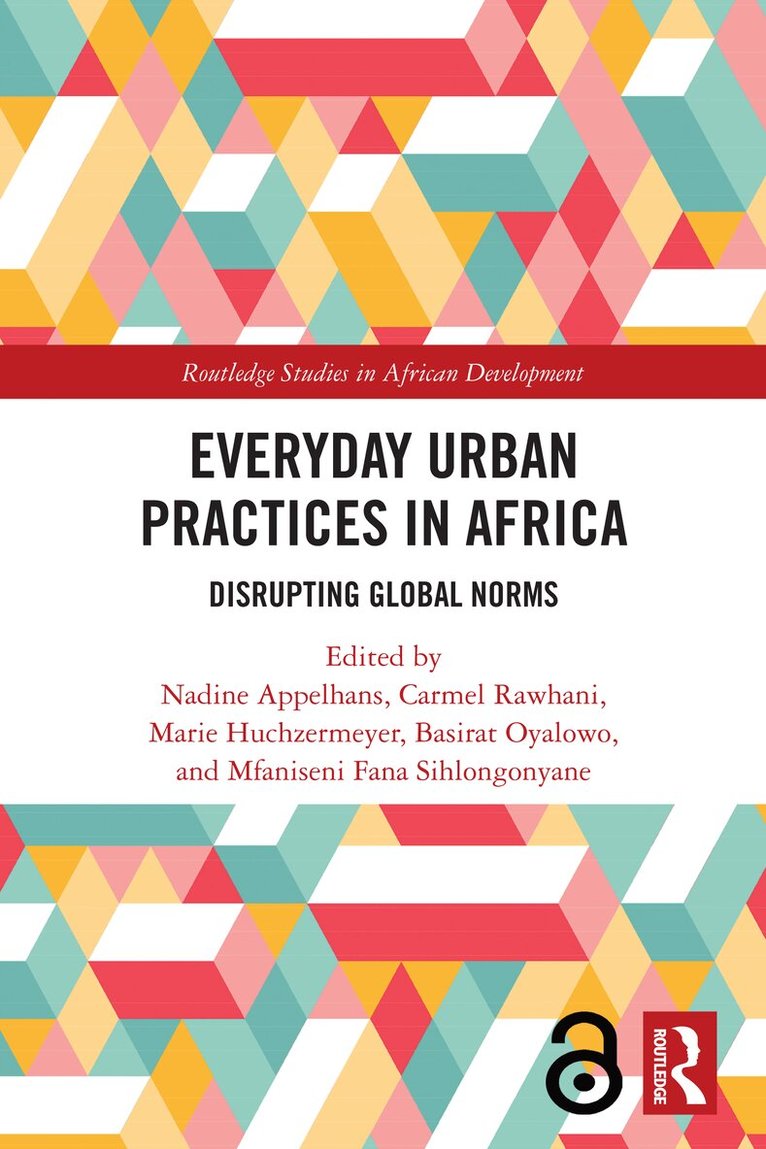
    Everyday Urban Practices in Africa

    Disrupting Global Norms

    AvNadine Appelhans,Carmel Rawhani

    Häftad, Engelska, 2025

    Del i serien Routledge Studies in African Development

    681 kr

    Beställningsvara. Skickas inom 10-15 vardagar. Fri frakt över 249 kr.

    Beskrivning

    This book disrupts the dominant underlying international norms informing urban development strategies across African cities. International policy frameworks have created a new universal agenda for developing cities. However, these frameworks have also imposed global paradigms and discourses that are often in conflict with local urbanisms. As we approach the deadline for achieving the Sustainable Development Goals, there is need for reflection and deliberation on a post-2030 agenda.The authors identify powerful assumptions, norms, and positionalities that obfuscate the efforts to achieve sustainable development in African cities, as well as along the North–South divide. They argue that a disruptive critique of these normative concepts, grounded in the lived African urban everyday, opens up opportunities to dismantle their assumed neutrality. Through disruption, the authors critically re-interpret the meanings of policy and the praxis of local urbanism, ultimately challenging the logic of universalising concepts underpinning implementation in the current international policy system, and asserting the need for contextualised urban policies.The book will be of interest to scholars and students of urban studies, development planning, urban governance, human settlements, development studies, urban geography, and African studies. It will also be useful for practitioners including town and regional/urban planners, urban policy consultants, and international development cooperation agencies.The Open Access version of this book, available at http://www.taylorfrancis.com, has been made available under a Creative Commons Attribution-Non Commercial-No Derivatives (CC-BY-NC-ND) 4.0 license.

    Produktinformation

    • Utgivningsdatum:2025-12-26
    • Mått:156 x 234 x 16 mm
    • Vikt:530 g
    • Format:Häftad
    • Språk:Engelska
    • Serie:Routledge Studies in African Development
    • Antal sidor:266
    • Förlag:Taylor & Francis Ltd
    • ISBN:9781032466996

    Utforska kategorier

    • Referensverk och tvärvetenskap inom Samhälle och politik
    • Geografi inom Naturvetenskap och teknik
    • Regional planering inom Naturvetenskap och teknik

    Mer om författaren

    Nadine Appelhans is Senior Researcher at the Habitat Unit, TU Berlin, Guest Researcher at the School of Architecture and Planning at the University of the Witwatersrand, and Scientific Coordinator of the Wits-TUB-UNILAG Urban Lab.Carmel Rawhani is the Impact Evaluation, Research, and Learning Manager at Fairtrade International, working from Bonn, Germany, and contributing to the Wits-TUB-UNILAG Urban Lab as Research Fellow.Marie Huchzermeyer is Professor in the School of Architecture and Planning at the University of the Witwatersrand, South Africa, and is Director of the Centre for Urbanism and Built Environment Studies in that school.Basirat Oyalowo is a senior lecturer in Real Estate at the Oxford Brookes University. Previously, she was Senior Lecturer and WITS-TUB-UNILAG Urban Lab Post doctoral fellow at the University of Lagos, Nigeria.Mfaniseni Fana Sihlongonyane is Professor of Development Planning and Urban Studies at the University of the Witwatersrand, School of Architecture and Planning.

    Recensioner i media

    "This is a great intellectual product. Its main premise is that everyday lived experiences are neither sufficiently noticed nor accounted for in the crafting of urban policy agendas at the global level, and this book takes a bold step toward this objective."Daniel K. B. Inkoom, Kwame Nkrumah University of Science and Technology, AAPS former Chair"Seen through the lens of the everyday in urban Africa as representing a multitude of both daily practices and realities, as well as a generative epistemic framework, this book brings together a varied set of thought-provoking contributions. Together, they call for a move beyond the 'business as usual' of development by urging us to rethink the global norms that drive the global post-2015 agenda. An important read for scholars and policymakers alike."Sylvia Croese, Assistant Professor of Global and International Studies, University of California, Irvine, and editor of Localizing the SDGs in African Cities

    Innehållsförteckning

    • Foreword Preface 1: Introduction: Global Norms, Urban Africa, the Everyday, and Disruption Part I: Heterogeneity Section Introduction 2: Questioning the Urban-Centrism of the New Urban Agenda and Its Implications for African Cities 3: Disrupting the myth of cohesion-generating public space: Contrasting narratives from Johannesburg and Berlin 4: The hybridisation of public transport in Dar es Salaam and Nairobi: Challenging inscriptions of innovation policy in bus rapid transit systems Part II: Fluid Belongings Section Introduction 5: The Faulty Premise of “Leave No One Behind” in Lagos: A Focus on People Living with Disabilities 6: Living Among the Dead: Disrupting Narratives on the Inclusion of the Homeless Through a Case of Public Open Space in Johannesburg 7: Exploring the Potential of the Spatial Agency of Refugees and IDPs to Inform Alternative Approaches of “Protection”: Case Studies from Lagos and Berlin Part III: Persistence Section Introduction 8: Unsettling the Formal–Informal Binary: the Right to Development and Self-Determination in the Harry Gwala Settlement Trajectory in Ekurhuleni, South Africa 9: Policy Transfer and the Misplaced Enabling Role of Government in Nigeria’s Housing Policy 10: The SDG Monitoring Framework Turns a Blind Eye to the Daily Realities of Lived Tenure Security in African Hybrid Land Transaction Systems: A South African Case Part IV: Interplay Section Introduction 11: Local Government Autonomy, Electoral Systems and Their Implications for Social Contracts in Nigeria: An Overlooked Obstacle to SDG Implementation 12: When Borders Do Not Matter: Contextualising Socio-Developmental Challenges in Urbanised Nigeria–Benin Border Communities 13: Transport Infrastructure as a Driver of Sustainable (Urban) Development in Africa? Critical Reflections on The Interrelations Between Sustainability Agendas and Infrastructure-Led Development through Experiences from Ethiopia 14: Conclusion: Towards Realistic Global Frames That Embrace Everyday Urban Practices in Africa