• Fri frakt över 249 kr
  • •
  • Snabba leveranser
  • •
  • Billiga böcker
Kundservice

Du är på sajten för privatpersoner.

Företag, bibliotek eller offentlig verksamhet?

Du handlar på classic.bokus.com, där alla dina funktioner finns intakta.
Till classic.bokus.com
Bokus logotyp. Gå till startsidan.
  • Erbjudanden
  • Nyheter
  • Student
  • Topplistor
  • Barn & ungdom
  • Bokus Play
  • E-böcker
  • Pocketböcker
  • Spel & pussel

Må bättre, för mindre! Upp till 50% rabatt på hälsoböcker

Sidfot

Mina sidor

    Hjälp

    • Kundservice
    • Vanliga frågor och svar
    • Frakt och leverans
    • Retur vid ångerrätt
    • Reklamera vara
    • Betalning
    • Köpvillkor
    • Allmänna villkor
    • Information om webbplatsens tillgänglighet

    Om Bokus

    • Om oss
    • Pressrum
    • För studenter
    • För företag
    • För bibliotek och offentlig verksamhet
    • För leverantörer
    • Hållbarhet

    Populärt

    • Aktuella erbjudanden
    • Presentkort
    • Studentlitteratur
    • Nya böcker
    • Topplistor
    • Signerade böcker
    • Engelska böcker

    Inspiration

    • Boktips
    • BookTok
    • Populära bokserier
    • Barnbokskaraktärer
    • Populära författare
    Logotyp för Bokus
    Följ oss på Facebook (extern länk)Följ oss på Instagram (extern länk)Följ oss på YouTube (extern länk)Följ oss på TikTok (extern länk)
    bokus @ CookiesAnpassa cookiesIntegritetspolicyKöpvillkor
    Till Citymail hemsida (extern länk)Till Budbee hemsida (extern länk)Till Postnord hemsida (extern länk)Till Schenker hemsida (extern länk)Till Early Bird hemsida (extern länk)Till Walleys hemsida (extern länk)
    1. Samhälle och politik
    2. Social välfärd och brottslighet
    3. Brottslighet och kriminologi

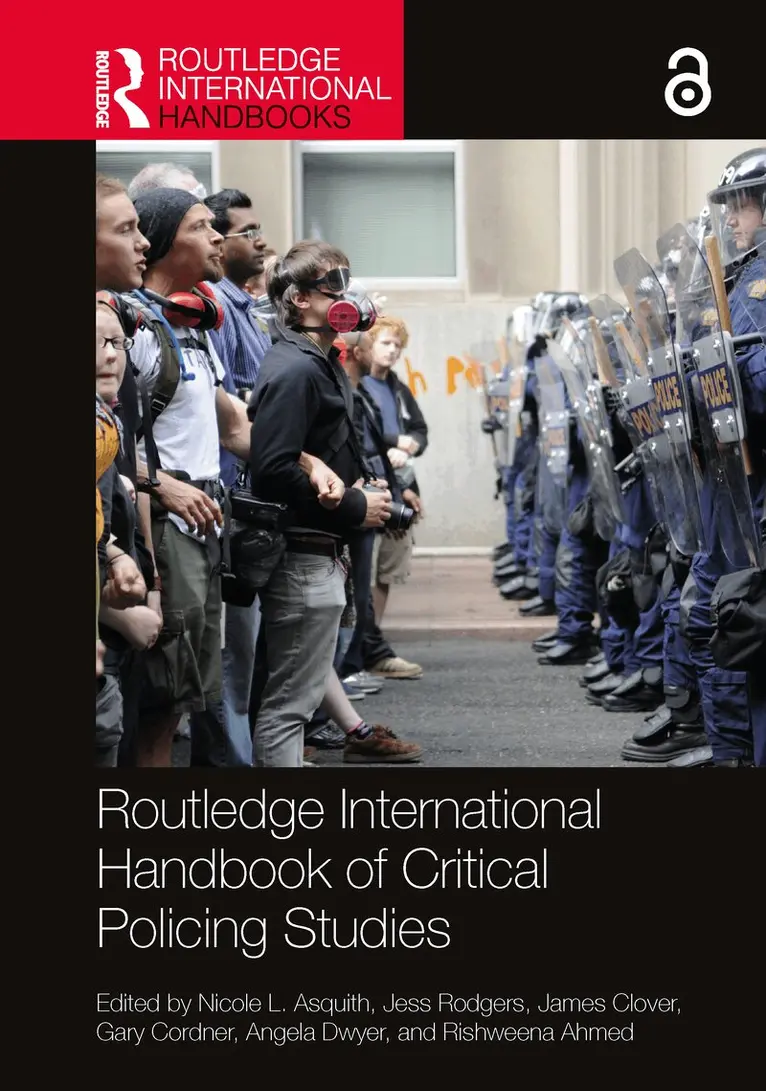
    Routledge International Handbook of Critical Policing Studies

    AvNicole L. Asquith,Jess Rodgers

    Inbunden, Engelska, 2025

    Del i serien Routledge International Handbooks

    3 676 kr

    Beställningsvara. Skickas inom 10-15 vardagar. Fri frakt över 249 kr.

    Beskrivning

    Critical analyses of policing have accompanied accounts of the police since the early days of modern police organisations. More so than ever, police and policing are subject to close and critical scrutiny from governments and the public. It is timely, therefore, to consider what is critical about police and policing.The Routledge International Handbook of Critical Policing Studies brings together scholars and practitioners to critically explore the full continuum of safety governance from police reforms to the redistribution of policing resources to the replacement of state police. In offering the three Rs of policing—reform, redistribute, replace—we provide a conceptualisation of critical policing studies that acknowledges a continuum of policing that mirrors the different trajectories, priorities, and possibilities that exist across different cultural and historical contexts. This collection is composed of 65 scholars and practitioners across 39 chapters, edited by a team of police pracademics and policing scholars, to showcase accounts of policing from outside the Anglo-European metropole, privileging works from First Nations people and from the Global South, and presenting contextualised solutions to the problems facing police and communities.This Handbook identifies the key issues facing the police and safety governance across the globe and offers insights into the implications for policing theory and practice, proposing solutions to some of the most intransigent problems facing contemporary societies. Individually, and as a collection, this Handbook will be an essential read for scholars, practitioners, and activists alike.

    Produktinformation

    • Utgivningsdatum:2025-06-06
    • Mått:174 x 246 x 34 mm
    • Vikt:1 100 g
    • Format:Inbunden
    • Språk:Engelska
    • Serie:Routledge International Handbooks
    • Antal sidor:522
    • Förlag:Taylor & Francis Ltd
    • ISBN:9781032511139

    Utforska kategorier

    • Brottslighet och kriminologi inom Samhälle och politik
    • Socialt arbete och välfärd inom Samhälle och politik
    • Sociologi inom Samhälle och politik

    Mer om författaren

    Nicole L. Asquith is Professor of Policing at the University of Tasmania, and Convenor of the Australian Hate Crime Network. Her research primarily focusses on victimisation and justice, including landmark studies into hate crime, sexual violence, honour-based violence, and family and domestic violence. She is a critical policing scholar, who has worked with and for policing organisations in Australia and the UK for over 20 years, and is the co-author of Policing Practices and Vulnerable People (2021) and Crime & Criminology (2023), and coeditor of Policing Encounters with Vulnerability (2017) and Policing Vulnerability (2012).Jess Rodgers is a research associate at the Tasmanian Institute of Law Enforcement Studies, University of Tasmania. They have undertaken research work in a wide range of topics, including policing domestic violence, small town policing, ableism in academia, and transgender people in prisons. Recently, they have published as leading authors in Police Practice and Research, International Journal of Police Science and Management, International Journal of Rural Criminology, and Higher Education Research and Development. They are passionate about closing the research to practice gap and working closely with government and organisations to institute robust evidence-based policy and practice.James Clover is a retired police officer from the Edmonton Police Service, and former instructor at MacEwan University in Edmonton, Alberta, Canada. He was awarded the 2018 International Police Officer of the Year, by the Canadian Association of Chiefs of Police, for his practitioner work in the field of law enforcement and public health. In 2021, James was named Police Fellow for the Global Law Enforcement and Public Safety Association.Gary Cordner is Academic Director in the Education and Training Section of the Baltimore Police Department (USA). He is Professor Emeritus at both Kutztown University of Pennsylvania and Eastern Kentucky University, where he served as Dean of the College of Justice & Safety. He was founding editor of Police Quarterly and is past editor of the American Journal of Police. Earlier in his career he was a police officer and police chief in Maryland and obtained his PhD from Michigan State University.Angela Dwyer is Associate Professor in Policing at the School of Social Sciences at the University of Tasmania. Her research on LGBTIQ-police relationships contributed to founding the discipline area of queer criminology, and this was acknowledged by being made the 2023 recipient of the Western Society of Criminology Richard Tewksbury award. She was also founding co-chair of the Division of Queer Criminology at the American Society of Criminology.Rishweena Ahmed is Chief Inspector at the Maldives Police Service. Her recent submission of a PhD thesis on criminal desistance in the context of the Global South underscores her commitment to advancing knowledge in policing and criminology. Chief Inspector Ahmed is also an experienced police educator and has been instrumental in designing numerous inservice programmes and tertiary-level courses for serving police officers. Presently, serving as a police commander, she leverages her expertise to tackle contemporary challenges in law enforcement in the island nation of the Maldives.

    Recensioner i media

    “Confirming and confronting of old truths while simultaneously offering new approaches to the policing praxis, this book is thought provoking, intellectually challenging, and entirely relevant. For origins to future trajectories, each aspect of policing is tackled in a multifaceted and multilayered manner reflecting at its core a careful weighing up and ethical reckoning of the police narrative.”Professor Rob White, Emeritus Distinguished Professor of Criminology, University of Tasmania, Australia“The Routledge International Handbook of Critical Policing Studies is a well-constructed compilation of global scholarship that challenges traditional beliefs about policing. The book also provides measured critiques of traditional policing, inequality, and injustice in policing, while offering critical reflections and potential new directions in policing.”Dr Wendell Wallace, Coordinator, Mediation Studies Unit, University of West Indies, Trinidad & Tobago“Honouring policing's aspirations—and more importantly protecting and elevating a society's most vulnerable members—requires that we question the status quo with a sharp critical lens. That is what this volume does so well: taking a broad, global scope, it provides fresh and rigorous thinking about some of the most vexing challenges of modern policing.”Dr Brandon del Pozo, Assistant Professor, Medicine and Health Services, Policy, and Practice, Warren Alpert Medical School, Brown University, USA

    Innehållsförteckning

    • List of Figures and TablesList of ContributorsForewordAcknowledgmentsSECTION I. Conceptual Frameworks1 ‘Who ya gonna call?’ Peelian ghosts, contemporary contradictions, and conceptualising critical policing studiesNicole L. Asquith, Jess Rodgers, Gary Cordner, Angela Dwyer, James Clover, and Rishweena Ahmed2 Origin stories and the possibilities of policingJonah Miller3 Policing and the myth of public safetyAmanda PorterSECTION II. Reform the Police4 Reforming policingGary Cordner and Rishweena Ahmed5 Reformism, abolitionism and the structural context of policework Roger Grimshaw, Tony Jefferson6 Reform and the policing of gender violence: specialist stations in the province of Buenos Aires, ArgentinaJess Rodgers, Kerry Carrington, María Victoria Puyol, Máximo Sozzo, and Vanessa Ryan7 Decoding of restorative justice practices: Evidence from Indian police stationsMichael L. Valan8 Desistance-led policing in the Maldives: A new way of policing persistent offendersRishweena Ahmed9 Policing indigenous communities in Canada John Kiedrowski, Nicholas A. Jones, and John Domm10 Rethinking community policing in FijiAnand Chand11 ‘Light touch’ police reform: The Tonga Police Development ProgramTyler Cawthray12 Citizens’ trust and legitimacy in the police in AfricaMichael K. Dzordzormenyoh13 Professionalising a profession: The PEQF and policing in England and WalesJennifer Hough and David Marshall14 National levers for reform of decentralised policing systemsJames Harris and Gary CordnerSECTION III. Redistribute Public Safety 15 Redistributing resources, rank, and relationships to reduce harm in public safety responsesAngela Dwyer and James Clover16 Propinquity and public safety Nicole Asquith and Jess Rodgers17 Crowdsourcing in missing person investigations: Opportunities for police to foster public trustScott Duncan18 When we need you, we will call you’: Policing through social contract in a localised health settingMonique Marks and Dhiya Pillay Matai19 The policing of dis/abilityCameron Russell and Clare Farmer20 Arts and policing: imagining new approaches to police-community relationships?Rachel Lewis and Jacqueline S. Hodgson21 Policing African migrants in AustraliaSamuel Sakama and Joseph Chitambo22 Lost in translation: Policing and alternatives to mental health crisisSabrina C. Taylor and Heather M. Ross23 Missing communities: A novel approach to police-community partnershipMaureen Taylor and Dave Grimstead24 Envisaging the future of community safety and wellbeing: Practical examples of policing and public health collaborationsCarla Chan Unger, Nick Crofts, and Auke van Dijk25 Civic heroes or untrained allies? A critical examination of bystander intervention in co-production policingNick Evans26 Beyond communities and securitarianism: Plural security in UmbriaStefano Anastasia, Antonino Azzarà, and Vincenzo ScaliaSECTION IV. Replace the Police27 Building up, not breaking down: Replacing systems of exclusion and harmJess Rodgers and Nicole Asquith28 Police reformism and the challenges of decolonialism and abolitionismChris Cunneen29 The failed Indigenisation experiment: a critical analysis of the state-of-exception policing in Aotearoa New ZealandAdele N. Norris, Antje Deckert, and Juan Tauri30 Policing of urban margins, police accountability and contested Human Rights: An enquiry into a Chilean neighbourhood Gonzalo García-Campo Almendros and Pascual Cortés31 An Elders-led response to the criminalisation of Aboriginal Young People in a Remote CommunityPeta MacGillivray, Virginia Robinson and Ruth McCausland32 The Rojava revolution and alternative models of policingHawzhin Azeez33 Freedom House: A critical counternarrativeTiffany Yang34 Sex workers, work! Anticarceral practices to criminalisationAlisson Rowland35 Reclaiming public safety: How lessons from harm reduction can help us realise a police-free futurePhillip Wadds and George Dertadian36 Crowdsourcing as a strategy to monitor police drug dog detection operations in New South Wales: The ‘Sniff Off’ case studyJustin R. Ellis37 Pain compliance, disability, and state accountability: Lessons from Chile and Colombia on the form and function of less lethal weaponsJavier Eduardo Velásquez Valenzuela and Lucía Guerrero Rivière38 Confronting the unconfronted: Colonial legacies and policing in the Swedish suburbAmanda Lanigan and Noor Nassef39 Considerations for Police Abolition in the Global SouthLeighann Spencer