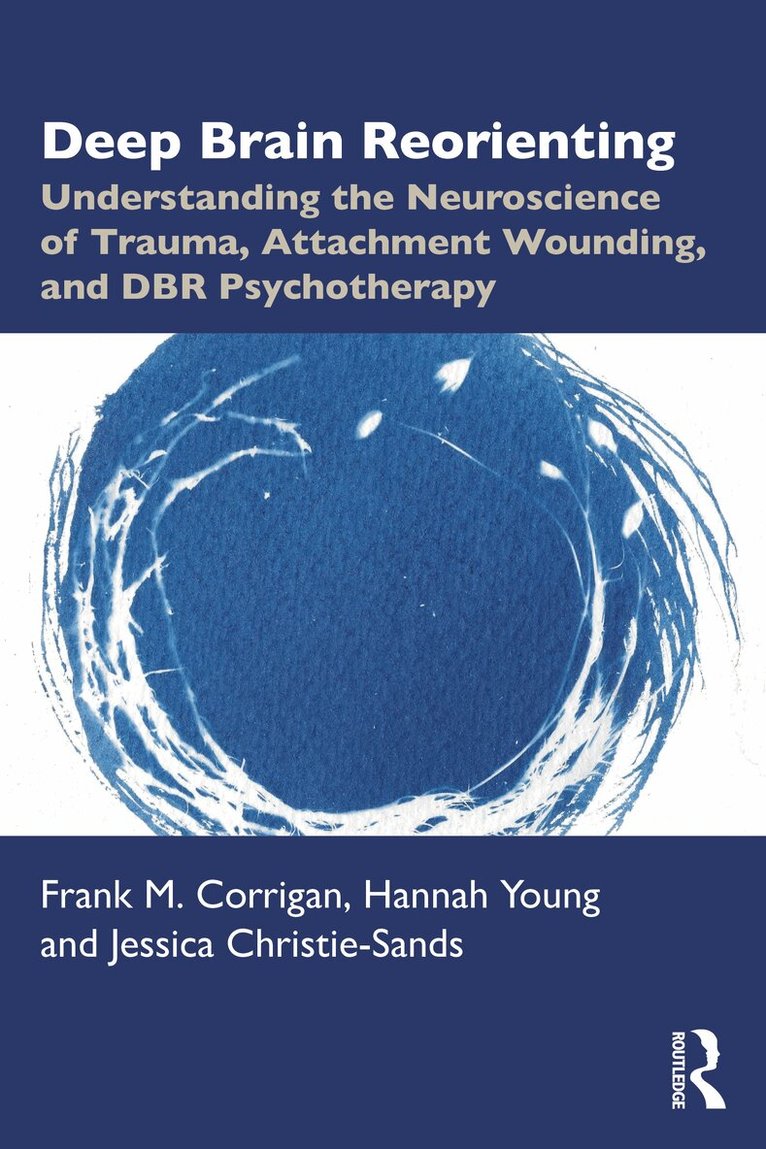
Deep Brain Reorienting
Understanding the Neuroscience of Trauma, Attachment Wounding, and DBR Psychotherapy
AvFrank M. Corrigan,Hannah Young
489 kr
Beställningsvara. Skickas inom 10-15 vardagar. Fri frakt över 249 kr.
Fler format och utgåvor
Beskrivning
Produktinformation
- Utgivningsdatum:2024-12-30
- Mått:152 x 229 x 17 mm
- Vikt:380 g
- Format:Häftad
- Språk:Engelska
- Antal sidor:240
- Förlag:Taylor & Francis Ltd
- ISBN:9781032556253
Utforska kategorier
Mer om författaren
Frank M. Corrigan, MD, FRCPsych, is an independent psychiatrist in private practice in Scotland. He is the developer of Deep Brain Reorienting.Hannah Young, PhD, is a chartered psychologist and psychotherapist working in private practice in Dundee and St Andrews, Scotland, specialising in attachment wounding and dissociative disorders.Jessica Christie-Sands, PhD, is a chartered psychologist and clinical director of a multidisciplinary psychology service that provides therapeutic work for children, young people, and adults with histories of developmental trauma.
Recensioner i media
"In Deep Brain Reorienting, Frank Corrigan and colleagues skillfully introduce us to highly relevant and neglected brain regions. They present the powerful concept of attachment shock, which illustrates the profound and enduring traumatic impacts of irregularities, absence, and loss of attachment in early life. By showing how these impacts may be held in brain regions, Deep Brain Reorienting offers new hope for those affected by childhood trauma, neglect and dissociation. The authors provide a neuroscientific and theoretical foundation, case examples illustrating clinical application of concepts, and a practical overview of this highly effective approach. A rich and illuminating read! Thank you to Frank Corrigan and co-authors for an invaluable contribution to our field!"Ruth Cohn, MFT, CST, BCN, author of Working with the Developmental Trauma of Childhood Neglect: Using Psychotherapy and Attachment Theory Techniques in Clinical Practice"Although he didn’t get far in his Project for a Scientific Psychology, the state of neuroscience being what it was in 1895, Freud knew that ‘neurosis’ had to have a basis in the brain. We know now that most of the ‘neurosis’ that Freud was writing about related to early childhood trauma. We know now, too, that early trauma profoundly impacts brain development, most importantly the brain’s ability to regulate affect. Although in many ways seemingly an awkward fit- he is anything but a Freudian-, Corrigan may well be adding the most important chapter to date to the Project, as he focuses our attention on what happens at the brain stem during trauma. Jung, speculating on the unconscious and the brain wrote, “I have long thought that, if there is any analogy between psychic and physiological processes, the organizing system of the brain must lie subcortically on the brain stem”. Corrigan hypothesizes that the shock of trauma resides in the brain stem not as an analogy but as a reality and he has formulated an elegant theory and an even more elegant therapy, Deep Brain Reorienting, to address it. I have quieted the aftermath of trauma in the brain with neurofeedback and often, along with standard psychotherapy, that has been all that was needed. But not for everyone. When I heard Corrigan’s hypothesis about the effects of shock on the brain stem, I realized that shock retained there might be the best explanation for relapses we’d seen. I tried the therapy and it does what he says it does. DBR takes you into a conversation with the unconscious. It is now the therapy that I recommend along with neurofeedback. If you are treating trauma, you will want to read this book. Both Freud and Jung have already endorsed it. Sebern Fisher, MA, author of Neurofeedback in the Treatment of Developmental Trauma: Calming the Fear-Driven Brain"‘Groundbreaking’ is an often misleading description of new psychotherapies. Corrigan and coauthors not only break new ground, but the soil they till is fertile and generative. Corrigan’s gift, honed over many years as an untiring student of the latest neuroscientific findings and creative integrator of brain/body/mind with trauma-informed psychotherapy, led to his developing Deep Brain Reorienting. All too often, the latest brain findings tell us, in scientific lingo, what we therapists already knew. In contrast, this book eloquently connects what we are learning about the deepest, subcortical structures, particularly the midbrain of the brainstem, with what we do in psychotherapy, never reducing the brain’s complexity yet keeping the Deep Brain Reorienting method deceptively simple and elegant. Deep Brain Reorienting helps patient and therapist access and process moments immediately following trauma’s shock and painful, often nonverbal experience. The structure of this book first affords the reader entry into the relevant brain science underlying Deep Brain Reorienting, followed by its clinical applications in Part Two. Readers learn what phenomena indicate cortical processing (e.g., structurally dissociated parts), as contrasted with brainstem activation (e.g., orienting tension, shock, and pre-affective defense), in order to work at the deepest, subcortical level of traumatic experience and attachment wounding. Corrigan and his coauthors apply their sophisticated understanding of the most current brain science to several clinical challenges and conundrums familiar to therapists working with complex trauma and dissociation including profound, early attachment neglect and unbearable aloneness, as well as structural dissociation. One remarkable chapter describes the hypothesized sensorimotor experience of a fetus that, perhaps one day, might contribute to psychotherapy attenuating the deleterious effects of pre-birth trauma. Corrigan and Warner further offer the reader a wonderful bonus, clearly demonstrating how Deep Brain Reorienting can be interwoven with the Alexander Technique to ameliorate the traumatic disruption of basic movement.Deep Brain Reorienting is already proving pivotal in providing therapists pathways to working with pre-verbal, pre-affective traumatic sequelae previously out of reach. This unique book and approach was developed by a brilliant and humble man dedicated to helping therapists reduce their patients’ suffering and reclaim their aliveness."Ken Benau, PhD, author of Shame, Pride, and Relational Trauma: Concepts and Psychotherapy
Innehållsförteckning
- 1. Introduction Part 1: Delving Deep Beneath the Cortex 2. Orienting to ‘Where?’ 3. Preaffective Forces of Shock 4. Affected by ‘What’ We Encounter 5. Seeking Attachment from the Brainstem Upwards 6. A Composite Model of Dissociative Disorders Part 2: Deep Brain Reorienting in Clinical Practice 7. Clinical Research Manual 8. The Deepest Sense of Being in a Body 9. Promoting the Healing of Attachment Wounding 10. Composite Model of Clinical Dissociation Applied 11. Observations of the Head-body Relationship 12. The Where-Self, the Innate Connection System, and the Origins of Attachment
Betyg & recensioner
5/5
Betyg & recensioner
- 5/5
Äntligen har den första boken om DBR kommit!
I Deep Brain Reorienting beskrivs DBRs bakgrund, teori samt hur metoden tillämpas. Huvudförfattare är psykiatern Frank Corrigan, MD, PhD, som utvecklat DBR. Den moderna hjärnforskningen har lärt oss att det är de djupare nivåerna av vår hjärna som svarar och aktiverar kroppen innan de övre nivåerna av hjärnan hinner med kroppens chockresponser i samband med hotfulla och anknytningsstörande situationer. Det gäller särskilt när hotet är nära. Den här första kroppsliga chockresponsen kan senare döljas av tankar och känslor som tar över vårt medvetande. Deep Brain Reorienting, DBR, är en metod som bygger på den senaste tidens hjärnforskning. I DBR hjälper terapeuten sin patient att backa till det första kroppsligt förankrade svaret på den överväldigande händelsen. Det sker genom att, efter grundning, identifiera en orienteringsanspänning på särskilda platser runt huvudet. Ofta väljs tillsynes vardagliga men meningsfulla händelser. Därefter får patienten hjälp med att via neddraget tempo följa processen där orienteringsanspänningen blir ett ankare. Terapeuten hjälper i första hand patienten att transformera kroppens chocksvar på den överväldigande händelsen som ska bearbetas. Därefter processas de affekter och känslor som kan ha aktiverats i samband med händelsen. När den kroppsliga chockreaktionen har klingat av är det mycket enklare för patienten att låta plågsamma tankar och känslor lösas upp utan att personen överväldigas. Det här innebär att DBR är en både mild och effektiv form av bearbetning av psykisk traumatisering inklusive anknytningsskador. Det har visat sig stämma i en kontrollerad randomiserad studie. Erfarna terapeuter med DBR utbildning verkar kunna hjälpa också de patienter som har svårt att tillgodogöra sig andra traumabearbetande metoder. Terapeuter som arbetar med anknytningsskador och/eller komplex traumatisering och dissociation kommer att ha stor glädje av DBR och boken ger en god introduktion till Deep Brain Reorienting. Boken inleds med ett intressant förord av professor Ruth Lanius, MD, PhD, en världsledande auktoritet och specialist på att behandla och undersöka neurobiologiska effekter av kvarstående traumatisering på kropp och själ.
Anna
Mer från samma författare
Neurobiology and Treatment of Traumatic Dissociation
Ulrich F. Lanius, Sandra L. Paulsen, Frank M. Corrigan, Ulrich F. Lanius, Sandra L. Paulsen, Frank M. Corrigan
Häftad, 2014
1 132 kr
Du kanske också är intresserad av
- 10% rabatt på allt
Neurobiology and Treatment of Traumatic Dissociation
Ulrich F. Lanius, Sandra L. Paulsen, Frank M. Corrigan, Ulrich F. Lanius, Sandra L. Paulsen, Frank M. Corrigan
Häftad, 2014
1 132 kr
Rainbow Readiness Activity Pack for Kids!
Hannah Young, Dana Smith Bader, Ansofie Reeders
94 kr
Chairs for Women in Science and Engineering Program
Caroline D'Amours, Hannah Young, Catherine Mavriplis
Inbunden, 2024
1 139 kr
Chairs for Women in Science and Engineering Program
Catherine Mavriplis, Hannah Young, Caroline D'Amours
1 459 kr
Chairs for Women in Science and Engineering Program
Caroline D'Amours, Hannah Young, Catherine Mavriplis
Häftad, 2025
799 kr