• Fri frakt över 249 kr
  • •
  • Snabba leveranser
  • •
  • Billiga böcker
Kundservice

Du är på sajten för privatpersoner.

Företag, bibliotek eller offentlig verksamhet?

Du handlar på classic.bokus.com, där alla dina funktioner finns intakta.
Till classic.bokus.com
Bokus logotyp. Gå till startsidan.
  • Erbjudanden
  • Nyheter
  • Student
  • Topplistor
  • Barn & ungdom
  • Bokus Play
  • E-böcker
  • Pocketböcker
  • Spel & pussel

10% rabatt på allt med kod: NYSTART10 →

Sidfot

Mina sidor

    Hjälp

    • Kundservice
    • Vanliga frågor och svar
    • Frakt och leverans
    • Retur vid ångerrätt
    • Reklamera vara
    • Betalning
    • Köpvillkor
    • Allmänna villkor
    • Information om webbplatsens tillgänglighet

    Om Bokus

    • Om oss
    • Pressrum
    • För studenter
    • För företag
    • För bibliotek och offentlig verksamhet
    • För leverantörer
    • Hållbarhet

    Populärt

    • Aktuella erbjudanden
    • Presentkort
    • Studentlitteratur
    • Nya böcker
    • Topplistor
    • Signerade böcker
    • Engelska böcker

    Inspiration

    • Boktips
    • BookTok
    • Populära bokserier
    • Barnbokskaraktärer
    • Populära författare
    Logotyp för Bokus
    Följ oss på Facebook (extern länk)Följ oss på Instagram (extern länk)Följ oss på YouTube (extern länk)Följ oss på TikTok (extern länk)
    bokus @ CookiesAnpassa cookiesIntegritetspolicyKöpvillkor
    Till Citymail hemsida (extern länk)Till Budbee hemsida (extern länk)Till Postnord hemsida (extern länk)Till Schenker hemsida (extern länk)Till Early Bird hemsida (extern länk)Till Walleys hemsida (extern länk)
    1. Naturvetenskap och teknik
    2. Geovetenskap
    3. Miljövetenskap och miljöpolitik

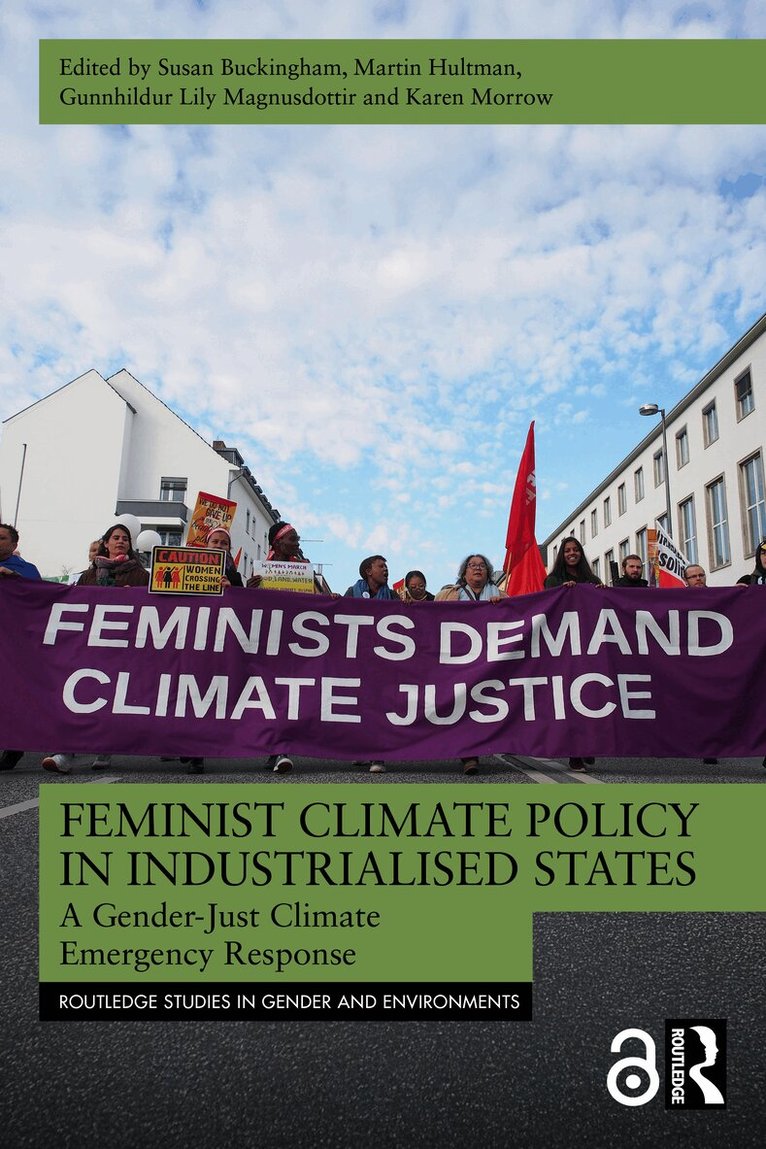
    Feminist Climate Policy in Industrialised States

    A Gender-Just Climate Emergency Response

    AvSusan Buckingham,Martin Hultman

    Häftad, Engelska, 2025

    Del i serien Routledge Studies in Gender and Environments

    624 kr

    Beställningsvara. Skickas inom 10-15 vardagar. Fri frakt över 249 kr.

    Beskrivning

    Feminist Climate Policy in Industrialised States explores ways in which policymakers can overcome institutional barriers and conventions in pursuit of the radical changes necessary for a gender-just climate emergency response.In 2021, the Intergovernmental Panel on Climate Change acknowledged that addressing the climate emergency must involve social justice and equality. Feminist approaches to decision-making, policy-making, community organising and their underpinning methodologies can enable this. The authors draw critically on case studies, research and interviews with feminist practitioners, legislators and leaders who have implemented significant changes, to signal how change might be achieved and ask what lessons can be drawn. The book posits that we need to ultimately move beyond the gender mainstreaming and gender equality issues which have been integrated into existing – and failing – structures, to more transformative feminist approaches. It concludes by identifying key strands of feminist-oriented praxis that offer the potential to expedite responses to climate change across multiple levels of governance.With industrialised states shifting rightwards to a politics which diminishes the importance and urgency of gender equality, diversity, human rights and the need for climate action, this volume will inspire, guide, and provide tools for policymakers, politicians, community activists, academics, and students to take transformative action to address the climate emergency.The Open Access version of this book, available at http://www.taylorfrancis.com, has been made available under a Creative Commons [Attribution-Non Commercial-No Derivatives (CC BY-NC-ND)] 4.0 license.

    Produktinformation

    • Utgivningsdatum:2025-08-22
    • Mått:156 x 234 x 21 mm
    • Vikt:600 g
    • Format:Häftad
    • Språk:Engelska
    • Serie:Routledge Studies in Gender and Environments
    • Antal sidor:308
    • Förlag:Taylor & Francis Ltd
    • ISBN:9781032590295

    Utforska kategorier

    • Miljövetenskap och miljöpolitik inom Naturvetenskap och teknik
    • Politik och statsskick inom Samhälle och politik

    Mer om författaren

    Susan Buckingham is a writer, researcher, consultant, campaigner and activist. She edits the Routledge series on Gender and Environments, and her work develops the understanding of links between gender and environment and applies this to different contexts. Most recently, this has been in the UN Decade of Ocean Science for Sustainable Development and through consultancies with the European Commission, including EIGE. She has edited and written extensively, is on the editorial board of the environmental justice journal Local Environment, and is currently writing a book on Ecofeminism. As an activist-academic, Susan has worked with women’s organisations, and was a trustee and collaborator with Women’s Environmental Network from 2000–2012. Susan co-founded Friends of the Cam in 2020 which campaigns against destructive, masculinist planning and water pollution practices which are destroying the chalk streams of SE England. She is also an activist in climate and social justice campaigns.Martin Hultman is Associate Professor at Chalmers University of Technology, Sweden. Hultman leads three research groups analysing ‘masculinities and environment, ‘rights of nature’ and ‘climate change denial’. He heads the global research network Center for Studies of Climate Change Denial (CEFORCED) and was appointed the most influential academic in Gothenburg 2019 and awarded Linköping University alumnus of the year 2021. As part of his academic work he publishes chronicles in a wide range of newspapers and gives public lectures commenting on contemporary politics. Recent books include Ecological Masculinities (2018), Men, Masculinities and Earth (2021), Climate Obstruction (2022) and the forthcoming Survival: Rights of Nature, Degrowth and Ecological Masculinities at the end of Anthropocene.Gunnhildur Lily Magnusdottir is Associate Professor in Political Science at the Department of Global Political Studies at Malmö University. Her main field of research is climate policy-making, in particular, how governmental authorities in Scandinavia and the European Union understand and work with gender and other issues related to the social dimensions of climate change and climate justice. Magnusdottir has published extensively on climate authorities, their practices, institutional norms and policy-making at different levels of governance. She currently leads a comparative research project on Gendered Norms and Practices in Nordic and Baltic Climate Policy Institutions: Implication for the Climate Transition (Nordforsk), exploring Nordic and Baltic governmental authorities and their institutional practices. She has previously been involved in various research projects financed by the Swedish Research Council for Sustainable Development and the Swedish Energy Agency, which circle around justice in climate and energy policy-making.Karen Morrow has been Professor of Environmental Law at Swansea University (2007–date), and has formerly worked at Leeds University, Durham University, the Queen’s University of Belfast and the University of Buckingham. Her research interests centre on public participation in environmental law and policy-making, and in particular on gender in the global climate governance regime. Her work spans theory and practice and multiple levels of law and governance, from the global/international to national and subnational levels. She also works on environmental law and policy in cross-border contexts in the UK. She is a member of the Earth Systems Governance Tipping Point subgroup. She was a founding co-editor of the Journal of Human Rights and the Environment and the IUCN e-journal. She sits on the editorial boards of the Journal of Human Rights and the Environment, the Environmental Law Review and the University of Western Australia Law Review and on the International Advisory Board for the Gender and Environment book series (Routledge).

    Innehållsförteckning

    • Introduction Part I: Global Chapter 1: To practice what you preach: Sweden’s Feminist Foreign Policy in diplomatic work [Interview 1: Catherine McKenna, former Minister of Environment and Climate Change, Canada: International and National Role in Climate Policy Chapter] 2: The Effect of Women’s Political Representation on GHG Emissions Chapter 3: To what extent can the European Union contribute to a feminist climate policy? Chapter 4: The Ocean We Want: a feminist approach to the Ocean Decade Chapter 5: Ensuring justice through good practice: Establishing the context for change across organisational scales [Interview 2: Marama Davidson, co-Leader, Green Party of Aotearoa New Zealand: The Importance of Grass Roots and Community Action] Part II: Initiatives Chapter 6: Gender Smart Mobility for all. Lessons learned from encounters with Danish Municipalities [Interview 3: Ada Colau, Mayor of Barcelona 2015-2023: Addressing the climate emergency in collaborative ways at the city level] Chapter 7: What does degrowth say about gender equality and social justice? [Interview 4: Guðmundur Ingi Guðbrandsson, ex-Leader of The Left-Green movement, and minister of social and labour affairs in Iceland] Chapter 8: Climate change policies and gender equity: What are the views of women who work in construction? Chapter 9: Applying Intersectionality in Climate Policy and Planning: Experiences from Gothenburg and Malmö [Interview 5: Marianne Borgen, Mayor of Oslo 2015-2023] Part III: Methodologies Chapter 10: Young people and old trees: posthuman intersectionality in Swedish climate litigation Chapter 11: Participatory assessment workshops as a guiding tool towards just and inclusive energy strategies Chapter 12: Theatre and Stories that ReConnect: Embodiment practices that ecologise masculinities Chapter 13: Photovoice: A tool for countering social path-dependencies in climate institutions? Chapter 14: Feminist Climate Approaches: how, why and what? Why we need Feminist Climate Approaches More Than Ever, what would they look like and How Do We Get There?