Inbunden, Engelska, 2025
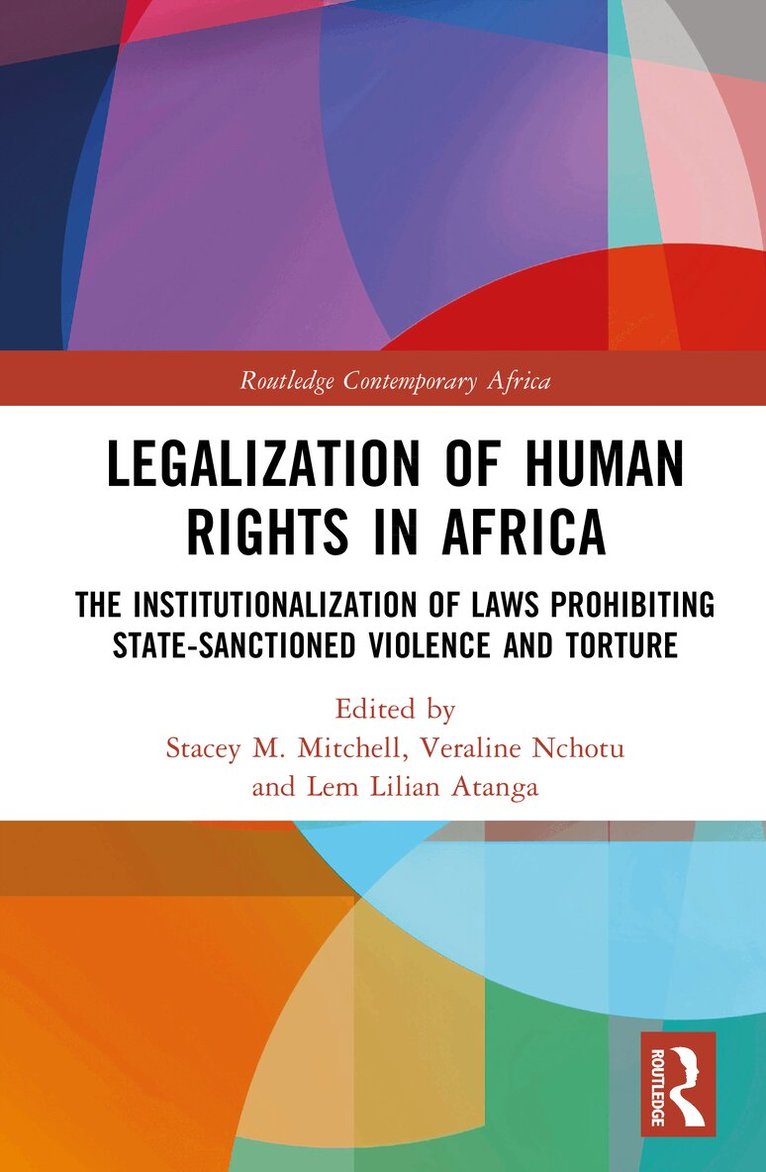
Legalization of Human Rights in Africa
The Institutionalization of Laws Prohibiting State-Sanctioned Violence and Torture
Av Stacey M. Mitchell, Veraline Nchotu, Lem Lilian Atanga
Del i serien Routledge Contemporary Africa
2302 kr
Beställningsvara. Skickas inom 10-15 vardagar. Fri frakt över 249 kr.
Beskrivning
Produktinformation
- Utgivningsdatum: 2025-06-02
- Mått: 156 x 234 x 21 mm
- Vikt: 680 g
- Format: Inbunden
- Språk: Engelska
- Serie: Routledge Contemporary Africa
- Antal sidor: 280
- Förlag: Taylor & Francis Ltd
- ISBN: 9781032749495
Utforska kategorier
Mer om författaren
Stacey M. Mitchell is an Associate Professor at Georgia State University’s Perimeter College, USA.Veraline Nchotu is a Research Fellow at Northeastern Illinois University’s Genocide and Human Rights Research in Africa and the Diaspora Center, USA.Lem Lilian Atanga is Associate Professor, Centre for Gender and African Studies, University of Free State, Bloemfontein, South Africa
Recensioner i media
“Using cross country comparisons, this thought-provoking book captures the complexity of domestic legalization processes, offering new insights on the importance of civil society actors to lawmaking and law implementing processes. The book makes important contributions to the literature of human rights development in Africa and the legalization of human rights law in political science.”Carrie Booth Walling, Professor of Political Science and Director of the Human Rights Program, University of Minnesota, USA“This volume is a welcome addition to the growing scholarly literature on the challenges facing efforts to institutionalize human rights laws prohibiting state sanctioned violence in Africa. The editors, Stacey Mitchell, Veraline Nchotu and Lem Lilian Atanga, and the contributors to this analytically insightful and empirically grounded project critically examine the concept of legalization using Lon Fuller's criterion of congruence. Challenging traditional understandings of legalization in the IR literature, they argue that it should be understood as an interactive process which impacts and is impacted by those involved in the processes of domestic lawmaking and accountability. According to them, the real test in assessing the domestic legalization of human rights is "the extent to which lawmaking and accountability processes are fair and inclusive." Providing a more comprehensive understanding of the factors that enable and hinder the domestic legalization of international human rights laws has important implications for the work of scholars and practitioners focusing on violence prevention in a region in which several countries are at risk for mass atrocity crimes.”George Andreopoulos, Professor of Political Science and Criminal Justice, City University of New York, USA
Betyg & recensioner
0 recensioner
Inga recensioner tillgängliga.