• Fri frakt över 249 kr
  • •
  • Snabba leveranser
  • •
  • Billiga böcker
Kundservice

Du är på sajten för privatpersoner.

Företag, bibliotek eller offentlig verksamhet?

Du handlar på classic.bokus.com, där alla dina funktioner finns intakta.
Till classic.bokus.com
Bokus logotyp. Gå till startsidan.
  • Erbjudanden
  • Nyheter
  • Student
  • Topplistor
  • Barn & ungdom
  • Bokus Play
  • E-böcker
  • Pocketböcker
  • Spel & pussel

10% rabatt på allt med kod: NYSTART10 →

Sidfot

Mina sidor

    Hjälp

    • Kundservice
    • Vanliga frågor och svar
    • Frakt och leverans
    • Retur vid ångerrätt
    • Reklamera vara
    • Betalning
    • Köpvillkor
    • Allmänna villkor
    • Information om webbplatsens tillgänglighet

    Om Bokus

    • Om oss
    • Pressrum
    • För studenter
    • För företag
    • För bibliotek och offentlig verksamhet
    • För leverantörer
    • Hållbarhet

    Populärt

    • Aktuella erbjudanden
    • Presentkort
    • Studentlitteratur
    • Nya böcker
    • Topplistor
    • Signerade böcker
    • Engelska böcker

    Inspiration

    • Boktips
    • BookTok
    • Populära bokserier
    • Barnbokskaraktärer
    • Populära författare
    Logotyp för Bokus
    Följ oss på Facebook (extern länk)Följ oss på Instagram (extern länk)Följ oss på YouTube (extern länk)Följ oss på TikTok (extern länk)
    bokus @ CookiesAnpassa cookiesIntegritetspolicyKöpvillkor
    Till Citymail hemsida (extern länk)Till Budbee hemsida (extern länk)Till Postnord hemsida (extern länk)Till Schenker hemsida (extern länk)Till Early Bird hemsida (extern länk)Till Walleys hemsida (extern länk)
    1. Psykologi och pedagogik
    2. Pedagogik
    3. Högskola och universitet

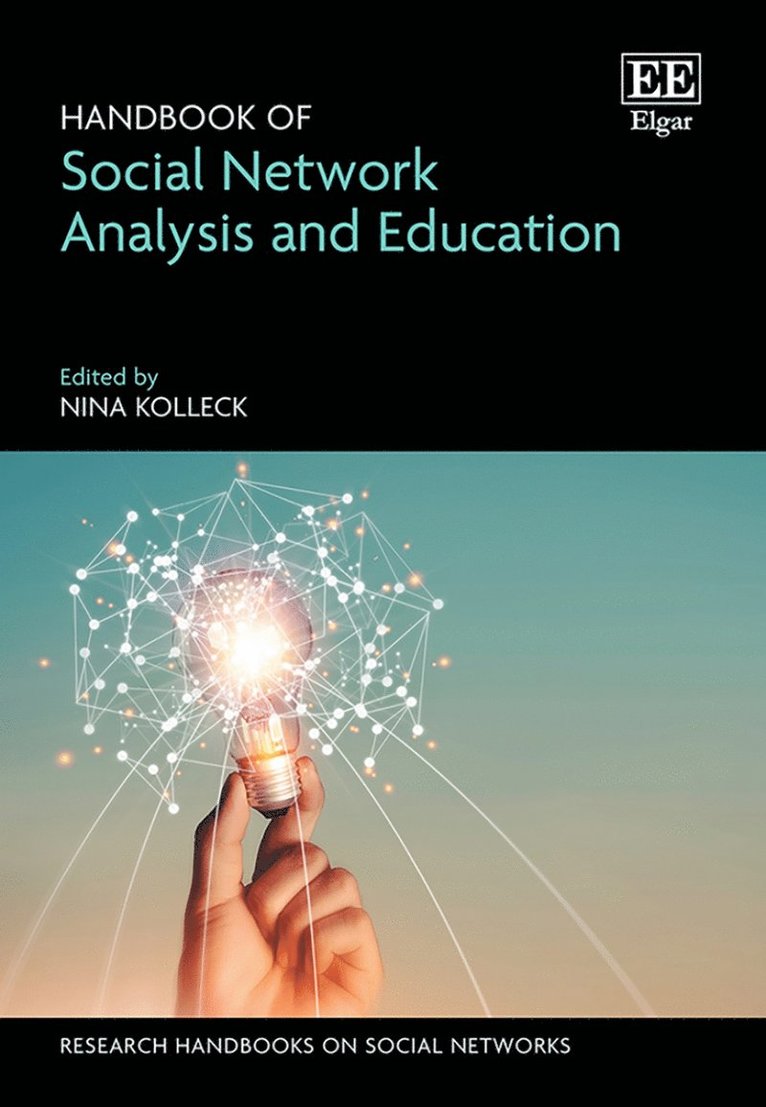
    Handbook of Social Network Analysis and Education

    AvNina Kolleck

    Inbunden, Engelska, 2025

    Del i serien Research Handbooks on Social Networks series

    4 179 kr

    Beställningsvara. Skickas inom 5-8 vardagar. Fri frakt över 249 kr.

    Beskrivning

    This prescient Handbook analyzes how Social Network Analysis (SNA) is revolutionizing educational research by transforming how we interpret the complex web of interactions between students, teachers, parents, and education systems.Showcasing contributions from leading experts, this Handbook reveals the profound impact of SNA on educational processes at every level, from the individual classroom to entire school districts and even global education policies. Chapters explore cutting-edge SNA methods tailored to educational contexts, including the impact of social media, the role of peer relationships in learning, and the communication structures that drive innovation and policy. Ultimately, the Handbook emphasizes the importance of understanding the intricacies of social relationships in educational settings.Providing a holistic overview of SNA and its applications, this Handbook is an invaluable resource for academics and students in education, sociology, psychology, and political science. It will also greatly benefit educators, policymakers, researchers, and all those looking to harness network analysis tools to drive innovation in education settings.

    Produktinformation

    • Utgivningsdatum:2025-07-22
    • Mått:169 x 244 x undefined mm
    • Format:Inbunden
    • Språk:Engelska
    • Serie:Research Handbooks on Social Networks series
    • Förlag:Edward Elgar Publishing Ltd
    • ISBN:9781035312184

    Utforska kategorier

    • Högskola och universitet inom Psykologi och pedagogik
    • Sociologi inom Samhälle och politik
    • Sociala grupper och identitet inom Samhälle och politik

    Mer om författaren

    Edited by Nina Kolleck, Full Professor, University of Potsdam, Germany

    Recensioner i media

    ‘Kolleck brings together leading scholars to offer a fresh, rich, and multi-level exploration of social network analysis in educational research. Showcasing diverse methodologies and approaches, this volume reveals the usually hidden network dynamics shaping key educational processes and outcomes, from teacher collaboration to policy adoption—a vital contribution to the field.’

    Innehållsförteckning

    • ContentsList of contributors ix1 From individuals to networks: the integration of SNA in educationalresearch 1Nina KolleckPART I RESEARCH DESIGN AND DATA2 Types of relations 19Hans Gruber and Tuire Palonen3 Collecting network data with visual methods 32Anique Atherley4 Survey methods for network studies in education 47Peter V. Marsden and Marissa A. Combs5 Network analysis of big data for education policy: challenges, limitations,and opportunities 62Davis Vo, Kaiwen Zheng, Chelsea Zhang, Manuel S. González Canchéand Cecilia Rios-Aguilar6 Web-based data, online networks and social media 85Dhrubasish Sarkar, Moumita Chatterjee, Dipak K. Kole and Premananda Jana7 The strengths and drawbacks of measuring self-reported and digitallytraced social networks 102Joshua Rosenberg, Ashley King, Rita Swartzentruber and Jeffrey Carpenter8 Ethics and trust in social network analysis: how data science andinteractive visualizations impact anonymity, confidentiality, consent, andIRB procedures? 114Manuel S. González CanchéPART II METHODS9 Social network analysis measures 133Johannes Schuster and Nina Kolleck10 Integrating networks and survey research: egocentric network analysis 144Raffaele Vacca11 Qualitative perspective in social network analysis for education andlearning 168Bartolomé Rubia-Avi and Jairo Rodríguez-Medina12 Mixed methods in social network analysis for education and learning 179Dominik E. Froehlich13 Discourse network analysis and its use in education 191Philip Leifeld and Laura Mastroianni14 Discourse network analysis and climate change education 204Alexandra Goritz and Nina Kolleck15 Exponential random gaph models 215Dean Lusher and Peng Wang16 Stochastic actor-oriented models for the co-evolution of networks andindividual outcomes 230Viviana Amati and Tom A. B. Snijders17 Studying network change in education with stochastic actor-orientedmodels 242András Vörös and Tomáš Diviák18 Topic modeling and network analysis 259Thomas Bryan Smith and Raffaele Vacca19 Keyphrase network analysis: Exploring text corpora using pre-trainedlanguage models and network text analysis 277Pedro Jacobetty and Nina KolleckPART III APPLICATION TO MICRO-LEVEL20 Ethno-religious inequalities and school-based friendship networks 291Lars Leszczensky and Sebastian Pink21 Peer homophily in educational settings 305Lysann Zander and Robert W. Krause22 Bullying, cyberbullying, and social network analysis 318Herbert Scheithauer23 SODA with peers or SODA with friends? An integration of spatialprinciples with social networks to detect and model social outcomedependence or autocorrelation—SODA 329Manuel S. González Canché24 The role of teachers’ social networks in the job search 349Huriya Jabbar and Priscilla Aquino GarzaPART IV APPLICATION TO MESO-LEVEL25 Comparative analysis of teacher collaboration on school improvement:exploring social networks using a meta-analytic approach to exponentialrandom graph models 360Andrea Wullschleger, András Vörös, Beat Rechsteiner and KatharinaMaag Merki26 Boundedness, connectedness, and mutuality: a simple framework forunderstanding professional learning networks 374Joelle Rodway27 Connecting the dots: social network analysis of networked improvementcommunities in the United States 391Megan Duff and Jennifer Lin Russell28 Understanding relational inclusivity through a social network analysistoolkit 407Christoforos Mamas, Mathias Mejeh and Georgios Michail29 The role of knowledge brokers in supporting social opportunity spaces 420Martin Rehm, Tim Fütterer, Christian Fischer, Marie Lockton, AnitaCaduff and Alan J. Daly30 Navigating the social terrain of educational leadership: insights from astudy of district-wide leadership advice network 438Yi-Hwa Liou, Yong-Shiuan Lee, Peter Bjorklund Jr., Martin Rehm andAlan J. DalyPART V APPLICATION TO MACRO-LEVEL31 Countries linked by intergovernmental organizations in the field ofeducation: correlations between membership patterns, school autonomyand accountability 457Helen Seitzer and Michael Windzio32 Policy networks, institutional environments, and the global educationindustry 484Christopher Lubienski and Moaaz Hamid33 Social network analysis and educational equity 498Emily M. Hodge and Danfeng Soto-Vigil Koon34 Transnational education networks 508Johannes Schuster, Lasse Hansen and Nina Kolleck35 Education policymaking at the national level 521Jarmo Kallunki, Joni Forsell, Paula Silvén, Katri Eeva and Jaakko Kauko36 Broadening participation in computing through regional partnerships 537Joshua Childs, Sarah Dunton, Anne Ottenbreit-Leftwich, JayceWarner and Rebecca Zarch