• Fri frakt över 249 kr
  • •
  • Snabba leveranser
  • •
  • Billiga böcker
Kundservice

Du är på sajten för privatpersoner.

Företag, bibliotek eller offentlig verksamhet?

Du handlar på classic.bokus.com, där alla dina funktioner finns intakta.
Till classic.bokus.com
Bokus logotyp. Gå till startsidan.
  • Erbjudanden
  • Nyheter
  • Student
  • Topplistor
  • Barn & ungdom
  • Bokus Play
  • E-böcker
  • Pocketböcker
  • Spel & pussel

10% rabatt på allt med kod: NYSTART10 →

Sidfot

Mina sidor

    Hjälp

    • Kundservice
    • Vanliga frågor och svar
    • Frakt och leverans
    • Retur vid ångerrätt
    • Reklamera vara
    • Betalning
    • Köpvillkor
    • Allmänna villkor
    • Information om webbplatsens tillgänglighet

    Om Bokus

    • Om oss
    • Pressrum
    • För studenter
    • För företag
    • För bibliotek och offentlig verksamhet
    • För leverantörer
    • Hållbarhet

    Populärt

    • Aktuella erbjudanden
    • Presentkort
    • Studentlitteratur
    • Nya böcker
    • Topplistor
    • Signerade böcker
    • Engelska böcker

    Inspiration

    • Boktips
    • BookTok
    • Populära bokserier
    • Barnbokskaraktärer
    • Populära författare
    Logotyp för Bokus
    Följ oss på Facebook (extern länk)Följ oss på Instagram (extern länk)Följ oss på YouTube (extern länk)Följ oss på TikTok (extern länk)
    bokus @ CookiesAnpassa cookiesIntegritetspolicyKöpvillkor
    Till Citymail hemsida (extern länk)Till Budbee hemsida (extern länk)Till Postnord hemsida (extern länk)Till Schenker hemsida (extern länk)Till Early Bird hemsida (extern länk)Till Walleys hemsida (extern länk)
    1. Samhälle och politik
    2. Samhälle och kultur
    3. Kultur och medier
    4. Referensverk och tvärvetenskap

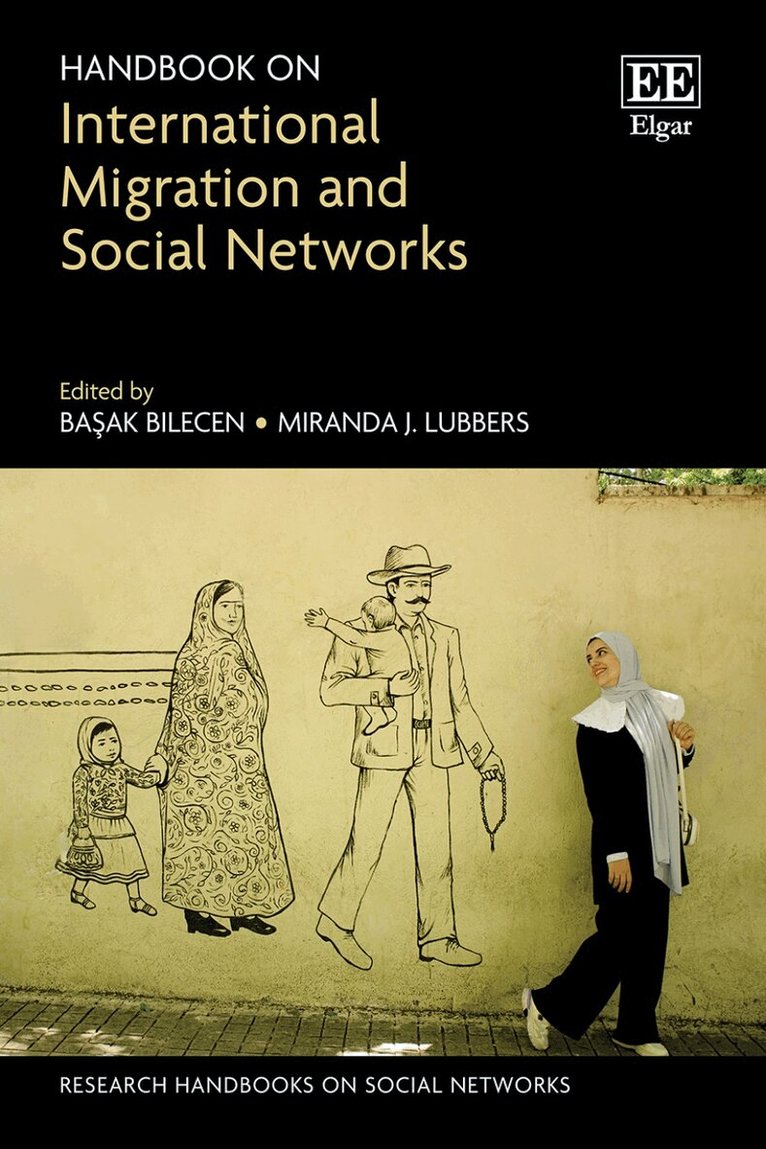
    Handbook on International Migration and Social Networks

    AvBaşak Bilecen,Miranda J. Lubbers

    Inbunden, Engelska, 2026

    Del i serien Research Handbooks on Social Networks series

    3 627 kr

    Beställningsvara. Skickas inom 5-8 vardagar. Fri frakt över 249 kr.

    Beskrivning

    This insightful Handbook explores the impact of social networks on migration, encompassing relationships between families, friends, communities and institutions. It shows how these networks shape migration decisions, facilitate border crossings and support life in new places.Leading researchers from across the globe adopt interdisciplinary methodological perspectives to assess a wide range of migration types including labor, student and refugee mobility. The Handbook examines how existing connections can positively influence migration, focusing on key factors such as access to housing, employment and childcare, as well as the ability to maintain connections with countries of origin. It also reveals how social dimensions can limit migration or expose individuals to risks, depending on their gender, age and legal status. Drawing on diverse case studies, this Handbook provides a rich, real-world understanding of migration not as an isolated journey, but as a deeply social and relational process.This Handbook is a beneficial resource for scholars and students of migration studies, cultural sociology, geography, development studies, political science and international relations. Containing actionable policy insights and a forward-looking research agenda, it is also an essential read for both practitioners and policymakers working in migration-related fields.

    Produktinformation

    • Utgivningsdatum:2026-05-12
    • Mått:169 x 244 x undefined mm
    • Format:Inbunden
    • Språk:Engelska
    • Serie:Research Handbooks on Social Networks series
    • Förlag:Edward Elgar Publishing Ltd
    • ISBN:9781035332311

    Utforska kategorier

    • Referensverk och tvärvetenskap inom Samhälle och politik
    • Migration inom Samhälle och politik
    • Sociala grupper och identitet inom Samhälle och politik

    Mer om författaren

    Edited by Başak Bilecen, Professor of Sociology and Rosalind Franklin Fellow, Department of Sociology/ICS, University of Groningen, the Netherlands and Miranda J. Lubbers, Professor of Social and Cultural Anthropology, Department of Social and Cultural Anthropology, Autonomous University of Barcelona, Spain

    Recensioner i media

    ‘This essential volume reveals how social ties shape every facet of cross-border mobility–from who migrates and where, to duration and long-term outcomes. With contributions from leading scholars across disciplines, it stands as an indispensable resource for students of migration. A remarkable gift to the field of international migration.’

    Innehållsförteckning

    • ContentsPART I INVESTIGATING SOCIAL NETWORKS IN MIGRATION STUDIES1 Unveiling the landscape: exploring the nexus of international migrationand social networks 2IntroductionBaşak Bilecen and Miranda J. Lubbers2 Seven social network designs in migration research27On methodologiesMiranda J. Lubbers and Marc Alcalà-i-RamsPART II SOCIAL NETWORKS AND MIGRATION PROCESSES3 The migration decision process amidst varying social networks andmigration types 43On migration decisionsAubrey D. Tabuga4 Social networks and transit 55On migration trajectoriesWendy A. Vogt5 Structural and institutional contexts of social networks 67On migration environmentsMarta Kindler and Aleksandra Winiarska6 Between networks and narratives: revisiting the Transnational VillageProject, 1990–95 83On transnationalismDavid Kyle and Emile Nicholls7 Gender dynamics in international migration and social networks 94On gender dynamicsAliakbar Akbaritabar, José Ignacio Carrasco and Athina Anastasiadou8 Digital agency within migration processes: a relational approach 107On communication technologiesMihaela NedelcuPART III SOCIAL NETWORKS AND SPECIFIC TYPES OF MIGRATION9 Social networks and labor migration 122On labor migrationYuyao Liu and Eric Fong10 Axes of differentiation: exploring highly skilled migrants and the variedroles of social networks 137On highly skilled migrationLouise Ryan11 Social networks and student mobility: mapping theoretical perspectivesthrough bibliographic analysis 152On student mobilityMaria Camilla Fraudatario and Maria Prosperina Vitale12 Family-propelled migration and the appearance of social networks 165On family migrationErnesto Castañeda and Daniel Jenks13 Networks in motion: the role of social ties in refugee transit, settlement,and organizational life in Uganda 180On refugeesBaşak Bilecen14 Social networks and undocumented migration 195On undocumented migrantsAshton M. Verdery, Mara Getz Sheftel and Heejo Lee15 The role of social networks in shaping return migration: insights fromrefugees 210On return migrationAhmet İçduygu16 Aging across borders: social connectedness and challenges in migrant laterlife 223On older migrantsBaşak Bilecen and Tineke FokkemaPART IV SOCIAL NETWORKS AND SOCIO-ECONOMIC OUTCOMES17 Social networks and migrant entrepreneurship 237On entrepreneurshipGiacomo Solano18 How social networks shape educational inequality along ethnic lines:segregation, social capital, and peer influence 253On educationGeorg Lorenz and Clemens Kroneberg19 Money networks in migration 264On remittancesSibel Kusimba20 Social networks and migrant health: theoretical frameworks, mechanisms,and evidence 277On healthRaffaele Vacca21 The role of social networks in arranging formal and informal childcareamong migrant families 293On childcare arrangementsVerena Seibel22 Personal networks of immigrants in mixed couples: a typology 305On intermarriageVerónica de Miguel-Luken23 “Still not one of us?” Migrant integration over time—revisiting conflict,contact and constrict theory 319On neighborhoodsBeate Völker24 The art of not assimilating: thriving through ethnic networks and culturalidentity 332On cultural identityVincent Chua and Elaine Lynn-Ee Ho25 Social networks and migrant participation: studying relational patterns forpolitical action and mobilization 346On political actionEva Fernández G. and Manlio CinalliPART V POLICY AND FUTURE DIRECTIONS26 The policy implications of migrants’ social networks 361On policy implicationsAlessio D’Angelo27 Reflecting on migration and social networks and future directions inresearch 373On future researchCecilia Menjívar