• Fri frakt över 249 kr
  • •
  • Snabba leveranser
  • •
  • Billiga böcker
Kundservice

Du är på sajten för privatpersoner.

Företag, bibliotek eller offentlig verksamhet?

Du handlar på classic.bokus.com, där alla dina funktioner finns intakta.
Till classic.bokus.com
Bokus logotyp. Gå till startsidan.
  • Erbjudanden
  • Nyheter
  • Student
  • Topplistor
  • Barn & ungdom
  • Bokus Play
  • E-böcker
  • Pocketböcker
  • Spel & pussel

10% studentrabatt med kod TERM26

Sidfot

Mina sidor

    Hjälp

    • Kundservice
    • Vanliga frågor och svar
    • Frakt och leverans
    • Retur vid ångerrätt
    • Reklamera vara
    • Betalning
    • Köpvillkor
    • Allmänna villkor
    • Information om webbplatsens tillgänglighet

    Om Bokus

    • Om oss
    • Pressrum
    • För studenter
    • För företag
    • För bibliotek och offentlig verksamhet
    • För leverantörer
    • Hållbarhet

    Populärt

    • Aktuella erbjudanden
    • Presentkort
    • Studentlitteratur
    • Nya böcker
    • Topplistor
    • Signerade böcker
    • Engelska böcker

    Inspiration

    • Boktips
    • BookTok
    • Populära bokserier
    • Barnbokskaraktärer
    • Populära författare
    Logotyp för Bokus
    Följ oss på Facebook (extern länk)Följ oss på Instagram (extern länk)Följ oss på YouTube (extern länk)Följ oss på TikTok (extern länk)
    bokus @ CookiesAnpassa cookiesIntegritetspolicyKöpvillkor
    Till Citymail hemsida (extern länk)Till Budbee hemsida (extern länk)Till Postnord hemsida (extern länk)Till Schenker hemsida (extern länk)Till Early Bird hemsida (extern länk)Till Walleys hemsida (extern länk)
    1. Naturvetenskap och teknik
    2. Geovetenskap
    3. Miljövetenskap och miljöpolitik

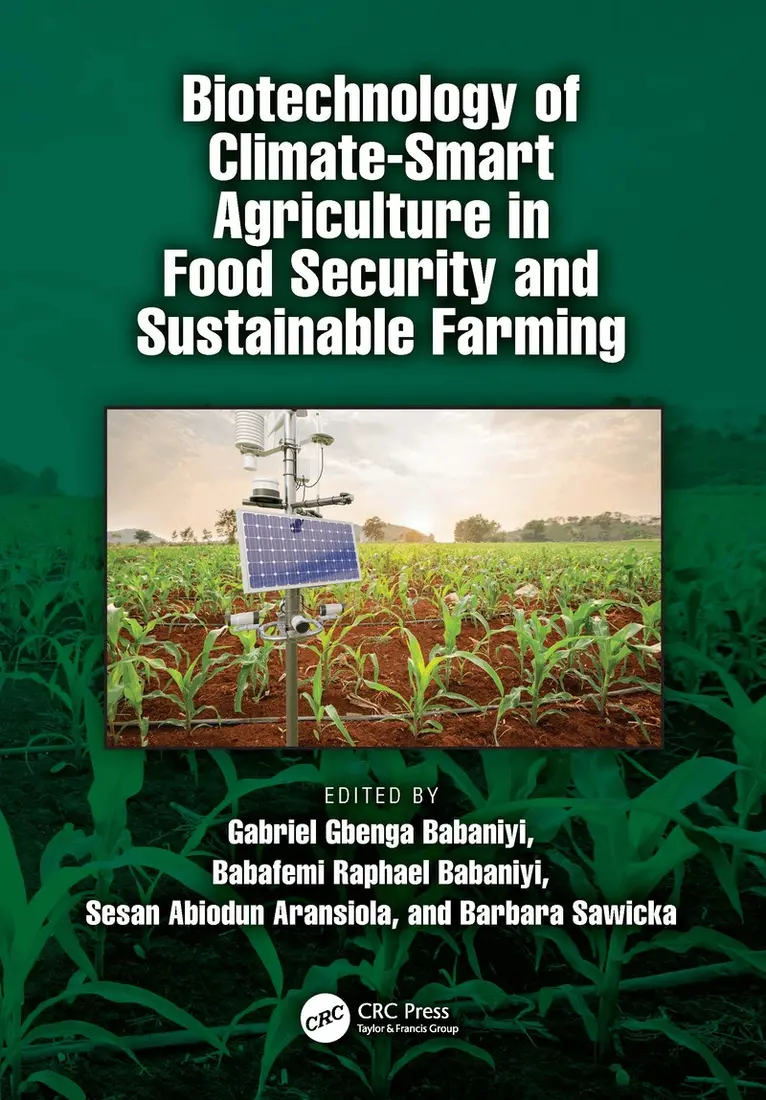
    Biotechnology of Climate-Smart Agriculture in Food Security and Sustainable Farming

    AvGabriel Gbenga Babaniyi,Babafemi Raphael Babaniyi

    Inbunden, Engelska, 2025

    3 323 kr

    Beställningsvara. Skickas inom 10-15 vardagar. Fri frakt över 249 kr.

    Beskrivning

    Biotechnology of Climate-Smart Agriculture in Food Security and Sustainable Farming reviews the transformative role of science in helping agriculture adapt to the challenges of climate change. This comprehensive book bridges the gap between biotechnology, digital innovation, and sustainability, offering invaluable guidance to researchers, policymakers, and farmers.From harnessing microbial solutions to enhance soil health and deploying precision tools to cultivate resilient crops, to leveraging solar energy for reducing farm emissions, this book covers a wide array of topics. It highlights regional policy frameworks and provides real-world case studies from regions including sub-Saharan Africa. It blends scientific advancements and practical applications, demonstrating how tools like Big Data, Geographic Information Systems (GIS), and remote sensing can revolutionize agricultural decision-making.Features:Advanced Biotechnologies: Explores innovative strategies such as precision farming, gene editing, and microbial applications designed for climate-resilient agriculture.Digital Tools for Agriculture: Showcases the transformative impact of Big Data analytics, GIS, and remote sensing in optimizing farm management and decision-making.Holistic Sustainability Framework: Integrates ecological, social, and economic dimensions, including gender roles, policy development, and financial models, for a comprehensive understanding of climate-smart agriculture.Biotechnology of Climate-Smart Agriculture in Food Security and Sustainable Farming is a vital addition to the library of professionals, academics, and practitioners striving to create a sustainable future for global farming.

    Produktinformation

    • Utgivningsdatum:2025-12-15
    • Mått:178 x 254 x 29 mm
    • Vikt:1 000 g
    • Format:Inbunden
    • Språk:Engelska
    • Antal sidor:436
    • Förlag:Taylor & Francis Ltd
    • ISBN:9781041015574

    Utforska kategorier

    • Miljövetenskap och miljöpolitik inom Naturvetenskap och teknik
    • Biokemisk teknik inom Naturvetenskap och teknik
    • Agronomi och lantbruk inom Naturvetenskap och teknik

    Mer om författaren

    Gabriel Gbenga Babaniyi is a skilled professional in animal production with a focus on physiology. Based in Nigeria, he serves as a Management Development Officer at the Agricultural and Rural Management Training Institute (ARMTI) in Ilorin. His academic journey spans from a Bachelor of Agriculture from the University of Abuja to ongoing postgraduate studies in animal production at the University of Ilorin. Babaniyi's research interests include regenerative agriculture, environmental protection, and aquaculture, contributing to various published works in reputable journals. His hands-on experience in agricultural management, coupled with a strong focus on research and development, has positioned him as a key player in addressing challenges related to food security and rural development. In addition to his research endeavors, he is actively involved in training facilitation, grant writing, and agricultural consultancy. Babaniyi’s academic and professional pursuits highlight his dedication to sustainable agricultural practices and rural transformation.Babafemi Raphael Babaniyi is a distinguished academic and researcher renowned for his contributions to environmental science and chemistry. He began his academic journey at Caritas University, Amorji-Nike, Emene, Enugu State, Nigeria, where he earned a Bachelor’s degree in Industrial Chemistry in 2008. Driven by an insatiable passion for knowledge, he pursued a Master’s degree in Environmental Chemistry at the prestigious Federal University of Technology, Akure, Ondo State, Nigeria, graduating in 2021. Currently, Babafemi is advancing his expertise as a Ph.D. candidate in Environmental Chemistry in the Department of Chemistry at the same institution. His scholarly impact extends far beyond academia. With over 40 publications to his name, including internationally recognized book chapters and articles, Babafemi has significantly enriched the global scientific community. His areas of expertise span a broad spectrum, encompassing Environmental Chemistry, Green Chemistry, Phytoremediation, Chemical Biology, Bioremediation of soil-contaminated environments, plant protection and animal health, Environmental Impact Assessment, and Biodegradable plastics. In addition to his academic achievements, Babafemi serves as an Assistant Chief Research Officer at the Bioresources Development Centre, under the National Biotechnology Development Agency in Nigeria. In this role, he plays a pivotal part in advancing biotechnology research and innovation, further cementing his influence in the scientific domain. Babafemi’s dedication to unraveling complex environmental challenges and his innovative approach to sustainability have established him as a trailblazer in his field. His unwavering commitment to excellence and his multifaceted contributions to science and research make him an inspiring figure and a beacon of knowledge in Environmental Chemistry.Sesan Abiodun Aransiola is a notable Ph.D holder in Environmental Microbiology in the Department of Microbiology, Federal University of Technology, Minna, Nigeria. He obtained his first degree (B.Tech) and Master Degree (M.Tech) from the same Department in 2009 and 2014 respectively. He has demonstrated his research expert in the production of vermicasts from vermicoposting (Vermitechnology) of organic wastes to assist plants in the remediation of polluted soil with heavy metals. Currently, he is a Lecturer at the Department of Microbiology, University of Abuja, Nigeria. His expertise spans environmental health, phytoremediation, vermicomposting, marine resources and bioremediation of pollutants soil including plastics. Aransiola’s research is deeply rooted in innovative solutions for soil and water remediation, with significant contributions to microbial biotechnology and waste management. He is an award-winning researcher and has over 90 publications including book chapters, research and review articles of good international repute with high impact factor. He has co-edited scientific books of global interest which include microbial biotechnology for bioenergy (Elsevier). Ecological interplays in microbial enzymology, prospects for soil regeneration and its impact on environmental protection, Soil microbiome in green technology sustainability, marine bioprospecting for sustainable blue-bioeconomy (Springer). Microbial biofilms – applications and control, marine greens: environmental, agricultural, industrial and biomedical applications, Emerging Contaminants in Food and Food Products, Phytoremediation in Food Safety: Risks and Prospects, Biotoxins in Food: Threat and Benefits (CRC Press) with many more in the process. Also, has worked to the rank of an assistant chief scientific officer at Bioresources Development Centre, National Biotechnology Research and Development Agency, Nigeria where he was involved in the uses of vinasse (a by-product of ethanol) as bio-fertilizer to reclaim polluted soil for agricultural purposes. Dr. Aransiola’s academic journey is complemented by a robust teaching career and active involvement in community services, where he leverages his knowledge to foster sustainability. His contributions continue to impact both academia and the broader environmental sciences community. Abiodun is a member of Nigerian Society for Microbiology and American Society for Microbiology among others.Prof. Barbara Sawicka is a distinguished full professor at the University of Life Sciences in Lublin, Poland, where she has served since 2004 in the Department of Plant Production Technology and Commodities Science. A renowned academic, she has a prolific research career with over 1,020 publications, including 152 monographs, 390 original research papers, and 27 books. Her expertise spans agronomy, bioengineering, food sciences, and environmental protection. Professor Sawicka has mentored 11 PhD students, 190 MSc students, and 250 engineers. Her editorial contributions include roles on the advisory boards of multiple scientific journals, alongside being deputy editor-in-chief and co-editor. In addition to her academic achievements, she has actively contributed to civil and social initiatives and is a key member of various scientific organizations, including the Polish Agronomic Society and the Polish Academy of Sciences. Her international influence is evident in her scholarships and collaborations across Europe, including institutions in Belgium, Lithuania, and Turkey. Proficient in multiple languages, she continues to impact her field globally.

    Innehållsförteckning

    • Section 1: Defining and Enhancing Climate-Smart Agriculture through Biotechnological InnovationsChapter 1: Climate-smart agricultural: definition, advantages and disadvantagesMukul Machhindra Barwant, Shreya Singh, Shivendra Singh, Vinod Kumar Dubey, Jyoti Rani, and Vivek SinghChapter 2: Adopting Climate-Resilient Crop Varieties: A Key to Ensuring Food SecuritySeun Cecilia Joshua, Bablee Kumari Singh, Deepak Rao, Aditya Kumar, and Ravish ChoudharyChapter 3: Biotech-based Climate-Smart Pest and Disease Management: Innovations for Resilient FarmingDamilare Isaiah Taiwo, Deborah Oluwadamilola Esho, Stephen Adeyemi Adejinmi, Emmanuel Olalekan Oladoja and Oluwafemi Adebayo OyewoleChapter 4: Biotech-based Climate-Smart Livestock Farming: Strategies for Reducing Greenhouse Gas EmissionsGabriel Gbenga Babaniyi, Babatunde Hadiyatullahi Ajao, Ulelu Jessica Akor anf Femi IbrahimChapter 5: Current biotechnological tools in climate smart agricultureMela Ilu Luka, Konjerimam Ishaku Chimbekujwo, Elkanah Glen, and Oluwafemi Adebayo OyewoleChapter 6: Biotech-base tools in Precision Agriculture for Climate-Smart FarmingJeremiah AgadaSection 2: Data-Driven and Technological Interventions for Sustainable Agricultural SystemsChapter 7: Digital Tools and Big Data in Climate-Smart Agriculture: Revolutionizing Farm ManagementJamilu Sani, Abdulrazaq Izuafa, Roseline Benjamin, Obi Priscilla Oluwaseyi, Oluwafemi Adebayo Oyewole, Mohammed Izuafa, Tiamiyu Maryam BolajiChapter 8: Integrating Renewable Energy in Climate-Smart Agriculture: Solar-Powered Farming SolutionsGabriel Gbenga Babaniyi, Femi Ibrahim, and Ulelu Jessica AkorChapter 9: Importance of GIS and remote sensing technology in climate-smart agricultural systemsAdejoke Blessing Aransiola, Nanpon Zitta, Yusuf Dirisu Opaluwa, Ahmed MusaChapter 10: Soil Health Management: Enhancing Crop Yields through Climate-Smart PracticesAbdulrazaq Izuafa, Muhammad Shamsudeen Muhammad, Oluwafemi Adebayo Oyewole, Jamilu Sani, and Obi Priscilla OluwaseyiSection 3: Policy, Social, and Economic Dimensions of Climate-Smart AgricultureChapter 11: The Role of Women in Advancing Climate-Smart Agriculture in Developing Countries*Jamilu Sani, Abdulrazaq Izuafa, Roseline Benjamin, Tiamiyu Maryam Bolaji, Obi Priscilla Oluwaseyi, Oluwafemi Adebayo Oyewole, amd Mohammed IzuafaChapter 12: Policy Frameworks for Scaling Up Climate-Smart Agriculture in Sub-Saharan AfricaOlusegun Opeyemi Oni, Kingsley Olusola Olurinde, Luqman Wole Agboola, and Gabriel Gbenga BabaniyiChapter 13: Biotech-based Financial Models and Incentives for Climate-Smart Agricultural InvestmentsOlusegun Opeyemi Oni, Olumide Ayobami Iyiola and Millicent Agyeru OnkpeChapter 14: Climate-Smart Agriculture and Its Impact on Nutritional SecuritySayed Rashad; Elhussein. A.F. Emam; and Ghadir A. El-ChaghabyChapter 15: Climate-Smart Agriculture and Food Waste Reduction: A Sustainable ApproachAbdulrazaq Izuafa, Emmanuel Olalekan Oladoja, Jamilu Sani, Mohammed Izuafa, Tiamiyu Maryam Bolaji, and Oluwafemi Adebayo OyewoleSection 4: Ecological Sustainability and Future-Proofing Climate-Smart AgricultureChapter 16: Mitigating Climate Change through Carbon Sequestration in Agricultural SystemsOluwatosin Olaoluwa Daramola, Idowu Blessing Apara, and Gbolahan Olamide IsaacChapter 17: Climate-Smart Agriculture and Biodiversity Conservation: Synergies and ChallengesBarbara Sawicka, Piotr Barbaś, Dominika Skiba, Mohammed Messaoudi, Piotr Pszczółkowski, Bernadetta Bienia, Barbara Krochmal-Marczak, and Ewelina Flis-OlszewskaChapter 18: Climate-Smart Agriculture and Sustainable Agro-industries: Creating Value Chains for the FutureKingsley Olusola OLURINDE, Gabriel Gbenga BABANIYI, and Olaniran Victor OLAGOKEChapter 19: Biogenic nanoparticles: biosynthesis, characterization and application as biofertilizer for sustainable agricultureIsiaka Adedayo Adelere, David Oyeyemi Aboyeji, Taofeek Olajide Hammed, Fatima Ahuoyiza-Root Megida, Maryam Shehu Akinlaso and Loveth Ayelo NakutaChapter 20: Climate Change, Agricultural Practices, and the Evolution of Antimicrobial ResistanceGbotemi Jerry Oni, Samuel Adeniyi Oyegbade, Samson Olusola Adeboye, Mahmud Abdullahi Gbate, Babatunde Oshinuga Muritada, Timothy Oluwatimileyin Ayeni, and Oluwafemi Adebayo OyewoleChapter 21: Microbial Biotechnology for Alleviating Malnutrition in Climate-Stressed CommunitiesSamuel Adeniyi Oyegbade, Gbotemi Jerry Oni, Zawu Yoowa Duyann, Timothy Oluwatimileyin Ayeni, Joy Iziegbe Azeta, Babatunde Oshinuga Muritada, and Oluwafemi Adebayo OyewoleChapter 22: Microbial-Based Biofortification for Enhanced NutritionAmarachukwu Bernaldine Isiaka, Uchechukwu Caroline Ilodinso, Chidimma Belinda Osilo, and Vivian Nonyelum Anakwenze