• Fri frakt över 249 kr
  • •
  • Snabba leveranser
  • •
  • Billiga böcker
Kundservice

Du är på sajten för privatpersoner.

Företag, bibliotek eller offentlig verksamhet?

Du handlar på classic.bokus.com, där alla dina funktioner finns intakta.
Till classic.bokus.com
Bokus logotyp. Gå till startsidan.
  • Erbjudanden
  • Nyheter
  • Student
  • Topplistor
  • Barn & ungdom
  • Bokus Play
  • E-böcker
  • Pocketböcker
  • Spel & pussel

10% studentrabatt med kod TERM26

Sidfot

Mina sidor

    Hjälp

    • Kundservice
    • Vanliga frågor och svar
    • Frakt och leverans
    • Retur vid ångerrätt
    • Reklamera vara
    • Betalning
    • Köpvillkor
    • Allmänna villkor
    • Information om webbplatsens tillgänglighet

    Om Bokus

    • Om oss
    • Pressrum
    • För studenter
    • För företag
    • För bibliotek och offentlig verksamhet
    • För leverantörer
    • Hållbarhet

    Populärt

    • Aktuella erbjudanden
    • Presentkort
    • Studentlitteratur
    • Nya böcker
    • Topplistor
    • Signerade böcker
    • Engelska böcker

    Inspiration

    • Boktips
    • BookTok
    • Populära bokserier
    • Barnbokskaraktärer
    • Populära författare
    Logotyp för Bokus
    Följ oss på Facebook (extern länk)Följ oss på Instagram (extern länk)Följ oss på YouTube (extern länk)Följ oss på TikTok (extern länk)
    bokus @ CookiesAnpassa cookiesIntegritetspolicyKöpvillkor
    Till Citymail hemsida (extern länk)Till Budbee hemsida (extern länk)Till Postnord hemsida (extern länk)Till Schenker hemsida (extern länk)Till Early Bird hemsida (extern länk)Till Walleys hemsida (extern länk)
    1. Samhälle och politik
    2. Samhälle och kultur
    3. Kultur och medier
    4. Referensverk och tvärvetenskap

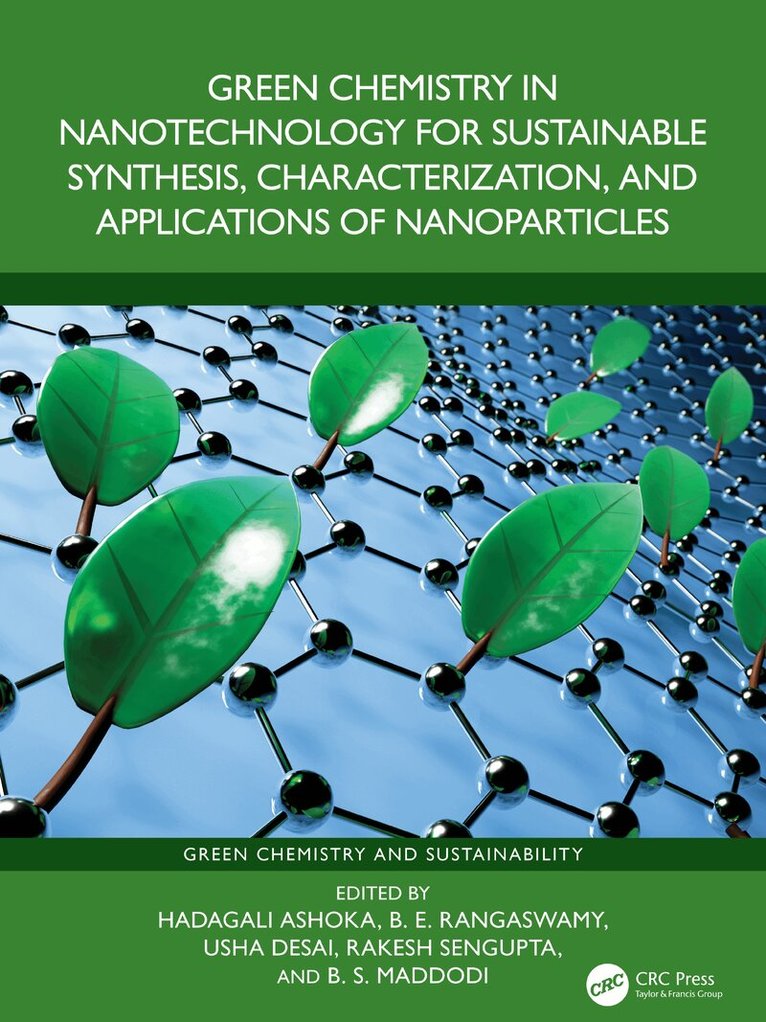
    Green Chemistry in Nanotechnology for Sustainable Synthesis, Characterization, and Applications of Nanoparticles

    AvHadagali Ashoka,B. E. Rangaswamy

    Inbunden, Engelska, 2026

    Del i serien Green Chemistry and Sustainability

    1 771 kr

    Beställningsvara. Skickas inom 10-15 vardagar. Fri frakt över 249 kr.

    Beskrivning

    Nanotechnology has become one of the most revolutionary scientific domains of the 21st century, providing answers for healthcare, renewable energy, environmental cleanup, and industrial advancements. Nonetheless, the swift expansion of this technology necessitates a comparable dedication to environmental responsibility and safety. Green Chemistry in Nanotechnology for Sustainable Synthesis, Characterization, and Applications of Nanoparticles meets this requirement by combining green chemistry principles with cutting-edge nanoscience.This edited collection offers an extensive summary of sustainable nanomaterial creation, starting with fundamental principles and synthesis methods based on renewable resources. It explores eco-friendly and bioinspired methods for producing gold, silver, calcium, and metal oxide nanoparticles, backed by in-depth case studies. Extensive coverage is provided on advanced characterization techniques, delivering insights into structural, morphological, and functional assessment. The book examines various applications, such as food packaging, antimicrobial surfaces, catalytic processes, energy devices, and biomedical technologies. A specific part on nanotoxicology showcases contemporary safety evaluation techniques, including organs-on-chips and 3D cell culture systems, while conversations regarding ethics and sustainability stress responsible innovation. The combination of scientific, safety, and social factors sets this work apart in its breadth. By connecting core concepts with real-world uses, the book acts as an essential tool for researchers, scholars, and industry experts aiming to create nanotechnology solutions that are not only efficient but also safe, sustainable, and ethically responsible. Policymakers and regulatory organizations will also appreciate it for developing frameworks that guarantee nanotechnology aids in advancing global sustainability objectives. This book merges green chemistry with nanotechnology, enabling synthesis from sustainable pathways and characterization through advanced techniques jointly with applications and ethical considerations all under one roof. Works by world top-rated scientists propose renewable-resource-based, bioinspired, and eco-friendly routes toward synthesis of widely varying nanoparticles that make sense in real life. Case studies with applications in health care, food packaging, catalysis, and industrial plus environmental remediation work supported by the most advanced tools of nanotoxicological assessment, such as organs-on-chips and 3D cell cultures, are also presented here. Scientific novelty will be integrated with safety and sustainability so that learners can not only create new forms of nanomaterials but also “create safely.” By combining breadth, depth, and practical insight, this work stands as an indispensable guide for researchers, industry professionals, policymakers, and educators shaping the future of sustainable nanotechnology.

    Produktinformation

    • Utgivningsdatum:2026-03-30
    • Mått:210 x 280 x undefined mm
    • Vikt:770 g
    • Format:Inbunden
    • Språk:Engelska
    • Serie:Green Chemistry and Sustainability
    • Antal sidor:312
    • Förlag:Taylor & Francis Ltd
    • ISBN:9781041082361

    Utforska kategorier

    • Referensverk och tvärvetenskap inom Samhälle och politik
    • Miljöteknik inom Naturvetenskap och teknik
    • Agronomi inom Naturvetenskap och teknik

    Mer om författaren

    Ashoka Hadagali, a faculty member at B.M.S. College of Engineering since 2009, specializes in Biotechnology and diabetes modeling. With a Ph.D. from IIT Bombay, his research bridges natural therapeutics and pharmacology. He is a passionate educator, prolific researcher, and active contributor to scientific journals and professional communities.B.E. Rangaswamy, Registrar at Visvesvaraya Technological University, Belagavi, Karnataka. He is Professor of Biotechnology and a renowned expert in aerobiology, microbial diversity, and bio-pollution. With over 80 research papers, numerous national and international presentations, and patents, he has led impactful projects funded by premier agencies like DST, DBT, AICTE, VGST and VTU other agencies. Recipient of multiple prestigious awards, including the, PH Gregory Award, Rajaram Bapu National Award and Karnataka Rajyothsava Award by Davangere District. Dr. Rangaswamy has significantly contributed to sustainable technologies, public health research, and rural development through vermicomposting, beekeeping, and biodegradable product innovations, inspiring future scientists and fostering community welfare.Usha Desai, Professor and Dean Research and Development at S.E.A College of Engineering & Technology, Bengaluru is an accomplished researcher in biomedical signal processing, AI, and brain–computer interfaces (BCI), with 21 years’ academic experience. Dr. Desai has contributed over 70 publications in impactful journals, books and global conferences.Rakesh Sengupta is a researcher and Assistant Professor in SIAS, Krea University, Sri City, India since 2025. His interdisciplinary background spans cognitive & computational neuroscience and AI. He has worked before in University of Trento, Italy and York University, Canada as visiting scholar and postdoc, respectively. He has a growing scholarly record with 28 indexed publications, over 300 citations, H index of 9.Balakrishna S. Maddodi, Academician and NSS Program Officer at Manipal Institute of Technology, India, is an expert in engineering geology, environmental management, GIS, remote sensing, solid waste management, and green chemistry, with over 27 years of influential teaching and research experience in diverse areas of education and innovation.

    Innehållsförteckning

    • Chapter 1 Green Chemistry Approaches for Sustainable Nanomaterial Synthesis and Catalysis Raji V Nair Chapter 2 Green Chemistry and Bioinspiration in Nanotechnology Pavithra Poornima S and Ravindra H J Chapter 3 Harnessing Renewable Resources for Sustainable Nanomaterial Synthesis: Principles, Challenges, and Future Trends Snigdha Roy Chapter 4 Evaluating Sustainable Nanomaterial Synthesis from Renewable Resources: Methods, Challenges, and Pathways for Green Innovation R. Venkatesh, Natarajan Sampathkumar, and K. Subramani Chapter 5 Green Synthesis of Gold Nanorods: Implications for Sustainable Clean Environment Zendesha Stephen Mbalaha, Intisar Albander, and Peverga Rex Jubu Chapter 6 Green Synthesis of Calcium Nanoparticles from Momordica cymbalaria and Their Applications in Drosophila melanogaster for Type 2 Diabetes Mellitus Aishwarya H S, Mukta Dixit, Anjan P Kumar, Gurudatta B V, and Savithri Bhat Chapter 7 Cow’s Milk Silver Nanoparticles Synthesized at Various pH Combat Multidrug-Resistant Pseudomonas aeruginosa 71 Akshata G Athreya, Ismail Shareef M, and S M Gopinath Chapter 8 Eco-Friendly Synthesis of Nanoparticles 81 Gurushantha K, Prashanth Kumar H P, Roopashree B N, and Shashidhar S Chapter 9 Nanocatalyst-Driven Sustainable Electrochemical Machining: Role of Gold Nanoparticle Size in Improving Dissolution Efficiency Ritesh Kumar Upadhyay, Gopisetti Srinivasarao, Shyam S. Majhi, and Susanta S. Mahapatra Chapter 10 Characterization and Applications of Green Nanoparticles Liny. P, Jagadish H Patil, Ismail Shareef M, and Ansh Varkar Chapter 11 Advance Characterization and Applications for Green Nanomaterials J. Preethi, P.K. Praveen Kumar, Srinidhi Varadharajan, and M. KevinChapter 12 Advanced Characterization Techniques for Green NanomaterialsG.K. Prashanth, Srilatha Rao, H.S. Lalithamba, N.P. Bhagya, K.V. Rashmi, and Mithun Kumar Ghosh Chapter 13 Applications of Nanoparticles: A Revolutionary Approach in the Food IndustryShashank Vasanthkumar, Chandan Kumar Sahu, and Ravi-Kumar Kadeppagari Chapter 14 Industrial Applications of Green-Synthesized Nanoparticles Venkatesh Sivalingam, Gaurav Rajasekhar, Bandaru Manideep, Asha P Johnson, Jeevan Kumar M, Poornima DS, and Lokesh Ravi Chapter 15 Toxicity Assessment of Nanomaterials: Molecular Mechanisms and Assessment of Nanotoxicity Sharmistha Dutta and Hadagali AshokaChapter 16 Toxicity Assessment of Nanomaterials Using Organs-on-Chips and 3D Cell Culture SystemsHemavathi Brijesh, Brijesh Ajjappala, Pavithra S, and Prithvika R Chapter 17 Zinc Oxide Nanoparticles: Uses in Food Additives and Packaging and Toxicological ProfileSnigdha Roy Chapter 18 Biomedical Applications of Green Nanoparticles: Emerging Trends and Therapeutic PotentialSuraj Prakash, Radha, and Sunil Puri Chapter 19 Metal Oxide Nanoparticles against Bacterial Biofilms: Emerging Trends and Technologies Neeraj Kumari, Sunil Puri, and Radha Chapter 20 Ethical Issues in Nanotechnology and Sustainability Narendra Kumar S, Shamantha Gowda T S, Manjunath Yadav S M, and Satheesh Babu G Chapter 21 Nickel Oxide/Reduced Graphene Oxide Nanocomposites: Synthesis, Properties, and Applications Dhruva Kumar, Joydeep Biswas, and Dheeraj Kumar Chapter 22 CMOS Active Full Wave Rectifier for Wirelessly Powered Biomedical Implants Sushma P S, Shrividya G, and Usha Desai Chapter 23 The Impact of Multiwalled Carbon Nanotubes on the Mechanical Properties of Glass Fiber–Reinforced Concrete Ali Ebrahim, S. Kandasamy, and N. Pannirselvam Chapter 24 Nanotechnological Advancements in Medical Devices P. R. Lighittha, M. Sundara Srivathsan, and G. Lakshmi PriyaChapter 25 Sustainable Nanomaterials and Green Synthesis: Biogenic Synthesis of Barium Sulphate Nanoparticles Using Azadirachta indica Leaf Extract and Assessment of Its Antibacterial PotentialMuktha H, Ishika Jain, Jayashree D R, and Dileep Kumar M GChapter 26 Emerging Trends and Applications of Green Nanotechnology in HealthcareChaitanya Lakshmi S R, Kuthambakam Baby Rani, Bhimavaram Keerthi, Lokesh Ravi, Asha P Johnson, Rajasekaran Subbarayan, Rupendra Shrestha, and Jeevan Kumar MChapter 27 An Integrated Approach to Fabricate, Visualize, and Analyze Nanostructured ImagesUsing EBL, DIP, and ToF-SIMSMbadiwe S. Benyeogor, Olusegun I. Lawal, Nnaemeka M. Mbachu, Kolawole I. Agbaogun, and Kabiru Alani Olaiya