• Fri frakt över 249 kr
  • •
  • Snabba leveranser
  • •
  • Billiga böcker
Kundservice

Du är på sajten för privatpersoner.

Företag, bibliotek eller offentlig verksamhet?

Du handlar på classic.bokus.com, där alla dina funktioner finns intakta.
Till classic.bokus.com
Bokus logotyp. Gå till startsidan.
  • Erbjudanden
  • Student
  • Topplistor
  • Barn & ungdom
  • Bokus Play
  • E-böcker
  • Ljudböcker
  • Pocketböcker
  • Spel & pussel

10% rabatt på allt med kod NYSTART10 →

Sidfot

Mina sidor

    Hjälp

    • Kundservice
    • Vanliga frågor och svar
    • Frakt och leverans
    • Retur vid ångerrätt
    • Reklamera vara
    • Betalning
    • Köpvillkor
    • Allmänna villkor
    • Information om webbplatsens tillgänglighet

    Om Bokus

    • Om oss
    • Pressrum
    • För studenter
    • För företag
    • För bibliotek och offentlig verksamhet
    • För leverantörer
    • Hållbarhet

    Populärt

    • Aktuella erbjudanden
    • Presentkort
    • Studentlitteratur
    • Nya böcker
    • Topplistor
    • Signerade böcker
    • Engelska böcker

    Inspiration

    • Boktips
    • BookTok
    • Populära bokserier
    • Barnbokskaraktärer
    • Populära författare
    Logotyp för Bokus
    Följ oss på Facebook (extern länk)Följ oss på Instagram (extern länk)Följ oss på YouTube (extern länk)Följ oss på TikTok (extern länk)
    bokus @ CookiesAnpassa cookiesIntegritetspolicyKöpvillkor
    Till Citymail hemsida (extern länk)Till Budbee hemsida (extern länk)Till Postnord hemsida (extern länk)Till Schenker hemsida (extern länk)Till Early Bird hemsida (extern länk)Till Walleys hemsida (extern länk)
    1. Naturvetenskap och teknik
    2. Teknik och industri
    3. Teknik: allmänt

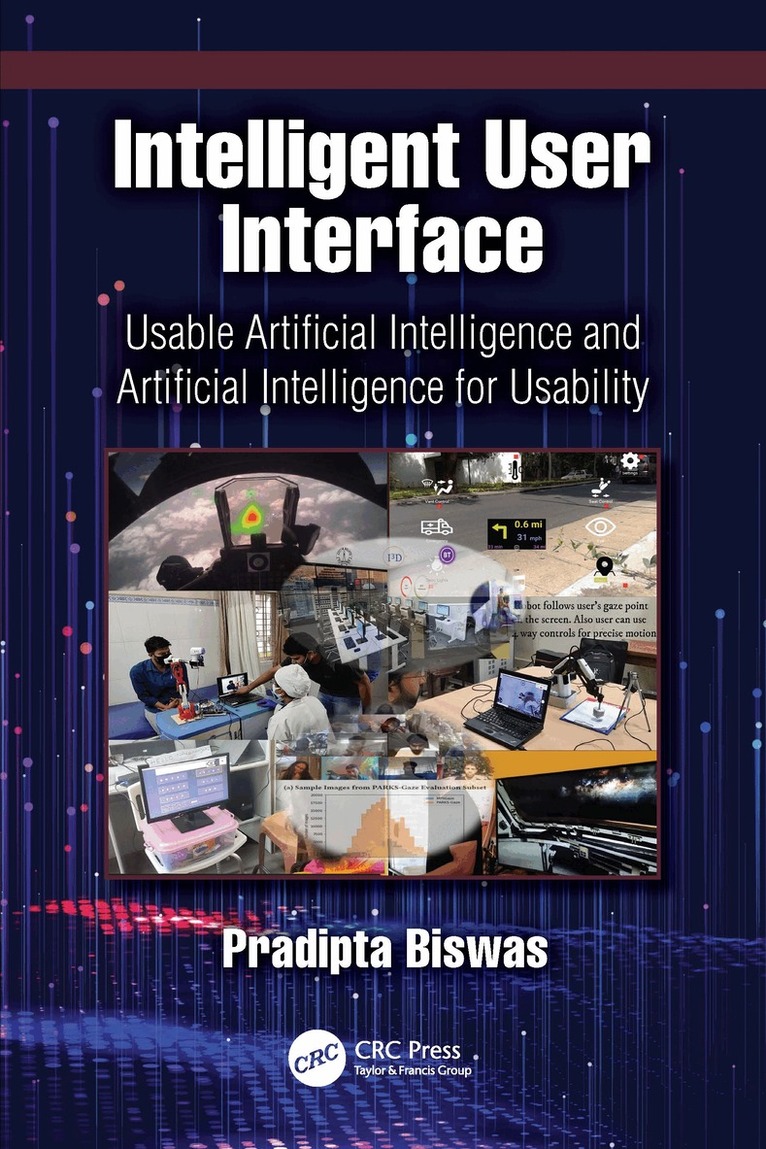
    Intelligent User Interface

    Usable Artificial Intelligence and Artificial Intelligence for Usability

    AvPradipta Biswas

    Inbunden, Engelska, 2026

    1 465 kr

    Beställningsvara. Skickas inom 10-15 vardagar. Fri frakt över 249 kr.

    Fler format och utgåvor

    E-bok

    1 698 kr

    E-bok

    1 693 kr

    Beskrivning

    This book aims to mainstream UI/UX design process by explaining latest AI/ML models in a comprehensible way and highlighting case studies on developing intelligent user interfaces for XR systems, human robot interaction, cockpit design and trajectory prediction. The book also discusses the latest standards and guidelines relevant to UI/UX design, layout and equipment list for setting up a lab on intelligent interaction design involving robots, drones and XR systems.Features:Covers a wide array of topics ranging from human factors, computer vision, AR/VR systems, large language models (LLMs) and usability evaluation techniques including statistical hypothesis techniquesDiscusses latest AI systems such as vision transformers, LLM-based human robot interface and virtual reality-based spacecraft simulation systemsProvides a list of freely downloadable software on the covered topicsContains graphical illustrations and a list of quick facts for easy review and recall of basic concepts in each chapterGives new project ideas on intelligent user interfaces that can be explored by students and early career rsearchersThe intended audience of this book is engineering and design students and faculty members, user interface designers, and product managers who would like to be aware of latest AI/ML without diving into too many theoretical details, and use it for their project or product development.

    Produktinformation

    • Utgivningsdatum:2026-03-04
    • Mått:156 x 234 x 15 mm
    • Vikt:520 g
    • Format:Inbunden
    • Språk:Engelska
    • Antal sidor:178
    • Förlag:Taylor & Francis Ltd
    • ISBN:9781041087335

    Utforska kategorier

    • Teknik: allmänt inom Naturvetenskap och teknik
    • Programvaruutveckling inom Data och IT
    • Artificiell intelligens inom Data och IT

    Mer om författaren

    Pradipta Biswas is an associate professor at the Department of Design and Manufacturing, associate faculty at the Robert Bosch Centre for Cyber Physical Systems and Curriculum Committee member of HAL-IISc Skill Development Centre at Indian Institute of Science. His experiment on human computer interaction is one of the seven experiments selected for the Axiom-4 mission to be launched on 10th June. He was elected a vice chairman of ITU Study Group 9 (2022-24) and also a co-chair of the IRG AVA (2020-24) and Focus Group on Smart TV at International Telecommunication Union, the telecom branch of United Nations. He is a convenor of BIS (Bureau of Indian Standard) Panel on Metaverse.His research focuses on user modelling and multimodal human-machine interaction for aviation and automotive environments and for assistive technology. He set up and lead the Interaction Design (I3D) Lab. His research won Microsoft’s AI 4 Accessibility Grant Award, Facebook’s Responsible AR/VR Award and research grants from Collins Aerospace (on AR-AI integration), Siemens (on Holoportation) , British Telecom (on AR/VR Systems), Faurecia Groupe Services Ltd. (on Automotive UI), Wipro Ltd (On Autonomous Vehicle), Defence Research and Development Organization (DRDO), Indian Space Research Organization (ISRO), Departments of Science & Technology (DST) and BioTechnology (DBT) and was featured in New Scientist, NDTV, All India Radio and various other media outlets.Earlier, Pradipta was a Senior Research Associate at the Engineering Department, Research Fellow at Wolfson College and Research Associate at Trinity Hall of University of Cambridge. He completed PhD in Computer Science at the Rainbow Group of University of Cambridge Computer Laboratory and Trinity College in 2010 and was awarded a Gates-Cambridge Scholarship in 2006. He is a member of the UKRI International Development Peer Review College, and was a professional member of the Society of Flight Test Engineers British Computer Society, Associate Fellow at the UK Higher Education Academy and Royal Society of Medicine.

    Innehållsförteckning

    • 1. Introduction. 2. Human Factors. 3. Basics of AI/ML. 4. Modalities of Interaction. 5. Computer Vision. 6. Textual Information Processing. 7. Information Visualization. 8. User Study. 9. Human Robot Interaction. 10. Case Studies on Cockpit Design. 11. Case Studies on Trajectory Prediction. 12. Standardization. 13. Concluding Remarks.