• Fri frakt över 249 kr
  • •
  • Snabba leveranser
  • •
  • Billiga böcker
Kundservice

Du är på sajten för privatpersoner.

Företag, bibliotek eller offentlig verksamhet?

Du handlar på classic.bokus.com, där alla dina funktioner finns intakta.
Till classic.bokus.com
Bokus logotyp. Gå till startsidan.
  • Erbjudanden
  • Nyheter
  • Student
  • Topplistor
  • Barn & ungdom
  • Bokus Play
  • E-böcker
  • Pocketböcker
  • Spel & pussel

10% rabatt på allt med kod NYSTART10 →

Sidfot

Mina sidor

    Hjälp

    • Kundservice
    • Vanliga frågor och svar
    • Frakt och leverans
    • Retur vid ångerrätt
    • Reklamera vara
    • Betalning
    • Köpvillkor
    • Allmänna villkor
    • Information om webbplatsens tillgänglighet

    Om Bokus

    • Om oss
    • Pressrum
    • För studenter
    • För företag
    • För bibliotek och offentlig verksamhet
    • För leverantörer
    • Hållbarhet

    Populärt

    • Aktuella erbjudanden
    • Presentkort
    • Studentlitteratur
    • Nya böcker
    • Topplistor
    • Signerade böcker
    • Engelska böcker

    Inspiration

    • Boktips
    • BookTok
    • Populära bokserier
    • Barnbokskaraktärer
    • Populära författare
    Logotyp för Bokus
    Följ oss på Facebook (extern länk)Följ oss på Instagram (extern länk)Följ oss på YouTube (extern länk)Följ oss på TikTok (extern länk)
    bokus @ CookiesAnpassa cookiesIntegritetspolicyKöpvillkor
    Till Citymail hemsida (extern länk)Till Budbee hemsida (extern länk)Till Postnord hemsida (extern länk)Till Schenker hemsida (extern länk)Till Early Bird hemsida (extern länk)Till Walleys hemsida (extern länk)
    1. Samhälle och politik
    2. Politik och statsskick
    3. Internationella relationer

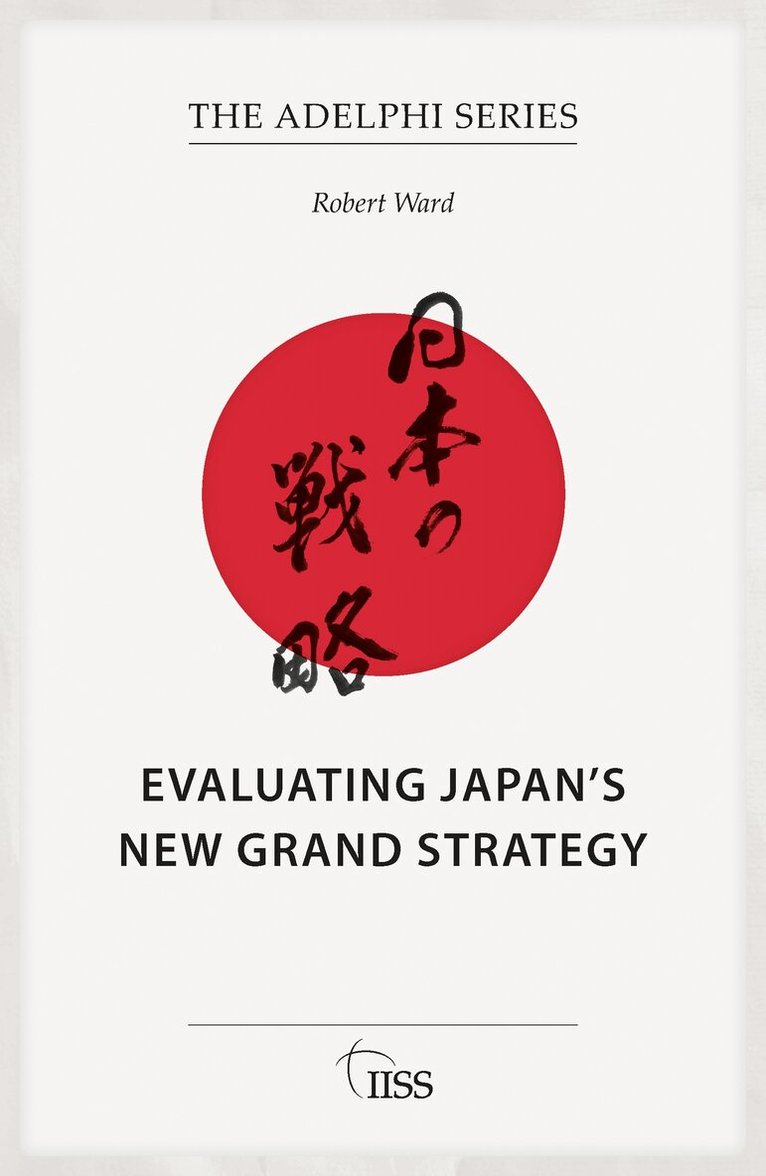
    Evaluating Japan’s New Grand Strategy

    AvRobert Ward

    Häftad, Engelska, 2025

    Del i serien Adelphi series

    274 kr

    Beställningsvara. Skickas inom 10-15 vardagar. Fri frakt över 249 kr.

    Fler format och utgåvor

    E-bok

    319 kr

    E-bok

    303 kr

    Beskrivning

    Geopolitical stresses in the Indo-Pacific are increasing and intensifying. These stresses derive from China’s more assertive regional behaviour; growing alignments between China and Russia on the one hand and Russia and North Korea on the other; and most recently from the apparent recalibration of United States foreign policy under the second Trump administration. They have magnified Japan’s significance as a strategic actor both in the Indo-Pacific and beyond.As such, it is of global importance whether Japan can meet the grand-strategic goals that it established in its 2022 National Security Strategy, National Defense Strategy and Defense Buildup Program. This Adelphi book evaluates Japan’s new grand strategy, considering whether it and associated reforms are sufficiently robust to fulfil Japan’s goal of ensuring its security even in the scenario of a Chinese attack on Taiwan.

    Produktinformation

    • Utgivningsdatum:2025-05-30
    • Mått:156 x 234 x 11 mm
    • Vikt:308 g
    • Format:Häftad
    • Språk:Engelska
    • Serie:Adelphi series
    • Antal sidor:156
    • Förlag:Taylor & Francis Ltd
    • ISBN:9781041101321

    Utforska kategorier

    • Internationella relationer inom Samhälle och politik
    • Militär strategi inom Samhälle och politik
    • Ekonomisk politik inom Ekonomi och Ledarskap

    Mer om författaren

    Robert Ward is the IISS Japan Chair, carrying out independent research and writing extensively on strategic issues related to Japan, including its contemporary security and foreign policies. He is also Director of Geo-economics and Strategy and leads the Institute’s work on a range of issues including global economic governance, rules and standards setting, and how economic coercion impacts policy at a national and corporate level. He is co-author of Japan’s Effectiveness as a Geo-Economic Actor: Navigating Great-Power Competition (Routledge, 2022) and co-editor of Japan and the IISS: Connecting Western and Japanese Strategic Thought from the Cold War to the War on Ukraine (Routledge, 2023). Prior to joining the IISS, Ward spent 23 years at the Economist Group, latterly leading the country and industry research teams at the Economist Intelligence Unit. He lived and worked in Japan from 1989 to 1996 and is a fluent speaker of Japanese. He holds bachelor’s and master’s degrees from Cambridge University.

    Recensioner i media

    ‘Robert Ward shines a brilliant light on the transformation seen in Japan’s grand strategy during the past 15 years, placing it in its historical context but crucially also illuminating how Japanese society has come to understand the threat to the country’s security posed by North Korea, Russia and above all China. Delivering the new grand strategy will not be easy, but this book shows that it can be done and that it has strong winds behind it.’Bill Emmott, Chairman of the Trustees, IISS and author of Deterrence, Diplomacy and the Risk of Conflict Over Taiwan‘This book offers a compelling, balanced and insightful exploration of the evolution of Japan’s foreign policy, tracing its trajectory from the Meiji Restoration to the present day while prompting readers to contemplate its future direction. It presents a persuasive analysis of how Japan’s strategic choices have shaped the global order – spanning security, economics and technology. This volume is indispensable not only for Japan specialists and security experts but also for policymakers, scholars, business leaders and students – indeed, for anyone seeking to grasp the profound geopolitical shifts unfolding across the region.’Doden Aiko, former NHK commentator; Journalist/Distinguished Senior Fellow, Reischauer Center for East Asian Studies, SAIS, Johns Hopkins University; Japan Foundation Indo-Pacific Partnership Program Fellow‘Robert Ward’s insightful book offers profound insights into the logic and principles underpinning Japan’s grand strategy, providing a roadmap to stability in today’s complex and rapidly changing international environment. This essential read compellingly describes Japan’s strategic evolution from the Yoshida Doctrine to Abe Shinzo’s transformative approach and beyond, signifying its transition from a postwar strategy focused on stability and strong US relations to playing a more autonomous and proactive role on the world stage. As the book illustrates, Japan’s increased participation in global affairs could serve as a beacon of stability amid the uncertainties in US–Japan relations and the waning of US leadership in an era marked by turbulence under the second Trump administration. Ward explores Japan’s dynamic engagement and swift advances in previously uncharted territories such as defence strategy and diplomacy, and cyber and space technologies. The book also examines Japan’s leadership in economic security, highlighting its strategic efforts to reinforce supply chains and assert itself as a geo-economic power through initiatives like the CPTPP and strategic industrial policies.’Suzuki Kazuto, Professor of Science and Technology Policy, Graduate School of Public Policy, University of Tokyo

    Innehållsförteckning

    • Introduction· A grand-strategic watershed· The catalysts for change· Testing Japanese resilience‘Hardware’ and ‘software’Chapter One: Japan’s shifting strategic compass· Maritime Japan· Four strategic phases· A triangle and triangulationChapter Two: Building Japanese deterrence and response capabilities – defence and diplomacy· Changing defence assumptions· Japan’s strategic shift to the Southwest Islands· Building defence and defence-industrial resilience· Cyber, intelligence and space· Defence diplomacy – networking deterrenceChapter Three: New tools of Japanese security· Japan’s ‘comprehensive national power’· Japan’s evolving geo-economic power· Economic security – increasing Japanese geo-economic agency· Economic security and industrial policyChapter Four: Structural impediments· Japan acquires its strategic ‘rheostat’· Demographic and fiscal headwinds· Societal changeConclusion· Structural change in Japan· Japan’s capacity to deliver