• Fri frakt över 249 kr
  • •
  • Snabba leveranser
  • •
  • Billiga böcker
Kundservice

Du är på sajten för privatpersoner.

Företag, bibliotek eller offentlig verksamhet?

Du handlar på classic.bokus.com, där alla dina funktioner finns intakta.
Till classic.bokus.com
Bokus logotyp. Gå till startsidan.
  • Erbjudanden
  • Nyheter
  • Student
  • Topplistor
  • Barn & ungdom
  • Bokus Play
  • E-böcker
  • Pocketböcker
  • Spel & pussel

10% rabatt på allt med kod NYSTART10 →

Sidfot

Mina sidor

    Hjälp

    • Kundservice
    • Vanliga frågor och svar
    • Frakt och leverans
    • Retur vid ångerrätt
    • Reklamera vara
    • Betalning
    • Köpvillkor
    • Allmänna villkor
    • Information om webbplatsens tillgänglighet

    Om Bokus

    • Om oss
    • Pressrum
    • För studenter
    • För företag
    • För bibliotek och offentlig verksamhet
    • För leverantörer
    • Hållbarhet

    Populärt

    • Aktuella erbjudanden
    • Presentkort
    • Studentlitteratur
    • Nya böcker
    • Topplistor
    • Signerade böcker
    • Engelska böcker

    Inspiration

    • Boktips
    • BookTok
    • Populära bokserier
    • Barnbokskaraktärer
    • Populära författare
    Logotyp för Bokus
    Följ oss på Facebook (extern länk)Följ oss på Instagram (extern länk)Följ oss på YouTube (extern länk)Följ oss på TikTok (extern länk)
    bokus @ CookiesAnpassa cookiesIntegritetspolicyKöpvillkor
    Till Citymail hemsida (extern länk)Till Budbee hemsida (extern länk)Till Postnord hemsida (extern länk)Till Schenker hemsida (extern länk)Till Early Bird hemsida (extern länk)Till Walleys hemsida (extern länk)
    1. Historia och arkeologi
    2. Historia
    3. Asiens historia

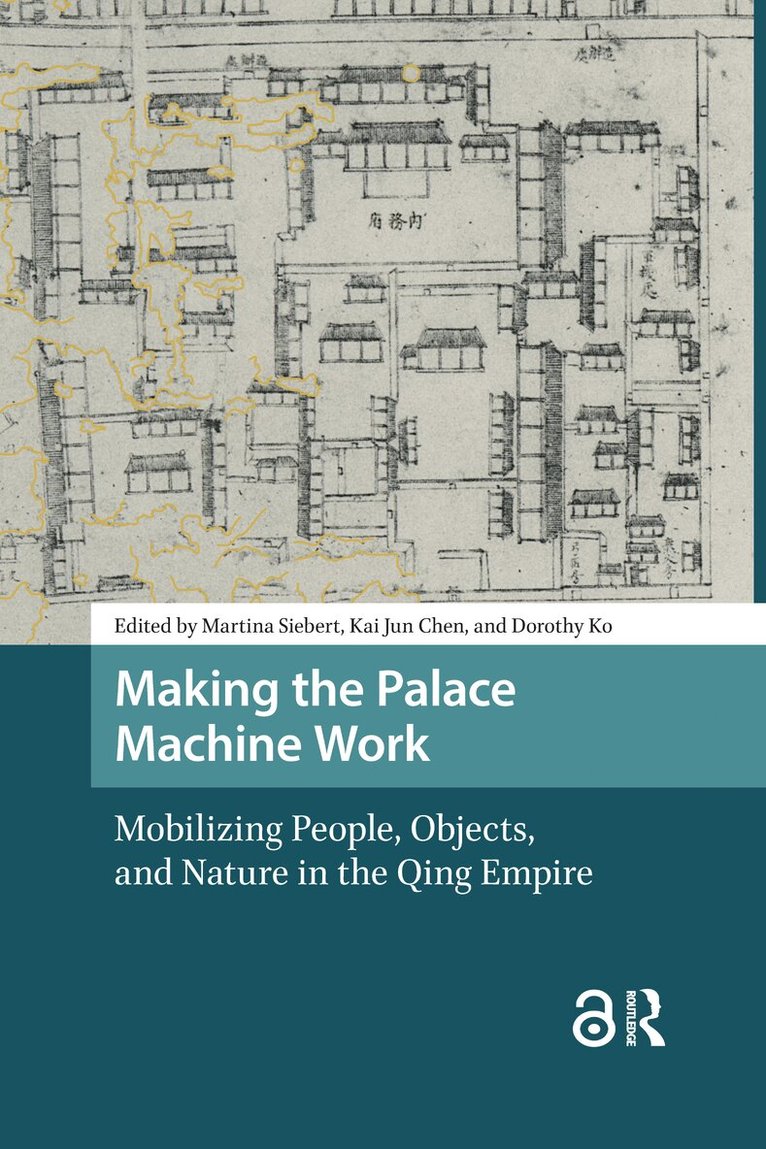
    Making the Palace Machine Work

    Mobilizing People, Objects, and Nature in the Qing Empire

    AvMartina Siebert,Kai Jun Chen

    Häftad, Engelska, 2025

    Del i serien Asian History

    702 kr

    Beställningsvara. Skickas inom 10-15 vardagar. Fri frakt över 249 kr.

    Beskrivning

    Making the Palace Machine Work: Mobilizing People, Objects, and Nature in the Qing Empire brings the studies of institutions, labour, and material cultures to bear on the history of science and technology by tracing the workings of the Imperial Household Department (Neiwufu) in the Qing court and empire. An enormous apparatus that employed 22,000 men and women at its heyday, the Department operated a machine with myriad moving parts. The first part of the book portrays the people who kept it running, from technical experts to menial servants, and scrutinises the paper trails they left behind. Part II uncovers the working principles of the machine by following the production chains of some of its most splendid products: gilded statues, jade, porcelain, and textiles. Part III examines the complex task of managing living organisms and natural environments, including lotus plants grown in imperial ponds in Beijing, fresh medicines sourced from disparate regions, and tribute elephants from Southeast Asia.

    Produktinformation

    • Utgivningsdatum:2025-12-01
    • Mått:156 x 234 x undefined mm
    • Format:Häftad
    • Språk:Engelska
    • Serie:Asian History
    • Antal sidor:334
    • Förlag:Taylor & Francis Ltd
    • ISBN:9781041182351

    Utforska kategorier

    • Asiens historia inom Historia och arkeologi
    • Socialhistoria och kulturhistoria inom Historia och arkeologi
    • Naturvetenskapens historia inom Naturvetenskap och teknik

    Mer om författaren

    Martina Siebert works as subject librarian at the East Asia department of the Staatsbibliothek zu Berlin and as independent scholar. She researches and publishes on the history of Chinese exploration into nature and technology with a focus on the styles and agendas of presenting and organizing that knowledge in writing. Kai Jun Chen is Assistant Professor at Brown University. The author of a forthcoming monograph on the technocratic culture in the Qing Imperial Ceramic Industry, he specialises in the history of imperial institutions, handicraft technology, and material culture studies. A native of Hong Kong, Dorothy Ko is Professor of History at Barnard College, Columbia University. She is a cultural historian of early modern China whose research and publication focus on gender, technology, and material culture.

    Innehållsförteckning

    • Map of Imperial and Forbidden City, Map of Beijing and outskirts, Map of Qing China (1820), Acknowledgments, Conventions for the Notation of Time, Weights, and Measures, Note on Translation, List of Figures, Tables, Charts, and Maps, Introduction, Part I. Operating the Machine: Personnel and Paper Trails, Vignette essay. Moving Pieces: On the Reuse of Interior Decoration Objects in Qing Palaces (Shuxian Zhang), 1. Working the Qing Palace Machine: The Servants' Perspective (Christine Moll-Murata), 2. Manager or Craftsman: Skillful Bannermen of the Qing Dynasty (1644-1912) (Kai Jun Chen), 3. Kupiao and the Accounting System of the Imperial Household Workshops (Yijun Wang and Kyoungjin Bae), Part II. Producing the Court: Materials and Artefacts, Vignette essay. The Story of An Image: Ding Guanpeng's 'Ultimate Bliss' and the Auspiciousness of Reproduction (Qiong Zhang), 4. Piecing Shards Together: The Uses and Manufacturing of Imperially Porcelain (Guangyao Wang), 5. Resplendent Innovations: Fire Gilding Techniques at the Qing Court (Hui-min Lai and Te-cheng Su), 6. Transporting Jade: Objects, Ecology and Local Bureaucracy in Qing Xinjiang (Yulian Wu), Part III. Mobilizing Nature: Plants and Animals, Vignette essay. Decluttering: On the Classification of Objects at the Imperial Household Department (Elif Akçetin), 7. Growing and Organizing Lotus in Qing Imperial Spaces: Interlocking Cycles of Money and Nature (Martina Siebert), 8. The Medicine Supply System of the Qing Court (Xueling Guan), 9. When There Is Peace, There Are Elephants (Hui-chun Yu), Coda, Bibliography, Index