• Fri frakt över 249 kr
  • •
  • Snabba leveranser
  • •
  • Billiga böcker
Kundservice

Du är på sajten för privatpersoner.

Företag, bibliotek eller offentlig verksamhet?

Du handlar på classic.bokus.com, där alla dina funktioner finns intakta.
Till classic.bokus.com
Bokus logotyp. Gå till startsidan.
  • Erbjudanden
  • Nyheter
  • Student
  • Topplistor
  • Barn & ungdom
  • Bokus Play
  • E-böcker
  • Pocketböcker
  • Spel & pussel

Må bättre, för mindre! Upp till 50% rabatt på hälsoböcker

Sidfot

Mina sidor

    Hjälp

    • Kundservice
    • Vanliga frågor och svar
    • Frakt och leverans
    • Retur vid ångerrätt
    • Reklamera vara
    • Betalning
    • Köpvillkor
    • Allmänna villkor
    • Information om webbplatsens tillgänglighet

    Om Bokus

    • Om oss
    • Pressrum
    • För studenter
    • För företag
    • För bibliotek och offentlig verksamhet
    • För leverantörer
    • Hållbarhet

    Populärt

    • Aktuella erbjudanden
    • Presentkort
    • Studentlitteratur
    • Nya böcker
    • Topplistor
    • Signerade böcker
    • Engelska böcker

    Inspiration

    • Boktips
    • BookTok
    • Populära bokserier
    • Barnbokskaraktärer
    • Populära författare
    Logotyp för Bokus
    Följ oss på Facebook (extern länk)Följ oss på Instagram (extern länk)Följ oss på YouTube (extern länk)Följ oss på TikTok (extern länk)
    bokus @ CookiesAnpassa cookiesIntegritetspolicyKöpvillkor
    Till Citymail hemsida (extern länk)Till Budbee hemsida (extern länk)Till Postnord hemsida (extern länk)Till Schenker hemsida (extern länk)Till Early Bird hemsida (extern länk)Till Walleys hemsida (extern länk)
    1. Ekonomi och Ledarskap
    2. Företagsekonomi
    3. Entreprenörskap
    • Nyhet

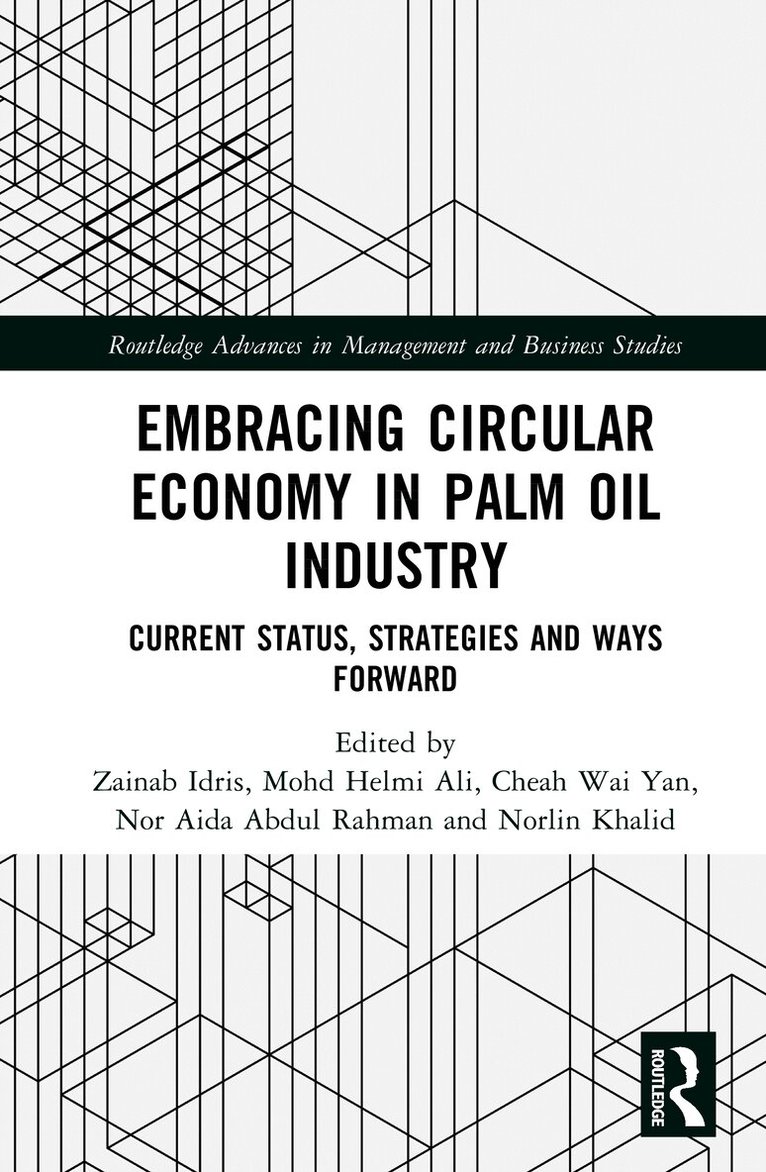
    Embracing Circular Economy in Palm Oil Industry

    Current Status, Strategies and Ways Forward

    AvZainab Idris,Mohd Helmi Ali

    Inbunden, Engelska, 2026

    Del i serien Routledge Advances in Management and Business Studies

    2 421 kr

    Beställningsvara. Skickas inom 10-15 vardagar. Fri frakt över 249 kr.

    Beskrivning

    This book examines how the palm oil industry may align its business practices with circular economy principles, amid growing environmental scrutiny and regulatory pressures.The book discusses the potential industrial benefits of adopting circular economy principles before reviewing the current state of business practice in the Malaysian palm oil industry. It highlights factors that influence the adoption of sustainable practices, including taxation, small- and medium-sized enterprises (SMEs), waste management and valorization, and digital technologies like the Internet of Things (IoT). In doing so, the contributors provide strategies and insights for other palm oil-producing countries to transition toward more sustainable business practices.This book is an essential resource for academics interested in agriculture, supply chain management, sustainability, and environmental studies. This volume will also be of interest to policymakers and professionals in the palm oil industry.

    Produktinformation

    • Utgivningsdatum:2026-08-17
    • Mått:156 x 234 x 19 mm
    • Vikt:740 g
    • Format:Inbunden
    • Språk:Engelska
    • Serie:Routledge Advances in Management and Business Studies
    • Antal sidor:286
    • Förlag:Taylor & Francis Ltd
    • ISBN:9781041206439

    Utforska kategorier

    • Entreprenörskap inom Ekonomi och Ledarskap
    • Lantbruk, fiske och skogsbruk inom Ekonomi och Ledarskap
    • Miljövetenskap och miljöpolitik inom Naturvetenskap och teknik

    Mer om författaren

    Zainab Idris is a former deputy director general (R&D) of the Malaysian Palm Oil Board (MPOB) since August 2019. She obtained her bachelor of science in chemistry from Laurentian University of Sudbury, Ontario, Canada, in 1988. She joined the Palm Oil Research Institute of Malaysia (PORIM), now known as the MPOB, in 1992, and she completed her M.Sc. in organic chemistry from Universiti Putra Malaysia in 1998 and her Ph.D. in 2010. She later obtained her MBA from the Graduate School of Business (GSB), UKM, in 2017. Zainab’s skills and expertise include transesterification processes, esterification reactions, heterogeneous catalysis, catalyst characterization, amino acid surfactants, catalyst synthesis, green chemistry, chemical reaction engineering, synthesis, and mesoporous materials.Mohd Helmi Ali is a professor at the UKM-Graduate School of Business (GSB), Universiti Kebangsaan Malaysia (UKM). With experience spanning various industries, including food, oil and gas, maritime, transportation, and construction, he brings a diverse perspective to his academic work. His research focuses on food integrity, halal food supply chains, sustainable development, operations management, and innovation. In addition to his academic role, he is a chartered member of the Chartered Institute of Logistics and Transport Malaysia. As an esteemed scholar at UKM, Prof. Helmi Ali makes significant contributions to fields such as halal studies, food supply chains, sustainable production and consumption, and transportation through his extensive research and expertise.Wai Yan Cheah is currently serving as a senior lecturer at the Centre of Research in Development, Social and Environment (SEEDS), Faculty of Social Sciences and Humanities, UKM. Her current field of research involves microalgae-related studies, biorefineries, and wastewater management. She received the Outstanding Paper Award from Springer in 2018 for her research paper on waste to energy. She has published many high-impact journal articles, book chapters, and many conference presentations since 2016. Her recent publication titled “Microalgae-Based Biotechnological Sequestration of Carbon Dioxide for Net Zero Emissions” has been published in the esteemed journal Trends in Biotechnology with an impact factor of 21, as well as on the United States Department of Agriculture (USDA) website. Additionally, she has reviewed many articles since 2018 for the following journals: Bioresource Technology, Chemosphere, Biochemical Engineering Journal, Sustainable Energy Technologies and Assessments, Biocatalysis and Agricultural Biotechnology, Scientific Reports, and Journal of Water Process Science and Engineering. She is leading her team in microalgae-based palm oil mill effluent bioremediation at the research center, supported by several internal and external grants. She is also serving as a guest editor for the Sustainability journal, Multidisciplinary Digital Publishing Institute (MDPI), and as an associate editor for The Journal of Sustainability Science and Management, Universiti Malaysia Terengganu (JSSM UMT) and Penerbit UKM. She has been serving as the cluster head of the MPOB-UKM Endowment Chair since 2023, working on environmental sustainability for the development of the Malaysian palm oil industry.Nor Aida Abdul Rahman is a professor of supply chain and strategy at Universiti Kuala Lumpur, based at the Centre for Research and Innovation, and teaches at Universiti Kuala Lumpur, Malaysian Institute of Aviation Technology (UniKL MIAT) Subang. She is also a fellow at the UKM–MPOB Endowment Chair, a visiting professor at Trisakti Institute of Transportation and Logistics (ITL) Trisakti Jakarta, and an active trainer in management, logistics, halal supply chain, and postgraduate research. Her research spans marketing logistics, strategic management, aviation and air travel, halal logistics and supply chains, logistics performance, branding, and women in aviation and transport. Her publications include articles in leading journals such as the International Journal of Logistics Research, Journal of Macromarketing, Industrial Marketing Management, and Journal of Islamic Marketing, along with books and edited volumes with Routledge and Springer. She holds a Ph.D. in supply chain management from Brunel University of London and business degrees from the National University of Malaysia. She serves on committees for MS2400 Halal Supply Chain and SMIIC TC10 standards, is a certified Halal Trainer Jabatan Kemajuan Islam Malaysia (JAKIM) and Human Resource Development Corporation (HRDF) trainer, an Malaysian Qualification Agency (MQA) panel auditor, and an academic board member of The Chartered Institute of Logistics and Transport (CILT) in Malaysia. Her industry attachment with MASkargo strengthened her industry–academic engagement and professional network.Norlin Khalid is an associate professor at the Centre for Sustainable and Inclusive Development Studies (SID), Faculty of Economics and Management, UKM. She holds a Ph.D. in economics from the University of Essex, United Kingdom, and received both of her bachelor’s and master’s degrees from UKM. In addition to her academic responsibilities, she serves as the manager of the MPOB–UKM Endowment Chair. Previously, she held positions as the assistant dean/head of Student Affairs & Alumni (HESA) and as a cluster head in the Faculty of Economics and Management, UKM. Dr. Norlin’s research primarily focuses on applied macroeconomics, with a particular emphasis on public economics, development economics, and international economics. She has contributed to over 50 articles in refereed journals, with several featured in SSCI Q1/Q2 impact journals. Her research interests have expanded to include sustainability and environmental economics, as reflected in her recent publications. Throughout her tenure as a lecturer, Dr. Norlin has been frequently sought by government agencies and the private sector for the formulation of economy-related policies. She has also been a speaker for economics and econometrics modules at various institutions. She leads nine major research grants and is a member of over 20 additional grants, all awarded by international, industry, or local organizations.Ahmad Parveez Ghulam Kadir is the director general of the MPOB and has over 36 years of experience in plant molecular biology, genetic engineering, and biosafety. In 1997, he made a major scientific breakthrough by developing the world’s first transgenic oil palm. He holds a bachelor of science and master of science in genetics and molecular genetics from UKM, and a Ph.D. in plant genetic engineering from Universiti Putra Malaysia (UPM). He was appointed as a fellow of the International Society of Biocatalysis and Agricultural Biotechnology (ISBAB) in 2024 and as a fellow of the Academy of Science Malaysia in 2016. Ahmad Parveez Ghulam Kadir currently serves on several national boards, including the National Biosafety Board (2018–2026) and the Science Council of Malaysian Agricultural Research and Development Institute (MARDI). He is also a board member of the Malaysian Palm Oil Council (MPOC), Malaysian Sustainable Palm Oil (MSPO), and Institute of Malaysian Plantation and Commodities (IMPAC). Previously, he chaired the Genetic Modification Advisory Committee (GMAC) from 2010 to 2018. In academia, he was appointed as an adjunct professor at Universiti Putra Malaysia in 2021 for two years. He is active in professional societies, serving as the president of The International Society for Oil Palm Breeders (ISOPB), chairperson of AOCS Asian Section, and a board member of International Society of Biocatalysis and Agricultural Biotechnology (ISBAB). He has filed 18 patents (of which 11 have been granted), published over 100 journal articles, and presented more than 250 conference papers. He has received numerous local and international awards for his contributions to science and the palm oil industry.

    Innehållsförteckning

    • PART I: Current State 1 The Concept of the Circular Economy and its Benefits for Industrial Applications 2 Palm Oil Supply Chain: Waste Management Technology towards Circular Economy 3 Challenges and Drivers in Achieving Circularity in the Palm Oil Industry PART II: Stakeholder Engagement and Actors 4 When There’s a Will, There’s A Way: Analysing the Barriers and Drivers of Circular Economy Practices Among the Palm Oil Smallholders 5 Multi-Stakeholder Approach Strategy to Empower Circular Economy in the Malaysian Palm Oil Industry 6 Community Engagement and Social Impacts of Palm Oil Waste Management PART III: Waste Management and Valorization 7 Sustainable Agricultural Waste Management for Circular Economy: Opportunities and Challenges 8 Sustainable Practices for Palm Oil Waste Valorization and Recycling 9 Transforming Agriculture Waste: Embracing the Circular Economy for Sustainable Resource Management 10 Economic Utilization and Management of Palm Fiber Waste 11 The Performance of the Biodiesel Industry towards the Effective Palm Oil Waste Management in Malaysia PART IV: Ways Forward 12 Digital technologies for sustainability and circular economy: A systematic review and research agenda 13 Potential of Internet-of-Things (IoT) in enabling palm oil circular ecosystem 14 Palm Oil and Climate: Unveiling the Environmental Dynamics in Malaysia. Conclusions and ways forward