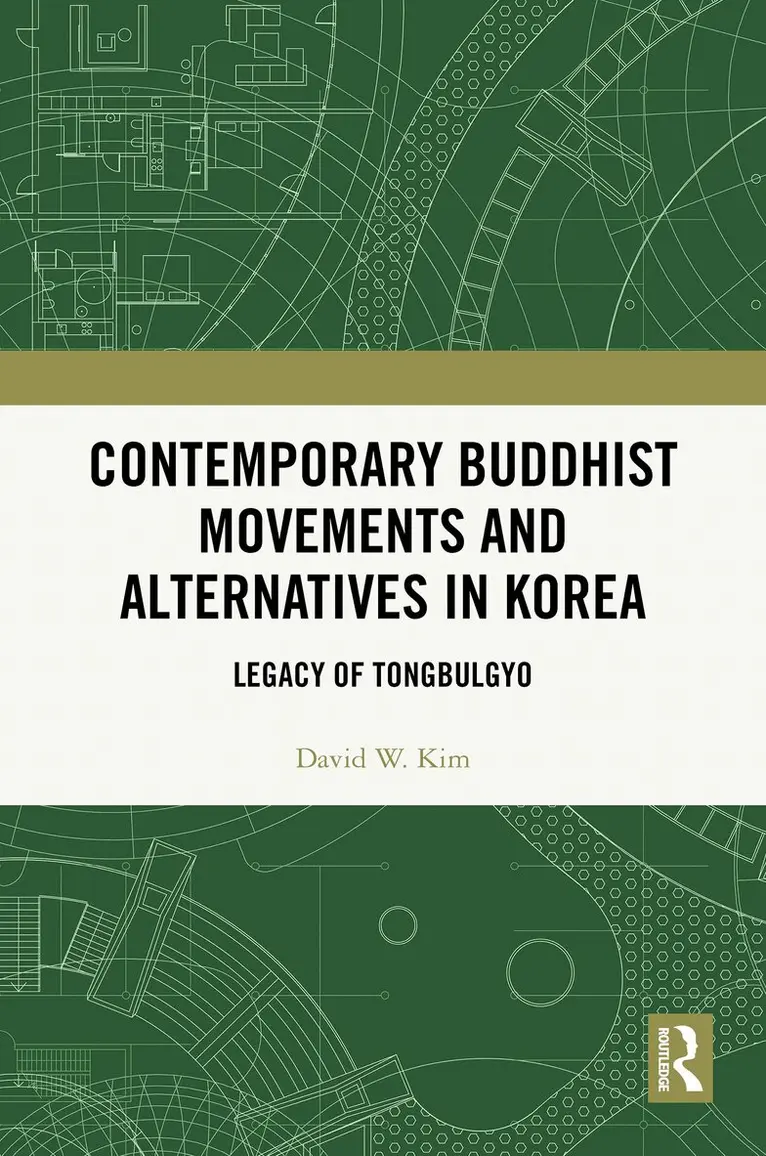
Inbunden, Engelska, 2026
Contemporary Buddhist Movements and Alternatives in Korea
Legacy of Tongbulgyo
Av David W. Kim
2502 kr
Beställningsvara. Skickas inom 10-15 vardagar. Fri frakt över 249 kr.
Beskrivning
Produktinformation
- Utgivningsdatum: 2026-11-17
- Mått: 156 x 234 x undefined mm
- Vikt: 610 g
- Format: Inbunden
- Språk: Engelska
- Antal sidor: 230
- Förlag: Taylor & Francis Ltd
- ISBN: 9781041226512
Utforska kategorier
Mer om författaren
David W. Kim (PhD, University of Sydney) is Professor of Modern History at Kookmin University, Seoul. He is an Affiliated Researcher at INFORM, Kings College London (KCL), a former Honorary Lecturer in the School of History at the Australian National University (2014–2025), and a Visiting Scholar at Harvard Divinity School (2023–2024). Kim is a Fellow of the Royal Historical Society (UK), a Fellow of the Royal Asiatic Society (UK), and an editor for Brill’s Handbook Series on Contemporary Religions (the Netherlands) as well as the Editor for the Series East Asian Religions and Culture (Cambridge Scholars Publishing, UK).Kim is a Committee Member for World Heritage, Korean Government. He has authored 12 books and 92 peer-reviewed articles, including Religion in Modern Education: Conflict, Economics, and Politics (2026), Silk Road Footprints: Transnational Transmission of Sacred Thoughts and Historical Legacy (2025), Socio-Anthropological Approaches to Religion: Environmental Hope (2024), Sacred Sites and Sacred Stories Across Cultures (2021), Daesoon Jinrihoe in Modern Korea (2020), Colonial Transformation and Asian Religions in Modern History (2018), Religious Encounters in Transcultural Society (2017), and Religious Transformation in Modern Asia: A Transnational Movement (2015).
Recensioner i media
David W. Kim has provided us with a contextualised and comparative account of seven new religious movements that have developed their individual interpretations of East Asian Buddhism within the past century. It is an informative and fascinating read.Eileen Barker OBE FBA, London School of Economics (LSE)This volume is a well-researched and cogent response to the need for a scholarly inquiry into the diversity of contemporary Korean Buddhism. Kim convincingly shows how the principle of «universalist» and integrative Buddhism (Tongbulgyo) has not only been the historical orientation of Korean Buddhism but also how it provides a central hermeneutic key for understanding the multiple adaptive facets of contemporary Korean Buddhism, on the intellectual, cultural and societal levels.Patrick Laude, Georgetown University
Betyg & recensioner
0 recensioner
Inga recensioner tillgängliga.