• Fri frakt över 249 kr
  • •
  • Snabba leveranser
  • •
  • Billiga böcker
Kundservice

Du är på sajten för privatpersoner.

Företag, bibliotek eller offentlig verksamhet?

Du handlar på classic.bokus.com, där alla dina funktioner finns intakta.
Till classic.bokus.com
Bokus logotyp. Gå till startsidan.
  • Erbjudanden
  • Nyheter
  • Student
  • Topplistor
  • Barn & ungdom
  • Bokus Play
  • E-böcker
  • Pocketböcker
  • Spel & pussel

10% rabatt på allt med kod: NYSTART10 →

Sidfot

Mina sidor

    Hjälp

    • Kundservice
    • Vanliga frågor och svar
    • Frakt och leverans
    • Retur vid ångerrätt
    • Reklamera vara
    • Betalning
    • Köpvillkor
    • Allmänna villkor
    • Information om webbplatsens tillgänglighet

    Om Bokus

    • Om oss
    • Pressrum
    • För studenter
    • För företag
    • För bibliotek och offentlig verksamhet
    • För leverantörer
    • Hållbarhet

    Populärt

    • Aktuella erbjudanden
    • Presentkort
    • Studentlitteratur
    • Nya böcker
    • Topplistor
    • Signerade böcker
    • Engelska böcker

    Inspiration

    • Boktips
    • BookTok
    • Populära bokserier
    • Barnbokskaraktärer
    • Populära författare
    Logotyp för Bokus
    Följ oss på Facebook (extern länk)Följ oss på Instagram (extern länk)Följ oss på YouTube (extern länk)Följ oss på TikTok (extern länk)
    bokus @ CookiesAnpassa cookiesIntegritetspolicyKöpvillkor
    Till Citymail hemsida (extern länk)Till Budbee hemsida (extern länk)Till Postnord hemsida (extern länk)Till Schenker hemsida (extern länk)Till Early Bird hemsida (extern länk)Till Walleys hemsida (extern länk)
    1. Psykologi och pedagogik
    2. Psykologi

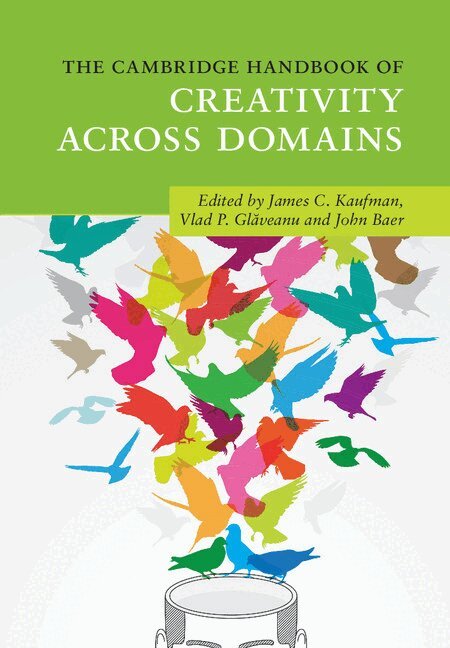
    The Cambridge Handbook of Creativity across Domains

    AvJames C. Kaufman,Vlad P. Glăveanu

    Inbunden, Engelska, 2017

    Del i serien Cambridge Handbooks in Psychology

    2 690 kr

    Beställningsvara. Skickas inom 10-15 vardagar. Fri frakt över 249 kr.

    Beskrivning

    Creativity is of rising interest to scholars and laypeople alike. Creativity in the arts, however, is very different from creativity in science, business, sports, cooking, or teaching. This book brings together top experts in the field from around the world to discuss creativity across many different domains. Each chapter includes clear definitions, intriguing research, potential measures, and suggestions for development or future directions. After a broad discussion of creativity across different domains, subsequent chapters look deeper into those individual domains (traditional arts, sciences, business, newer domains, and everyday life) to explore how creativity varies when expressed in different ways. Ultimately, the book offers a future-looking perspective integrating the different variations of creativity across domains.

    Produktinformation

    • Utgivningsdatum:2017-09-28
    • Mått:184 x 261 x 35 mm
    • Vikt:1 540 g
    • Format:Inbunden
    • Språk:Engelska
    • Serie:Cambridge Handbooks in Psychology
    • Antal sidor:682
    • Förlag:Cambridge University Press
    • ISBN:9781107110182

    Utforska kategorier

    • Psykologi inom Psykologi och pedagogik
    • Kognitiv psykologi inom Psykologi och pedagogik

    Mer om författaren

    James C. Kaufman is Professor of Educational Psychology at the University of Connecticut. The author or editor of more than thirty-five books, he is a past president of American Psychological Association's Division 10 and founding editor of two APA journals. He currently co-edits International Journal of Creativity and Problem Solving. Kaufman has won awards from APA (the Berlyne Award and the Farnsworth Award), Mensa's Research Award, National Association for Gifted Children's Torrance Award, and the American Library Association's Choice Outstanding Academic Title. Vlad Glăveanu is Associate Professor in the Department of Communication and Psychology at Aalborg University, Denmark. His books include Thinking Through Creativity and Culture (2014), Distributed Creativity (2014), Rethinking Creativity (with Alex Gillespie and Jaan Valsiner, 2014), and Creativity: A New Vocabulary (with Lene Tanggaard Pedersen and Charlotte Wegener, 2016). John Baer is Professor of Educational Psychology at Rider University, New Jersey. He is winner of the American Psychological Association's Berlyne Prize and the National Conference on College Teaching and Learning's Award for Innovative Excellence. His books include Domain Specificity of Creativity (2015), Being Creative Inside and Outside the Classroom (with James C. Kaufman, 2012), Creativity and Divergent Thinking: A Task-Specific Approach (1993), Creative Teachers, Creative Students (1996), Creativity across Domains: Faces of the Muse (with James C. Kaufman, 2005), Creativity and Reason in Cognitive Development (with James C. Kaufman, Cambridge, 2016), Are We Free? Psychology and Free Will (with James C. Kaufman and Roy F. Baumeister, 2008), and Essentials of Creativity Assessment (with James C. Kaufman and Jonathan A. Plucker, 2008).

    Recensioner i media

    '… The Cambridge Handbook of Creativity across Domains is a useful counterweight to the reductionist 'underbelly' tendencies of a neuroscience approach to creativity. The intellectual enterprise of achieving a thorough understanding of the nature of creativity would do well to keep both aspects in mind as we all proceed.' Aaron Kozbelt, Evolutionary Studies in Imaginative Culture

    Innehållsförteckning

    • Part I. Creativity and Domains: 1. Creativity across different domains: an expansive approach James C. Kaufman, Vlad Glăveanu and John Baer; 2. The amusement park theoretical model of creativity: an attempt to bridge the domain specificity/generality gap John Baer and James C. Kaufman; 3. Mix and match: opportunities, conditions, and limitations of cross-domain creativity Joanna Szen-Ziemiańska, Izabela Lebuda and Maciej Karwowski; 4. Domain-general creativity: on generating original, useful, and surprising combinations Dean Keith Simonton; Part II. Creativity in the Traditional Arts: 5. The creativity of literary writing Keith Oatley and Maja Djikic; 6. Creativity in the visual arts Matthew Pelowski, Helmut Leder and Pablo Tinio; 7. The creation and aesthetic appreciation of architecture Oshin Vartanian; 8. Photography and creativity Joanna Serafin and Stephen J. Dollinger; 9. The constricted muse: acting Thalia R. Goldstein and Anne G. Levy; 10. Musical creativity Aaron Kozbelt; 11. Dance Paula Thomson; Part III. Creativity in the Sciences: 12. Creativity in the physical sciences Gregory J. Feist; 13. Biomedicine, creativity, and the story of AIDS Mei Tan and Elena L. Grigorenko; 14. Creativity in psychology: finding its niche in the sciences Dean Keith Simonton; 15. Creativity in the engineering domain David H. Cropley, Arthur J. Cropley and Bree L. Sandwith; 16. Creativity in the domain of mathematics Ugur Sak, Ülkü Ayvaz, Bilge Bal-Sezerel and N. Nazlı Özdemir; 17. Creativity in computer science Paul Joseph Barnett and Ralf Romeike; Part IV. Creativity in Business: 18. Advertising - generating creative ideas in a complex environment Mark Kilgour; 19. Marketing Marie Taillard and Benjamin G. Voyer; 20. Creative leadership: how problem solving, decision making and organizational context influence leadership creativity Kevin Mitchell and Roni Reiter-Palmon; 21. Creativity in educational technologies Kylie Peppler; 22. Creativity in design Nathalie Bonnardel and Carole Bouchard; 23. A minimalist model for measuring entrepreneurial creativity Elias Carayannis and Phillip Harvard; Part V. Newer Domains for Creativity Research: 24. Intellectual property: does the law influence creativity? Gregory N. Mandel; 25. Gastronomy and culinary creativity Jeou-Shyan Horng and Lin Lin; 26. Tactical creativity in sport Daniel Memmert; 27. Creativity in non-human animals Allison B. Kaufman and William J. O'Hearn; 28. Violent innovation: creativity in the domain of terrorism Gina Scott Ligon, Karyn Sporer and Douglas C. Derrick; Part VI. Creativity in Everyday Life: 29. Creativity in the domain of emotions Zorana Ivcevic, Marina Ebert, Jessica D. Hoffmann and Marc A. Brackett; 30. Creativity in teaching Ronald A. Beghetto; 31. Culture and creativity Rodica Ioana Damian and Reese Tou; 32. The benefits of creativity in therapy: current evidence and future directions Marie J. C. Forgeard and Jeanette G. Elstein; 33. Creativity in the domain of play: product and processes Sandra Russ and Claire Wallace; 34. Creativity in craft Vlad Glăveanu; Part VI. Conclusion: 35. Taking a prospective look at creativity domains Molly Holinger, Vlad Glăveanu, James C. Kaufman and John Baer.