• Fri frakt över 249 kr
  • •
  • Snabba leveranser
  • •
  • Billiga böcker
Kundservice

Du är på sajten för privatpersoner.

Företag, bibliotek eller offentlig verksamhet?

Du handlar på classic.bokus.com, där alla dina funktioner finns intakta.
Till classic.bokus.com
Bokus logotyp. Gå till startsidan.
  • Erbjudanden
  • Student
  • Topplistor
  • Barn & ungdom
  • Bokus Play
  • E-böcker
  • Ljudböcker
  • Pocketböcker
  • Spel & pussel

10% rabatt på allt med kod NYSTART10 →

Sidfot

Mina sidor

    Hjälp

    • Kundservice
    • Vanliga frågor och svar
    • Frakt och leverans
    • Retur vid ångerrätt
    • Reklamera vara
    • Betalning
    • Köpvillkor
    • Allmänna villkor
    • Information om webbplatsens tillgänglighet

    Om Bokus

    • Om oss
    • Pressrum
    • För studenter
    • För företag
    • För bibliotek och offentlig verksamhet
    • För leverantörer
    • Hållbarhet

    Populärt

    • Aktuella erbjudanden
    • Presentkort
    • Studentlitteratur
    • Nya böcker
    • Topplistor
    • Signerade böcker
    • Engelska böcker

    Inspiration

    • Boktips
    • BookTok
    • Populära bokserier
    • Barnbokskaraktärer
    • Populära författare
    Logotyp för Bokus
    Följ oss på Facebook (extern länk)Följ oss på Instagram (extern länk)Följ oss på YouTube (extern länk)Följ oss på TikTok (extern länk)
    bokus @ CookiesAnpassa cookiesIntegritetspolicyKöpvillkor
    Till Citymail hemsida (extern länk)Till Budbee hemsida (extern länk)Till Postnord hemsida (extern länk)Till Schenker hemsida (extern länk)Till Early Bird hemsida (extern länk)Till Walleys hemsida (extern länk)
    1. Naturvetenskap och teknik
    2. Teknik och industri
    3. Transportteknik
    4. Flyg- och rymdteknik

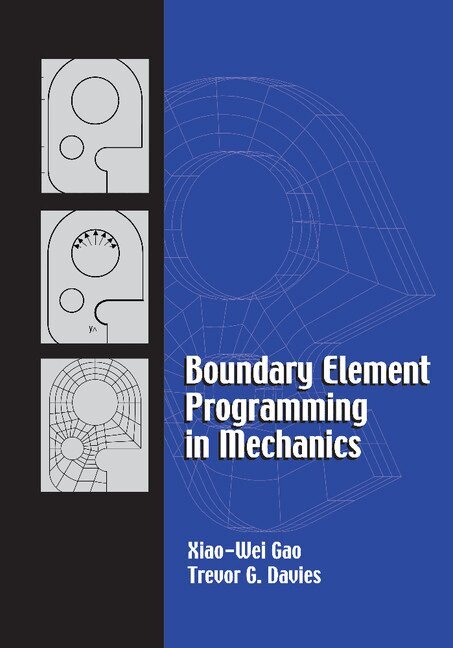
    Boundary Element Programming in Mechanics

    AvXiao-Wei Gao,Trevor G. Davies

    Häftad, Engelska, 2011

    687 kr

    Beställningsvara. Skickas inom 7-10 vardagar. Fri frakt över 249 kr.

    Beskrivning

    Nonlinear stress analysis (a branch of solid mechanics) is an essential feature in the design of such diverse structures as aircraft, bridges, machines, and dams. Computational techniques have become vital tools in dealing with the complex, time-consuming problems associated with nonlinear stress analysis. Although finite element techniques are widely used, boundary element methods (BEM) offer a powerful alternative, especially in tackling problems of three-dimensional plasticity. This 2002 book describes the application of BEM in solid mechanics, beginning with basic theory and then explaining the numerical implementation of BEM in nonlinear stress analysis. The authors have also developed a BEM source code for use by the reader, which is available on the book's companion website. This book will be especially useful to stress analysts in industry, research workers in the field of computational plasticity, and postgraduate students taking courses in engineering mechanics.

    Produktinformation

    • Utgivningsdatum:2011-07-21
    • Mått:178 x 254 x 15 mm
    • Vikt:480 g
    • Format:Häftad
    • Språk:Engelska
    • Antal sidor:272
    • Förlag:Cambridge University Press
    • ISBN:9781107400252

    Utforska kategorier

    • Flyg- och rymdteknik inom Naturvetenskap och teknik
    • Teknik: allmänt inom Naturvetenskap och teknik
    • Byggnadsteknik inom Naturvetenskap och teknik

    Recensioner i media

    Review of the hardback: 'This book will be especially useful to stress analysts in industry, to research workers in computational plasticity, and to postgraduate students taking courses in engineering mechanics.' Zentralblatt für Mathematik und ihre Grenzgebiete Mathematics Abstracts

    Innehållsförteckning

    • Preface; Part I. Linear Problems: 1. Introduction; 2. Theory of elasticity; 3. Boundary integral equations for elasticity; 4. Numerical implementation; 5. The elastic program code; 6. Linear applications; Part II. Non-Linear Problems: 7. Rate-independent plasticity theory; 8. Boundary integral equations in elasto-plasticity; 9. Numerical implementation; 10. The elasto-plastic program code; 11. Non-linear applications; 12. Epilogue; Appendices: A. Derivation of the kernel functions; B. Shape functions; C. Degenerate elements; D. Elasto-plastic flow theory; E. Domain integral formulations; F. Solution of non-linear system equations; G. Elements of elasto-plasticity; H. Description of input data.