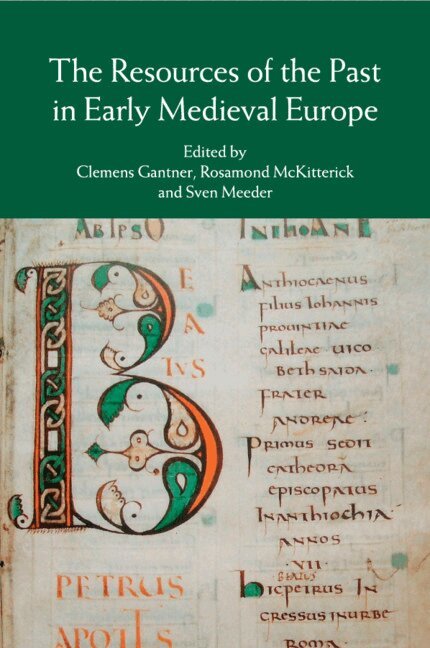
Häftad, Engelska, 2019
The Resources of the Past in Early Medieval Europe
Av Clemens Gantner, Rosamond McKitterick, Sven Meeder
687 kr
Beställningsvara. Skickas inom 5-8 vardagar. Fri frakt över 249 kr.
Beskrivning
Produktinformation
- Utgivningsdatum: 2019-11-28
- Mått: 225 x 150 x 20 mm
- Vikt: 540 g
- Format: Häftad
- Språk: Engelska
- Antal sidor: 372
- Förlag: Cambridge University Press
- ISBN: 9781107463820
Utforska kategorier
Mer om författaren
Clemens Gantner works and teaches at Universität Wien, Austria and the Institute for Medieval Research, Österreichische Akademie der Wissenschaften, Wien. He is a member of the Austrian Institute of Historical Research. He is the author of the forthcoming book on the perception of others in early medieval papal Rome, Freunde Roms und Völker der Finsternis, and co-editor of the acclaimed volume Visions of Community in the Post-Roman World (2012, with Walter Pohl and Richard Payne). His main research area is the history of the papacy in the early Middle Ages, and more generally Italy from 600–1000. He has also published on early medieval apocalyptic texts and on the contacts of the Latin West with Byzantium and the Islamic world. Rosamond McKitterick holds the Chair in Medieval History in the University of Cambridge and is Vice-Master of Sidney Sussex College. Her books include The Carolingians and the Written Word (1989), History and Memory in the Carolingian World (2004), Perceptions of the Past in the Early Middle Ages (2006), Charlemagne: The Formation of a European Identity (2008) and Old Saint Peter's, Rome (edited with J. Osborne, C. Richardson and J. Story, 2013), and she has lectured and given seminars in many universities in Britain, Continental Europe, North America and Australia. She is a Corresponding Fellow of the Medieval Academy of America, the Monumenta Germaniae Historica and the Austrian Academy of Sciences, and in 2010 she was awarded the Dr A. H. Heineken International Prize for History. Her current work within the field of the early medieval history of Europe focuses on a people's (re)construction, knowledge and use of the past, especially the Roman past. Latterly this has also taken her into study of the historical and cultural context and implications of early medieval glossaries. Sven Meeder is Lecturer in Medieval History at Radboud Universiteit Nijmegen. His work focuses on the intellectual history of early medieval Europe, in particular the mechanics of the spread and transmission of texts, books and ideas. He has published on the religious, intellectual and social history of early medieval Ireland as well as the connections between the British Isles and the Continent through the dissemination of Hiberno-Latin texts, notably liturgical texts and works of canon law. Recently, he has been awarded a prestigious NOW research grant for the project 'Networks of Knowledge' into intellectual networks in the Carolingian period.
Recensioner i media
'This coherent collection focuses on the collection, formation, and management of the distant (classical and patristic) and the more recent past through processes of selective transmission, suppression, and rewriting of this heritage in the early Middle Ages. They are an important contribution to our understanding of the importance of biblical and patristic texts and the core significance of the Eusebius-Jerome tradition to create useful cultural memories, but also the malleability of these texts at the hands of authors and compilers.' Patrick J. Geary, Institute for Advanced Study, Princeton
Betyg & recensioner
0 recensioner
Inga recensioner tillgängliga.