• Fri frakt över 249 kr
  • •
  • Snabba leveranser
  • •
  • Billiga böcker
Kundservice

Du är på sajten för privatpersoner.

Företag, bibliotek eller offentlig verksamhet?

Du handlar på classic.bokus.com, där alla dina funktioner finns intakta.
Till classic.bokus.com
Bokus logotyp. Gå till startsidan.
  • Erbjudanden
  • Nyheter
  • Student
  • Topplistor
  • Barn & ungdom
  • Bokus Play
  • E-böcker
  • Pocketböcker
  • Spel & pussel

10% rabatt på allt med kod: NYSTART10 →

Sidfot

Mina sidor

    Hjälp

    • Kundservice
    • Vanliga frågor och svar
    • Frakt och leverans
    • Retur vid ångerrätt
    • Reklamera vara
    • Betalning
    • Köpvillkor
    • Allmänna villkor
    • Information om webbplatsens tillgänglighet

    Om Bokus

    • Om oss
    • Pressrum
    • För studenter
    • För företag
    • För bibliotek och offentlig verksamhet
    • För leverantörer
    • Hållbarhet

    Populärt

    • Aktuella erbjudanden
    • Presentkort
    • Studentlitteratur
    • Nya böcker
    • Topplistor
    • Signerade böcker
    • Engelska böcker

    Inspiration

    • Boktips
    • BookTok
    • Populära bokserier
    • Barnbokskaraktärer
    • Populära författare
    Logotyp för Bokus
    Följ oss på Facebook (extern länk)Följ oss på Instagram (extern länk)Följ oss på YouTube (extern länk)Följ oss på TikTok (extern länk)
    bokus @ CookiesAnpassa cookiesIntegritetspolicyKöpvillkor
    Till Citymail hemsida (extern länk)Till Budbee hemsida (extern länk)Till Postnord hemsida (extern länk)Till Schenker hemsida (extern länk)Till Early Bird hemsida (extern länk)Till Walleys hemsida (extern länk)
    1. Naturvetenskap och teknik
    2. Geovetenskap
    3. Miljövetenskap och miljöpolitik

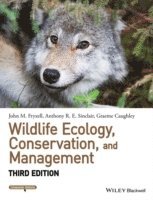
    Wildlife Ecology, Conservation, and Management

    AvJohn M. Fryxell,Anthony R. E. Sinclair

    Häftad, Engelska, 2014

    677 kr

    Beställningsvara. Skickas inom 5-8 vardagar. Fri frakt över 249 kr.

    Fler format och utgåvor

    Inbunden

    1 689 kr

    Beskrivning

    To understand modern principles of sustainable management and the conservation of wildlife species requires intimate knowledge about demography, animal behavior, and ecosystem dynamics. With emphasis on practical application and quantitative skill development, this book weaves together these disparate elements in a single coherent textbook for senior undergraduate and graduate students. It reviews analytical techniques, explaining the mathematical and statistical principles behind them, and shows how these can be used to formulate realistic objectives within an ecological framework. This third edition is comprehensive and up-to-date, and includes: Brand new chapters that disseminate rapidly developing topics in the field: habitat use and selection; habitat fragmentation, movement, and corridors; population viability. analysis, the consequences of climate change; and evolutionary responses to disturbanceA thorough updating of all chapters to present important areas of wildlife research and management with recent developments and examples.A new online study aid – a wide variety of downloadable computer programs in the freeware packages R and Mathcad, available through a companion website. Worked examples enable readers to practice calculations explained in the text and to develop a solid understanding of key statistical procedures and population models commonly used in wildlife ecology and management.The first half of the book provides a solid background in key ecological concepts. The second half uses these concepts to develop a deeper understanding of the principles underlying wildlife management and conservation. Global examples of real-life management situations provide a broad perspective on the international problems of conservation, and detailed case histories demonstrate concepts and quantitative analyses. This third edition is also valuable to professional wildlife managers, park rangers, biological resource managers, and those working in ecotourism.

    Produktinformation

    • Utgivningsdatum:2014-08-08
    • Mått:188 x 246 x 28 mm
    • Vikt:1 089 g
    • Format:Häftad
    • Språk:Engelska
    • Antal sidor:528
    • Upplaga:3
    • Förlag:John Wiley and Sons Ltd
    • ISBN:9781118291078

    Utforska kategorier

    • Miljövetenskap och miljöpolitik inom Naturvetenskap och teknik
    • Biovetenskap inom Naturvetenskap och teknik

    Mer om författaren

    Professor John Fryxell currently teaches in the Department of Integrative Biology at the University of Guelph, Canada, where he has worked closely with a number of university and government scientists to develop sustainable conservation strategies for elk, woodland caribou, wolves, and marten. Previous to this he worked at the University of British Columbia and as Wildlife Consultant for the Provincial Government of Newfoundland and Labrador. His research has focused on the role of behavior in population and community dynamics of large mammals. He has a continuing interest in African wildlife, including long-term studies on the demography and spatial ecology of large herbivores and their predators in Serengeti National Park.  Professor Anthony Sinclair is currently Professor Emeritus at the University of British Columbia, Vancouver, Canada. He has been Director of the Centre for Biodiversity Research at the University, and a Professor at the Department of Zoology. He has researched Canadian subarctic ecosystems and worked on Canadian boreal forest ecosystems, in particular on cycles of snowshoe hares. He worked in the Serengeti National Park, Tanzania, Africa, on ecology and conservation projects for over 40 years. He has conducted ecological research on the Serengeti ecosystem of Tanzania, documenting multiple states in Serengeti savanna and grassland communities. He has also worked on endangered marsupial mammal populations and predation by exotic carnivores in Australia and similar systems in New Zealand.

    Recensioner i media

    “I recommend the book unreservedly to wildlife managers, park rangers, biological resource managers, and those working in ecotourism.”  (Tahrcountry, 10 August 2014)

    Innehållsförteckning

    • Preface xi About the companion website xiii1 Introduction: goals and decisions 11.1 How to use this book 11.2 What is wildlife conservation and management? 21.3 Goals of management 31.4 Hierarchies of decision 61.5 Policy goals 71.6 Feasible options 71.7 Summary 8Part 1 Wildlife ecology 92 Food and nutrition 112.1 Introduction 112.2 Constituents of food 112.3 Variation in food supply 142.4 Measurement of food supply 172.5 Basal metabolic rate and food requirement 202.6 Morphology of herbivore digestion 232.7 Food passage rate and food requirement 262.8 Body size and diet selection 272.9 Indices of body condition 282.10 Summary 333 Home range and habitat use 353.1 Introduction 353.2 Estimating home range size and utilization frequency 363.3 Estimating habitat availability and use 383.4 Selective habitat use 403.5 Using resource selection functions to predict population response 423.6 Sources of variation in habitat use 423.7 Movement within the home range 453.8 Movement among home ranges 483.9 Summary 514 Dispersal, dispersion, and distribution 534.1 Introduction 534.2 Dispersal 534.3 Dispersion 554.4 Distribution 564.5 Distribution, abundance, and range collapse 614.6 Species reintroductions or invasions 624.7 Summary 675 Population growth and regulation 695.1 Introduction 695.2 Rate of increase 695.3 Geometric or exponential population growth 735.4 Stability of populations 735.5 The theory of population limitation and regulation 765.6 Evidence for regulation 815.7 Applications of regulation 855.8 Logistic model of population regulation 865.9 Stability, cycles, and chaos 885.10 Intraspecific competition 905.11 Interactions of food, predators, and disease 935.12 Summary 936 Competition and facilitation between species 956.1 Introduction 956.2 Theoretical aspects of interspecific competition 966.3 Experimental demonstrations of competition 986.4 The concept of the niche 1036.5 The competitive exclusion principle 1066.6 Resource partitioning and habitat selection 1066.7 Competition in variable environments 1136.8 Apparent competition 1136.9 Facilitation 1146.10 Applied aspects of competition 1196.11 Summary 1227 Predation 1237.1 Introduction 1237.2 Predation and management 1237.3 Definitions 1237.4 The effect of predators on prey density 1247.5 The behavior of predators 1257.6 Numerical response of predators to prey density 1297.7 The total response 1307.8 Behavior of the prey 1367.9 Summary 1388 Parasites and pathogens 1398.1 Introduction and definitions 1398.2 Effects of parasites 1398.3 The basic parameters of epidemiology 1408.4 Determinants of spread 1438.5 Endemic pathogens 1448.6 Endemic pathogens: synergistic interactions with food and predators 1448.7 Epizootic diseases 1468.8 Emerging infectious diseases of wildlife 1478.9 Parasites and the regulation of host populations 1508.10 Parasites and host communities 1518.11 Parasites and conservation 1528.12 Parasites and control of pests 1558.13 Summary 1569 Consumer–resource dynamics 1579.1 Introduction 1579.2 Quality and quantity of a resource 1579.3 Kinds of resource 1579.4 Consumer–resource dynamics: general theory 1589.5 Kangaroos and their food plants in semi-arid Australian savannas 1619.6 Wolf–moose–woody plant dynamics in the boreal forest 1679.7 Other population cycles 1729.8 Summary 17510 The ecology of behavior 17710.1 Introduction 17710.2 Diet selection 17710.3 Optimal patch or habitat use 18310.4 Risk-sensitive habitat use 18610.5 Social behavior and foraging 18710.6 Summary 19011 Climate change and wildlife 19111.1 Introduction 19111.2 Evidence for climate change 19111.3 Wildlife responses to climate change 19211.4 Mechanisms of response to climate change 19611.5 Complex ecosystem responses to climate change 19911.6 Summary 201Part 2 Wildlife conservation and management 20312 Counting animals 20512.1 Introduction 20512.2 Total counts 20512.3 Sampled counts: the logic 20712.4 Sampled counts: methods and arithmetic 21212.5 Indirect estimates of population size 22012.6 Indices 22712.7 Harvest-based population estimates 22812.8 Summary 23113 Age and stage structure 23313.1 Introduction 23313.2 Demographic rates 23313.3 Direct estimation of life table parameters 23513.4 Indirect estimation of life table parameters 23613.5 Relationships among parameters 23813.6 Age-specific population models 23913.7 Elasticity of matrix models 24213.8 Stage-specific models 24313.9 Elasticity of the loggerhead turtle model 24513.10 Short-term changes in structured populations 24613.11 Environmental stochasticity and age-structured populations 24613.12 Summary 24914 Experimental management 25114.1 Introduction 25114.2 Differentiating success from failure 25114.3 Technical judgments can be tested 25214.4 The nature of the evidence 25514.5 Experimental and survey design 25714.6 Some standard analyses 26214.7 Summary 27115 Model evaluation and adaptive management 27315.1 Introduction 27315.2 Fitting models to data and estimation of parameters 27415.3 Measuring the likelihood of the observed data 27615.4 Evaluating the likelihood of alternate models using AIC 27815.5 Adaptive management 28115.6 Summary 28416 Population viability analysis 28516.1 Introduction 28516.2 Environmental stochasticity 28516.3 PVA based on the exponential growth model 28616.4 PVA based on the diffusion model 28716.5 PVA based on logistic growth 29016.6 Demographic stochasticity 29116.7 Estimating both environmental and demographic stochasticity 29416.8 PVA based on demographic and environmental stochasticity 29616.9 Strengths and weaknesses of PVA 29616.10 Extinction caused by environmental change 29816.11 Extinction threat due to introduction of exotic predators or competitors 29816.12 Extinction threat due to unsustainable harvesting 30016.13 Extinction threat due to habitat loss 30216.14 Summary 30217 Conservation in practice 30517.1 Introduction 30517.2 How populations go extinct 30517.3 How to prevent extinction 31517.4 Rescue and recovery of near-extinctions 31617.5 Conservation in National Parks and reserves 31717.6 Community conservation outside National Parks and reserves 32217.7 International conservation 32317.8 Summary 32418 Wildlife harvesting 32518.1 Introduction 32518.2 Fixed-quota harvesting strategy 32518.3 Fixed-proportion harvesting strategy 32918.4 Harvesting in practice: dynamic variation in quotas or effort 33218.5 No-harvest reserves 33418.6 Age- or sex-biased harvesting 33518.7 Commercial harvesting 34018.8 Bioeconomics 34018.9 Game cropping and the discount rate 34418.10 Summary 34619 Wildlife control 34719.1 Introduction 34719.2 Definitions 34719.3 Effects of control 34819.4 Objectives of control 34819.5 Determining whether control is appropriate 34919.6 Methods of control 35019.7 Summary 35620 Evolution and conservation genetics 35720.1 Introduction 35720.2 Maintenance of genetic variation 35820.3 Natural selection 35920.4 Natural selection and life history tradeoffs 36120.5 Natural selection due to hunting 36320.6 Natural selection due to fishing 36520.7 Selection due to environmental change 36720.8 Ecological dynamics due to evolutionary changes 37220.9 Heterozygosity 37420.10 Genetic drift and mutation 37520.11 Inbreeding depression 37620.12 How much genetic variation is needed? 37720.13 Effective population size 37820.14 Effect of sex ratio 37920.15 How small is too small? 38020.16 Summary 38021 Habitat loss and metapopulation dynamics 38121.1 Introduction 38121.2 Habitat loss and fragmentation 38121.3 Ecological effects of habitat loss 38421.4 Metapopulation dynamics 38621.5 Territorial metapopulations 38921.6 Mainland–island metapopulations 39021.7 Source–sink metapopulations 39121.8 Metacommunity dynamics of competitors 39221.9 Metacommunity dynamics of predators and prey 39321.10 Corridors 39421.11 Summary 39822 Ecosystem management and conservation 39922.1 Introduction 39922.2 Definitions 40022.3 Gradients of communities 40022.4 Niches 40022.5 Food webs and intertrophic interactions 40022.6 Community features and management consequences 40222.7 Multiple states 40422.8 Regulation of top-down and bottom-up processes 40522.9 Ecosystem consequences of bottom-up processes 40722.10 Ecosystem disturbance and heterogeneity 40822.11 Ecosystem management at multiple scales 41022.12 Biodiversity 41122.13 Island biogeography and dynamic processes of diversity 41322.14 Ecosystem function 41522.15 Summary 417Appendices 419Glossary 423References 435Index 489