• Fri frakt över 249 kr
  • •
  • Snabba leveranser
  • •
  • Billiga böcker
Kundservice

Du är på sajten för privatpersoner.

Företag, bibliotek eller offentlig verksamhet?

Du handlar på classic.bokus.com, där alla dina funktioner finns intakta.
Till classic.bokus.com
Bokus logotyp. Gå till startsidan.
  • Erbjudanden
  • Nyheter
  • Student
  • Topplistor
  • Barn & ungdom
  • Bokus Play
  • E-böcker
  • Pocketböcker
  • Spel & pussel

10% rabatt på allt med kod: NYSTART10 →

Sidfot

Mina sidor

    Hjälp

    • Kundservice
    • Vanliga frågor och svar
    • Frakt och leverans
    • Retur vid ångerrätt
    • Reklamera vara
    • Betalning
    • Köpvillkor
    • Allmänna villkor
    • Information om webbplatsens tillgänglighet

    Om Bokus

    • Om oss
    • Pressrum
    • För studenter
    • För företag
    • För bibliotek och offentlig verksamhet
    • För leverantörer
    • Hållbarhet

    Populärt

    • Aktuella erbjudanden
    • Presentkort
    • Studentlitteratur
    • Nya böcker
    • Topplistor
    • Signerade böcker
    • Engelska böcker

    Inspiration

    • Boktips
    • BookTok
    • Populära bokserier
    • Barnbokskaraktärer
    • Populära författare
    Logotyp för Bokus
    Följ oss på Facebook (extern länk)Följ oss på Instagram (extern länk)Följ oss på YouTube (extern länk)Följ oss på TikTok (extern länk)
    bokus @ CookiesAnpassa cookiesIntegritetspolicyKöpvillkor
    Till Citymail hemsida (extern länk)Till Budbee hemsida (extern länk)Till Postnord hemsida (extern länk)Till Schenker hemsida (extern länk)Till Early Bird hemsida (extern länk)Till Walleys hemsida (extern länk)
    1. Psykologi och pedagogik
    2. Psykologi
    3. Psykologisk metod

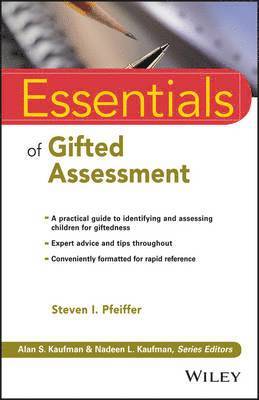
    Essentials of Gifted Assessment

    AvSteven I. Pfeiffer,Alan S. Kaufman

    Häftad, Engelska, 2015

    Del i serien Essentials of Psychological Assessment

    340 kr

    Tillfälligt slut

    Fler format och utgåvor

    E-bok

    674 kr

    E-bok

    674 kr

    Beskrivning

    An Up-to-Date Overview of the Theory and Practice Underlying Gifted Assessment Essentials of Gifted Assessment introduces readers to the theory and practice underlying gifted assessment. Steven Pfeiffer, a leading expert in the field of gifted assessment, discusses what it means to be gifted, why we should identify gifted students, and the purposes of gifted assessment.Well-organized and engaging, the book examines key principles of gifted assessment and provides an up-to-date overview of gifted assessment measures. Topics include the use of local norms, measuring creativity and motivation, nonverbal measures, the importance of recurring gifted assessment, multi-potentiality, gifted testing and minority group students, and evaluating the twice-exceptional student. Early identification and intervention greatly benefits gifted students, who may otherwise never realize their full potential. Throughout the book, Pfeiffer equips school psychologists with the tools they need to: Identify and assess uniquely bright and talented studentsIntegrate multiple assessment measures including intelligence, cognitive ability, and achievement testsAssess gifted students with coexisting disabilities and disordersPromote the abilities of gifted students using evidence-based strategiesThe book also includes extensive illustrative material, such as callout boxes and case examples, that facilitate use as a quick reference, plus end-of-chapter "Test Yourself" questions that help reinforce key concepts. Essentials of Gifted Assessment helps new and seasoned school psychologists and other professionals acquire the skills and knowledge needed for ethical, evidence-based, and informed clinical practice with high-ability students.

    Produktinformation

    • Utgivningsdatum:2015-05-29
    • Mått:140 x 213 x 15 mm
    • Vikt:204 g
    • Format:Häftad
    • Språk:Engelska
    • Serie:Essentials of Psychological Assessment
    • Antal sidor:192
    • Förlag:John Wiley & Sons Inc
    • ISBN:9781118589205

    Utforska kategorier

    • Psykologisk metod inom Psykologi och pedagogik

    Mer om författaren

    STEVEN I. PFEIFFER, PHD, is a licensed psychologist and Professor and Director of Clinical Training in the combined School Psychology and Counseling Psychology program at Florida State University. An authority on the psychology of giftedness, he is the lead author of the Gifted Rating Scales, a widely used measure to help identify gifted students published by Pearson Assessment. Previously, Dr. Pfeiffer served as Executive Director of Duke University's acclaimed precollegiate gifted program.

    Innehållsförteckning

    • Series Preface xiAcknowledgments xiiiOne Introduction to Gifted Assessment 1Who Are the Gifted? 1Brief History of Gifted Education 3Giftedness as a Social Construction 6Tripartite Model 7Should We Identify Gifted Students? 13Purposes of Gifted Assessment 14Two Conceptions of Giftedness Guide Gifted Assessment 17Traditional Psychometric View 19Talent Development Models 21Differentiated Model of Giftedness and Talent 22Subotnik’s Developmental Transitions in Giftedness and Talent 23Stanley’s Talent Search Model 27Renzulli’s Three-Ring Conception of Giftedness 29Expert Performance Perspective 30Multiple Intelligences Model 32Theory of Successful Intelligence: WICS 33Synthesis of Divergent Views of Giftedness 35Conclusion 40Three Gifted Assessment: Guiding Principles and Fundamental Beliefs 44Fundamental Beliefs of Gifted Assessment 44Key Principles in Gifted Assessment 48How We Define Gifted Is Important 48Assessment Should Consider Types of Available Gifted Programs 49Psychometrics Count 51People, Not Test Scores, Should Make Diagnostic Decisions 52Multiple Measures Are an Advantage 53Local Norms and Recurring Assessment Are Advantages 53Beliefs and Principles Conclusion 57Decision-Making or Selection Models 58Four Measuring Intellectual and Academic Ability 63Why and When to Use Tests of Cognitive and Academic Ability 64Where Does Abstract Reasoning Fit In? 65What Tests of Cognitive Ability Measure 67General and Specific Abilities 68Hierarchical Models: Cattell-Horn-Carroll 68Abstract Reasoning 70General Intelligence (g) 71Clinical Insights 73General Ability Index 73Clinical Considerations and Adaptations for High-Ability Students 75Tests with High Ceilings 75Testing the Limits 76Extended Norms 77Levels of Intellectual Giftedness 78Some Popular IQ Tests Used in Gifted Assessment 79Wechsler Intelligence Scale for Children—Fifth Edition 80Wechsler Preschool and Primary Scale of Intelligence—Fourth Edition 81Stanford-Binet Intelligence Scales, Fifth Edition 82Woodcock-Johnson IV Tests of Cognitive Abilities 83Differential Ability Scales, Second Edition 84Kaufman Assessment Battery for Children, Second Edition 85Cognitive Assessment System, Second Edition 86Reynolds Intellectual Assessment Scales 87A Few Illustrative Academic Measures 88Conclusion and Recommendations 88Five Identifying and Assessing Creativity 92Defining Creativity 92Measuring Creativity 97Divergent Thinking: Torrance Tests of Creative Thinking 97Divergent Thinking: Profile of Creative Abilities 100Self-Report: Abedi Test of Creativity 101Teacher Checklist: Gifted RatingScales—Creativity Scale 102Consensual Assessment Technique 104Creativity, Intelligence, and Talent Development 106Unanswered Questions 108Six Alternative Gifted Assessment Methods 110Teacher and Parent Nominations 110Portfolio Assessment 111Nonverbal Measures 115Teacher Ratings 115The GRS as a Measure of Change 124Assessing Readiness for Grade Acceleration 124Types of Acceleration 124Iowa Acceleration Scale 126Seven Frequently Asked Questions About Gifted Assessment 129Six Questions 1291. Should Nonverbal Tests Be Used as Part of Gifted Assessment, and If So, When? 1302. How Should We Approach the Assessment and Identification of Typically Underrepresented Gifted Populations? 1313. What Constitutes a Complete Gifted Assessment Test Battery? 1344. Should Social Competence, Passion for Learning, Motivation, and Emotional Intelligence Be Included in Gifted Assessment? 1355. Should We Be Concerned About Multipotentiality When Testing High-Ability Students? 1376. Are There Any Recommendations for Assessment of the Twice-Exceptional Learner? 138Concluding Comments 140References 143About the Author 163Index 165