• Fri frakt över 249 kr
  • •
  • Snabba leveranser
  • •
  • Billiga böcker
Kundservice

Du är på sajten för privatpersoner.

Företag, bibliotek eller offentlig verksamhet?

Du handlar på classic.bokus.com, där alla dina funktioner finns intakta.
Till classic.bokus.com
Bokus logotyp. Gå till startsidan.
  • Erbjudanden
  • Nyheter
  • Student
  • Topplistor
  • Barn & ungdom
  • Bokus Play
  • E-böcker
  • Pocketböcker
  • Spel & pussel

10% rabatt på allt med kod: NYSTART10 →

Sidfot

Mina sidor

    Hjälp

    • Kundservice
    • Vanliga frågor och svar
    • Frakt och leverans
    • Retur vid ångerrätt
    • Reklamera vara
    • Betalning
    • Köpvillkor
    • Allmänna villkor
    • Information om webbplatsens tillgänglighet

    Om Bokus

    • Om oss
    • Pressrum
    • För studenter
    • För företag
    • För bibliotek och offentlig verksamhet
    • För leverantörer
    • Hållbarhet

    Populärt

    • Aktuella erbjudanden
    • Presentkort
    • Studentlitteratur
    • Nya böcker
    • Topplistor
    • Signerade böcker
    • Engelska böcker

    Inspiration

    • Boktips
    • BookTok
    • Populära bokserier
    • Barnbokskaraktärer
    • Populära författare
    Logotyp för Bokus
    Följ oss på Facebook (extern länk)Följ oss på Instagram (extern länk)Följ oss på YouTube (extern länk)Följ oss på TikTok (extern länk)
    bokus @ CookiesAnpassa cookiesIntegritetspolicyKöpvillkor
    Till Citymail hemsida (extern länk)Till Budbee hemsida (extern länk)Till Postnord hemsida (extern länk)Till Schenker hemsida (extern länk)Till Early Bird hemsida (extern länk)Till Walleys hemsida (extern länk)
    1. Ekonomi och Ledarskap
    2. Nationalekonomi

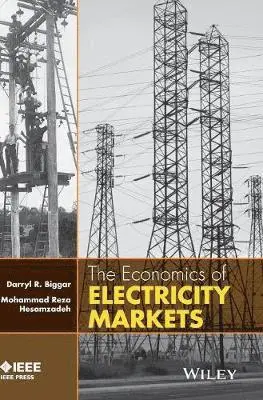
    Economics of Electricity Markets

    AvDarryl R. Biggar,Mohammad Reza Hesamzadeh

    Inbunden, Engelska, 2014

    Del i serien IEEE Press

    1 323 kr

    Beställningsvara. Skickas inom 5-8 vardagar. Fri frakt över 249 kr.

    Beskrivning

    Bridges the knowledge gap between engineering and economics in a complex and evolving deregulated electricity industry, enabling readers to understand, operate, plan and design a modern power system With an accessible and progressive style written in straight-forward language, this book covers everything an engineer or economist needs to know to understand, operate within, plan and design an effective liberalized electricity industry, thus serving as both a useful teaching text and a valuable reference. The book focuses on principles and theory which are independent of any one market design. It outlines where the theory is not implemented in practice, perhaps due to other over-riding concerns. The book covers the basic modelling of electricity markets, including the impact of uncertainty (an integral part of generation investment decisions and transmission cost-benefit analysis). It draws out the parallels to the Nordpool market (an important point of reference for Europe). Written from the perspective of the policy-maker, the first part provides the introductory background knowledge required. This includes an understanding of basic economics concepts such as supply and demand, monopoly, market power and marginal cost. The second part of the book asks how a set of generation, load, and transmission resources should be efficiently operated, and the third part focuses on the generation investment decision. Part 4 addresses the question of the management of risk and Part 5 discusses the question of market power. Any power system must be operated at all times in a manner which can accommodate the next potential contingency. This demands responses by generators and loads on a very short timeframe. Part 6 of the book addresses the question of dispatch in the very short run, introducing the distinction between preventive and corrective actions and why preventive actions are sometimes required. The seventh part deals with pricing issues that arise under a regionally-priced market, such as the Australian NEM. This section introduces the notion of regions and interconnectors and how to formulate constraints for the correct pricing outcomes (the issue of "constraint orientation"). Part 8 addresses the fundamental and difficult issue of efficient transmission investment, and finally Part 9 covers issues that arise in the retail market. Bridges the gap between engineering and economics in electricity, covering both the economics and engineering knowledge needed to accurately understand, plan and develop the electricity marketComprehensive coverage of all the key topics in the economics of electricity marketsCovers the latest research and policy issues as well as description of the fundamental concepts and principles that can be applied across all markets globallyNumerous worked examples and end-of-chapter problemsCompanion website holding solutions to problems set out in the book, also the relevant simulation (GAMS) codes

    Produktinformation

    • Utgivningsdatum:2014-09-05
    • Mått:176 x 257 x 27 mm
    • Vikt:806 g
    • Format:Inbunden
    • Språk:Engelska
    • Serie:IEEE Press
    • Antal sidor:432
    • Förlag:John Wiley & Sons Inc
    • ISBN:9781118775752

    Utforska kategorier

    • Nationalekonomi inom Ekonomi och Ledarskap
    • Energiindustri inom Ekonomi och Ledarskap

    Mer om författaren

    Dr Biggar is Australia’s leading expert on the economics of wholesale electricity markets and the economics of public utility regulation. Since 2002 he has provided economic advice primarily to the Australian Energy Regulator and the Australian Competition and Consumer Commission. He has also provided advice to other government agencies including the Australian Energy Markets Operator, the Australian Energy Markets Commission, and the New Zealand Electricity Authority. He has published a number of papers in academic journals in the economics of electricity markets and the economics of public utility regulation and regularly provides training courses in these areas to government agencies and industry. He has a particular interest in the assessment of market power in wholesale electricity markets and in matters related to wholesale market design.Dr Hesamzadeh is assistant professor in electric power systems division of the school of electrical engineering at KTH Royal Institute of Technology in Stockholm, Sweden. Dr Hesamzadeh is a world leader in the modelling of market power in wholesale electricity markets, particularly in the context of transmission planning. His special fields of interests include Power Systems Planning and Design, Economics of Wholesale Electricity Markets, and Mathematical Modelling and Computing. Hesamzadeh is currently working towards his Docent degree in Electricity Markets at KTH.

    Innehållsförteckning

    • Preface xvNomenclature xviiPART I INTRODUCTION TO ECONOMIC CONCEPTS 11 Introduction to Micro-economics 31.1 Economic Objectives 31.2 Introduction to Constrained Optimisation 51.3 Demand and Consumers’ Surplus 61.3.1 The Short-Run Decision of the Customer 71.3.2 The Value or Utility Function 71.3.3 The Demand Curve for a Price-Taking Customer Facing a Simple Price 71.4 Supply and Producers’ Surplus 101.4.1 The Cost Function 111.4.2 The Supply Curve for a Price-Taking Firm Facing a Simple Price 111.5 Achieving Optimal Short-Run Outcomes Using Competitive Markets 141.5.1 The Short-Run Welfare Maximum 141.5.2 An Autonomous Market Process 151.6 Smart Markets 171.6.1 Smart Markets and Generic Constraints 171.6.2 A Smart Market Process 181.7 Longer-Run Decisions by Producers and Consumers 201.7.1 Investment in Productive Capacity 201.8 Monopoly 221.8.1 The Dominant Firm – Competitive Fringe Structure 241.8.2 Monopoly and Price Regulation 251.9 Oligopoly 261.9.1 Cournot Oligopoly 271.9.2 Repeated Games 271.10 Summary 28Questions 29Further Reading 30PART II INTRODUCTION TO ELECTRICITY NETWORKS AND ELECTRICITY MARKETS 312 Introduction to Electric Power Systems 332.1 DC Circuit Concepts 332.1.1 Energy, Watts and Power 342.1.2 Losses 352.2 AC Circuit Concepts 362.3 Reactive Power 382.3.1 Mathematics of Reactive Power 402.3.2 Control of Reactive Power 422.3.3 Ohm’s Law on AC Circuits 432.3.4 Three-Phase Power 442.4 The Elements of an Electric Power System 452.5 Electricity Generation 462.5.1 The Key Characteristics of Electricity Generators 492.6 Electricity Transmission and Distribution Networks 522.6.1 Transmission Networks 542.6.2 Distribution Networks 572.6.3 Competition and Regulation 592.7 Physical Limits on Networks 602.7.1 Thermal Limits 612.7.2 Voltage Stability Limits 642.7.3 Dynamic and Transient Stability Limits 642.8 Electricity Consumption 662.9 Does it Make Sense to Distinguish Electricity Producers and Consumers? 672.9.1 The Service Provided by the Electric Power Industry 692.10 Summary 70Questions 71Further Reading 723 Electricity Industry Market Structure and Competition 733.1 Tasks Performed in an Efficient Electricity Industry 733.1.1 Short-Term Tasks 733.1.2 Risk-Management Tasks 753.1.3 Long-Term Tasks 753.2 Electricity Industry Reforms 763.2.1 Market-Orientated Reforms of the Late Twentieth Century 773.3 Approaches to Reform of the Electricity Industry 793.4 Other Key Roles in a Market-Orientated Electric Power System 813.5 An Overview of Liberalised Electricity Markets 823.6 An Overview of the Australian National Electricity Market 853.6.1 Assessment of the NEM 873.7 The Pros and Cons of Electricity Market Reform 883.8 Summary 89Questions 90Further Reading 90PART III OPTIMAL DISPATCH: THE EFFICIENT USE OF GENERATION, CONSUMPTION AND NETWORK RESOURCES 914 Efficient Short-Term Operation of an Electricity Industry with no Network Constraints 934.1 The Cost of Generation 934.2 Simple Stylised Representation of a Generator 964.3 Optimal Dispatch of Generation with Inelastic Demand 974.3.1 Optimal Least Cost Dispatch of Generation Resources 984.3.2 Least Cost Dispatch for Generators with Constant Variable Cost 994.3.3 Example 1014.4 Optimal Dispatch of Both Generation and Load Assets 1024.5 Symmetry in the Treatment of Generation and Load 1044.5.1 Symmetry Between Buyer-Owned Generators and Stand-Alone Generators 1044.5.2 Symmetry Between Total Surplus Maximisation and Generation Cost Minimisation 1054.6 The Benefit Function 1054.7 Nonconvexities in Production: Minimum Operating Levels 1064.8 Efficient Dispatch of Energy-Limited Resources 1084.8.1 Example 1094.9 Efficient Dispatch in the Presence of Ramp-Rate Constraints 1104.9.1 Example 1114.10 Startup Costs and the Unit-Commitment Decision 1134.11 Summary 115Questions 116Further Reading 1175 Achieving Efficient Use of Generation and Load Resources using a Market Mechanism in an Industry with no Network Constraints 1195.1 Decentralisation, Competition and Market Mechanisms 1195.2 Achieving Optimal Dispatch Through Competitive Bidding 1215.3 Variation in Wholesale Market Design 1235.3.1 Compulsory Gross Pool or Net Pool? 1245.3.2 Single Price or Pay-as-Bid? 1255.4 Day-Ahead Versus Real-Time Markets 1265.4.1 Improving the Quality of Short-Term Price Forecasts 1275.4.2 Reducing the Exercise of Market Power 1295.5 Price Controls and Rationing 1295.5.1 Inadequate Metering and Involuntary Load Shedding 1315.6 Time-Varying Demand, the Load-Duration Curve and the Price-Duration Curve 1335.7 Summary 135Questions 137Further Reading 1376 Representing Network Constraints 1396.1 Representing Networks Mathematically 1396.2 Net Injections, Power Flows and the DC Load Flow Model 1416.2.1 The DC Load Flow Model 1446.3 The Matrix of Power Transfer Distribution Factors 1456.3.1 Converting between Reference Nodes 1466.4 Distribution Factors for Radial Networks 1466.5 Constraint Equations and the Set of Feasible Injections 1476.6 Summary 151Questions 1527 Efficient Dispatch of Generation and Consumption Resources in the Presence of Network Congestion 1537.1 Optimal Dispatch with Network Constraints 1537.1.1 Achieving Optimal Dispatch Using a Smart Market 1557.2 Optimal Dispatch in a Radial Network 1567.3 Optimal Dispatch in a Two-Node Network 1577.4 Optimal Dispatch in a Three-Node Meshed Network 1597.5 Optimal Dispatch in a Four-Node Network 1617.6 Properties of Nodal Prices with a Single Binding Constraint 1627.7 How Many Independent Nodal Prices Exist? 1637.8 The Merchandising Surplus, Settlement Residues and the Congestion Rents 1637.8.1 Merchandising Surplus and Congestion Rents 1637.8.2 Settlement Residues 1647.8.3 Merchandising Surplus in a Three-Node Network 1657.9 Network Losses 1667.9.1 Losses, Settlement Residues and Merchandising Surplus 1677.9.2 Losses and Optimal Dispatch 1687.10 Summary 169Questions 170Further Reading 1708 Efficient Network Operation 1718.1 Efficient Operation of DC Interconnectors 1718.1.1 Entrepreneurial DC Network Operation 1738.2 Optimal Network Switching 1738.2.1 Network Switching and Network Contingencies 1748.2.2 A Worked Example 1748.2.3 Entrepreneurial Network Switching? 1768.3 Summary 177Questions 178Further Reading 178PART IV EFFICIENT INVESTMENT IN GENERATION AND CONSUMPTION ASSETS 1799 Efficient Investment in Generation and Consumption Assets 1819.1 The Optimal Generation Investment Problem 1819.2 The Optimal Level of Generation Capacity with Downward Sloping Demand 1839.2.1 The Case of Inelastic Demand 1859.3 The Optimal Mix of Generation Capacity with Downward Sloping Demand 1869.4 The Optimal Mix of Generation with Inelastic Demand 1899.5 Screening Curve Analysis 1919.5.1 Using Screening Curves to Assess the Impact of Increased Renewable Penetration 1929.5.2 Generation Investment in the Presence of Network Constraints 1939.6 Buyer-Side Investment 1939.7 Summary 195Questions 196Further Reading 19710 Market-Based Investment in Electricity Generation 19910.1 Decentralised Generation Investment Decisions 19910.2 Can We Trust Competitive Markets to Deliver an Efficient Level of Investment in Generation? 20110.2.1 Episodes of High Prices as an Essential Part of an Energy-Only Market 20110.2.2 The ‘Missing Money’ Problem 20210.2.3 Energy-Only Markets and the Investment Boom–Bust Cycle 20310.3 Price Caps, Reserve Margins and Capacity Payments 20310.3.1 Reserve Requirements 20410.3.2 Capacity Markets 20510.4 Time-Averaging of Network Charges and Generation Investment 20610.5 Summary 207Questions 207PART V HANDLING CONTINGENCIES: EFFICIENT DISPATCH IN THE VERY SHORT RUN 20911 Efficient Operation of the Power System in the Very Short-Run 21111.1 Introduction to Contingencies 21111.2 Efficient Handling of Contingencies 21211.3 Preventive and Corrective Actions 21311.4 Satisfactory and Secure Operating States 21511.5 Optimal Dispatch in the Very Short Run 21611.6 Operating the Power System Ex Ante as though Certain Contingencies have Already Happened 21811.7 Examples of Optimal Short-Run Dispatch 21911.7.1 A Second Example, Ignoring Network Constraints 22111.7.2 A Further Example with Network Constraints 22211.8 Optimal Short-Run Dispatch Using a Competitive Market 22311.8.1 A Simple Example 22411.8.2 Optimal Short-Run Dispatch through Prices 22711.8.3 Investment Incentives 22811.9 Summary 229Questions 230Further Reading 23012 Frequency-Based Dispatch of Balancing Services 23112.1 The Intradispatch Interval Dispatch Mechanism 23112.2 Frequency-Based Dispatch of Balancing Services 23212.3 Implications of Ignoring Network Constraints when Handling Contingencies 23312.3.1 The Feasible Set of Injections with a Frequency-Based IDIDM 23512.4 Procurement of Frequency-Based Balancing Services 23812.4.1 The Volume of Frequency Control Balancing Services Required 23812.4.2 Procurement of Balancing Services 23912.4.3 Allocating the Costs of Balancing Services 24012.5 Summary 241Questions 242Further Reading 242PART VI MANAGING RISK 24313 Managing Intertemporal Price Risks 24513.1 Introduction to Forward Markets and Standard Hedge Contracts 24513.1.1 Instruments for Managing Risk: Swaps, Caps, Collars and Floors 24613.1.2 Swaps 24613.1.3 Caps 24713.1.4 Floors 24813.1.5 Collars (and Related Instruments) 24913.2 The Construction of a Perfect Hedge: The Theory 24913.2.1 The Design of a Perfect Hedge 25013.3 The Construction of a Perfect Hedge: Specific Cases 25213.3.1 Hedging by a Generator with no Cost Uncertainty 25213.3.2 Hedging Cost-Shifting Risks 25413.4 Hedging by Customers 25613.4.1 Hedging by a Customer with a Constant Utility Function 25713.4.2 Hedging Utility-Shifting Risks 25813.5 The Role of the Trader 25913.5.1 Risks Facing Individual Traders 26113.6 Intertemporal Hedging and Generation Investment 26313.7 Summary 264Questions 26514 Managing Interlocational Price Risk 26714.1 The Role of the Merchandising Surplus in Facilitating Interlocational Hedging 26714.1.1 Packaging the Merchandising Surplus in a Way that Facilitates Hedging 26914.2 Interlocational Transmission Rights: CapFTRs 26914.3 Interlocational Transmission Rights: Fixed-Volume FTRs 27114.3.1 Revenue Adequacy 27114.3.2 Are Fixed-Volume FTRs a Useful Hedging Instrument? 27314.4 Interlocational Hedging and Transmission Investment 27314.4.1 Infinitesimal Investment in Network Capacity 27414.4.2 Lumpy Investment in Network Capacity 27414.5 Summary 276Questions 277Further Reading 277PART VII MARKET POWER 27915 Market Power in Electricity Markets 28115.1 An Introduction to Market Power in Electricity Markets 28115.1.1 Definition of Market Power 28115.1.2 Market Power in Electricity Markets 28215.2 How Do Generators Exercise Market Power? Theory 28415.2.1 The Price–Volume Trade-Off 28415.2.2 The Profit-Maximising Choice of Rate of Production for a Generator with Market Power 28615.2.3 The Profit-Maximising Offer Curve 28715.3 How do Generators Exercise Market Power? Practice 28915.3.1 Economic and Physical Withholding 28915.3.2 Pricing Up and the Marginal Generator 29115.4 The Incentive to Exercise Market Power: The Importance of the Residual Demand Curve 29215.4.1 The Shape of the Residual Demand Curve 29315.4.2 The Importance of Peak Versus Off-Peak for the Exercise of Market Power 29315.4.3 Other Influences on the Shape of the Residual Demand Curve 29515.5 The Incentive to Exercise Market Power: The Impact of the Hedge Position of a Generator 29515.5.1 Short-Term Versus Long-Term Hedge Products and the Exercise of Market Power 29715.5.2 Hedge Contracts and Market Power 29715.6 The Exercise of Market Power by Loads and Vertical Integration 29815.6.1 Vertical Integration 29915.7 Is the Exercise of Market Power Necessary to Stimulate Generation Investment? 30015.8 The Consequences of the Exercise of Market Power 30115.8.1 Short-Run Efficiency Impacts of Market Power 30115.8.2 Longer-Run Efficiency Impacts of Market Power 30215.8.3 A Worked Example 30215.9 Summary 304Questions 306Further Reading 30616 Market Power and Network Congestion 30716.1 The Exercise of Market Power by a Single Generator in a Radial Network 30716.1.1 The Exercise of Market Power by a Single Generator in a Radial Network: The Theory 30816.2 The Exercise of Market Power by a Single Generator in a Meshed Network 31116.3 The Exercise of Market Power by a Portfolio of Generators 31316.4 The Effect of Transmission Rights on Market Power 31416.5 Summary 315Questions 315Further Reading 31517 Detecting, Modelling and Mitigating Market Power 31717.1 Approaches to Assessing Market Power 31717.2 Detecting the Exercise of Market Power Through the Examination of Market Outcomes in the Past 31817.2.1 Quantity-Withdrawal Studies 31917.2.2 Price–Cost Margin Studies 32117.3 Simple Indicators of Market Power 32217.3.1 Market-Share-Based Measures and the HHI 32217.3.2 The PSI and RSI Indicators 32417.3.3 Variants of the PSI and RSI Indicators 32617.3.4 Measuring the Elasticity of Residual Demand 32817.4 Modelling of Market Power 33017.4.1 Modelling of Market Power in Practice 33117.4.2 Linearisation 33217.5 Policies to Reduce Market Power 33217.6 Summary 333Questions 334Further Reading 334PART VIII NETWORK REGULATION AND INVESTMENT 33518 Efficient Investment in Network Assets 33718.1 Efficient AC Network Investment 33718.2 Financial Implications of Network Investment 33818.2.1 The Two-Node Graphical Representation 33918.2.2 Financial Indicators of the Benefit of Network Expansion 34118.3 Efficient Investment in a Radial Network 34218.4 Efficient Investment in a Two-Node Network 34418.4.1 Example 34518.5 Coordination of Generation and Network Investment in Practice 34818.6 Summary 350Questions 351Further Reading 351PART IX CONTEMPORARY ISSUES 35319 Regional Pricing and Its Problems 35519.1 An Introduction to Regional Pricing 35519.2 Regional Pricing Without Constrained-on and Constrained-off Payments 35719.2.1 Short-Run Effects of Regional Pricing in a Simple Network 36019.2.2 Effects of Regional Pricing on the Balance Sheet of the System Operator 36119.2.3 Long-Run Effects of Regional Pricing on Investment 36319.3 Regional Pricing with Constrained-on and Constrained-off Payments 36419.4 Nodal Pricing for Generators/Regional Pricing for Consumers 36719.4.1 Side Deals and Net Metering 36719.5 Summary 369Questions 370Further Reading 37020 The Smart Grid and Efficient Pricing of Distribution Networks 37120.1 Efficient Pricing of Distribution Networks 37120.1.1 The Smart Grid and Distribution Pricing 37320.2 Decentralisation of the Dispatch Task 37420.2.1 Decentralisation in Theory 37420.3 Retail Tariff Structures and the Incentive to Misrepresent Local Production and Consumption 37720.3.1 Incentives for Net Metering and the Effective Price 37820.4 Incentives for Investment in Controllable Embedded Generation 38020.4.1 Incentives for Investment in Intermittent Solar PV Embedded Generation 38420.4.2 Retail Tariff Structures and the Death Spiral 38520.4.3 An Illustration of the Death Spiral 38620.5 Retail Tariff Structures 38820.5.1 Retail Tariff Debates 38920.6 Declining Demand for Network Services and Increasing Returns to Scale 39020.7 Summary 393Questions 395References 397Index 399