• Fri frakt över 249 kr
  • •
  • Snabba leveranser
  • •
  • Billiga böcker
Kundservice

Du är på sajten för privatpersoner.

Företag, bibliotek eller offentlig verksamhet?

Du handlar på classic.bokus.com, där alla dina funktioner finns intakta.
Till classic.bokus.com
Bokus logotyp. Gå till startsidan.
  • Erbjudanden
  • Nyheter
  • Student
  • Topplistor
  • Barn & ungdom
  • Bokus Play
  • E-böcker
  • Pocketböcker
  • Spel & pussel

10% rabatt på allt med kod: NYSTART10 →

Sidfot

Mina sidor

    Hjälp

    • Kundservice
    • Vanliga frågor och svar
    • Frakt och leverans
    • Retur vid ångerrätt
    • Reklamera vara
    • Betalning
    • Köpvillkor
    • Allmänna villkor
    • Information om webbplatsens tillgänglighet

    Om Bokus

    • Om oss
    • Pressrum
    • För studenter
    • För företag
    • För bibliotek och offentlig verksamhet
    • För leverantörer
    • Hållbarhet

    Populärt

    • Aktuella erbjudanden
    • Presentkort
    • Studentlitteratur
    • Nya böcker
    • Topplistor
    • Signerade böcker
    • Engelska böcker

    Inspiration

    • Boktips
    • BookTok
    • Populära bokserier
    • Barnbokskaraktärer
    • Populära författare
    Logotyp för Bokus
    Följ oss på Facebook (extern länk)Följ oss på Instagram (extern länk)Följ oss på YouTube (extern länk)Följ oss på TikTok (extern länk)
    bokus @ CookiesAnpassa cookiesIntegritetspolicyKöpvillkor
    Till Citymail hemsida (extern länk)Till Budbee hemsida (extern länk)Till Postnord hemsida (extern länk)Till Schenker hemsida (extern länk)Till Early Bird hemsida (extern länk)Till Walleys hemsida (extern länk)
    1. Naturvetenskap och teknik
    2. Teknik och industri
    3. Tillverkningsteknik

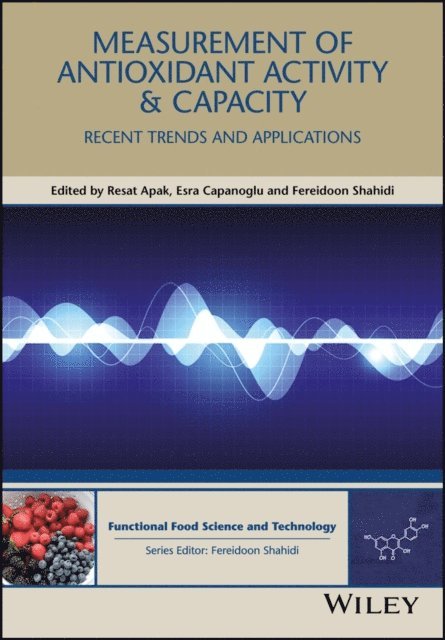
    Measurement of Antioxidant Activity and Capacity

    Recent Trends and Applications

    AvResat Apak,Esra Capanoglu

    Inbunden, Engelska, 2018

    Del i serien Hui: Food Science and Technology

    2 381 kr

    Beställningsvara. Skickas inom 11-20 vardagar. Fri frakt över 249 kr.

    Beskrivning

    A comprehensive reference for assessing the antioxidant potential of foods and essential techniques for developing healthy food productsMeasurement of Antioxidant Activity and Capacity offers a much-needed resource for assessing the antioxidant potential of food and includes proven approaches for creating healthy food products. With contributions from world-class experts in the field, the text presents the general mechanisms underlying the various assessments, the types of molecules detected, and the key advantages and disadvantages of each method. Both thermodynamic (i.e. efficiency of scavenging reactive species) and kinetic (i.e. rates of hydrogen atom or electron transfer reactions) aspects of available methods are discussed in detail. A thorough description of all available methods provides a basis and rationale for developing standardized antioxidant capacity/activity methods for food and nutraceutical sciences and industries. This text also contains data on new antioxidant measurement techniques including nanotechnological methods in spectroscopy and electrochemistry, as well as on innovative assays combining several principles. Therefore, the comparison of conventional methods versus novel approaches is made possible. This important resource: Offers suggestions for assessing the antioxidant potential of foods and their componentsIncludes strategies for the development of healthy functional food productsContains information for identifying antioxidant activity in the bodyPresents the pros and cons of the available antioxidant determination methods, and helps in the selection of the most appropriate methodWritten for researchers and professionals in the nutraceutical and functional food industries,academia and government laboratories, this text includes the most current knowledge in order to form a common language between research groups and to contribute to the solution of critical problems existing for all researchers working in this field.

    Produktinformation

    • Utgivningsdatum:2018-02-16
    • Mått:178 x 246 x 25 mm
    • Vikt:848 g
    • Format:Inbunden
    • Språk:Engelska
    • Serie:Hui: Food Science and Technology
    • Antal sidor:352
    • Förlag:John Wiley & Sons Inc
    • ISBN:9781119135357

    Utforska kategorier

    • Tillverkningsteknik inom Naturvetenskap och teknik

    Mer om författaren

    About the editorsResat Apak is Professor of Analytical Chemistry Division, Department of Chemistry, Faculty of Engineering, Istanbul University, Turkey. Esra Capanoglu is Associate Professor at the Food Engineering Department, Faculty of Chemical and Metallurgical Engineering, Istanbul Technical University, Turkey. Fereidoon Shahidi is a University Research Professor at the Department of Biochemistry, Memorial University of Newfoundland, St. John's, Canada.

    Innehållsförteckning

    • List of contributors xi1 Nomenclature and general classification of antioxidant activity/capacity assays 1Yong Sun, Cheng Yang, and Rong Tsao1.1 Introduction 11.2 Nomenclature of antioxidant activity/capacity assays 21.3 Classification of antioxidant activity/capacity assays 21.4 Conclusions 15References 152 Assays based on competitive measurement of the scavenging ability of reactive oxygen/nitrogen species 21Dejian Huang and Restituto Tocmo2.1 Introduction 212.2 Kinetics is more important than thermodynamics when it comes to scavenging ROS 222.3 Peroxyl radical scavenging capacity assay based on inhibition of lipid autoxidation 232.4 Application of molecular probes for quantification of antioxidant capacity in scavenging specific ROS/RNS 262.5 Conclusion: a unified approach for measuring antioxidant capacity against different ROS? 35Acknowledgment 36References 363 Evaluation of the antioxidant capacity of food samples: a chemical examination of the oxygen radical absorbance capacity assay 39Eva Dorta, Eduardo Fuentes]Lemus, Hernan Speisky, Eduardo Lissi, and Camilo Lopez]Alarcon3.1 Introduction 393.2 Chemical assays to evaluate the antioxidant capacity of food samples 413.3 Chemical examination of the ORAC assay: advantages and drawbacks 463.4 Future perspectives to improve the antioxidant capacity evaluation of food samples 503.5 Conclusions 52Acknowledgments 52References 524 Electron transfer]based antioxidant capacity assays and the cupricion reducing antioxidant capacity (CUPRAC) assay 57Resat Apak4.1 Introduction 574.2 ET]based TAC assays 584.3 CUPRAC assay of antioxidant capacity measurement 64References 715 The ferric reducing/antioxidant power (FRAP) assay for non]enzymatic antioxidant capacity: concepts, procedures, limitations and applications 77Iris F.F. Benzie and Malegaddi Devaki5.1 Introduction: concepts and context 775.2 The ferric reducing/antioxidant power (FRAP) assay: a brief overview 795.3 Working concepts, what results represent, potential interferences, and limitations 805.4 Method outline and detailed procedures for manual, semi]automated, and fully automated modes 835.5 Technical tips for the FRAP assay 895.6 Issues of standardization (calibration) and how results are expressed 935.7 Issues of sample handling, storage, and extraction 945.8 Modifications to the FRAP assay 945.9 Illustrative applications 995.10 Cautions and concluding remarks 99Acknowledgments 102References 102Further Reading 1046 Folin–Ciocalteu method for the measurement of total phenolic content and antioxidant capacity 107Rosa M. Lamuela]Raventos6.1 Introduction 1076.2 Is the Folin–Ciocalteu method an antioxidant assay? 1076.3 Folin–Ciocalteu assay to quantify phenolic compounds 1086.4 Folin–Ciocalteu index in wines 1096.5 Improving the method: more sustainability, less time, and lower cost 1106.6 Beneficial effects of polyphenols measured by the Folin–Ciocalteu assay in human biological samples: a biomarker of polyphenol intake 114References 1147 ABTS/TEAC (2,2′]azino]bis(3]ethylbenzothiazoline]6]sulfonic acid)/ TroloxR]Equivalent Antioxidant Capacity) radical scavenging mixed]mode assay 117Antonio Cano and Marino B. Arnao7.1 Introduction 1177.2 Use of ABTS as a sensor of antioxidant activity: the TEAC assay 1197.3 Advantages and disadvantages 1257.4 TEAC assay in hyphenated and high]throughput techniques 1267.5 TEAC in pure compounds 1287.6 TEAC in foods 1307.7 Future perspectives 134References 1358 DPPH (2,2]di(4]tert]octylphenyl)]1]picrylhydrazyl) radical scavenging mixed]mode colorimetric assay(s) 141Nikolaos Nenadis and Maria Z. Tsimidou8.1 Overview 1418.2 Characteristics of the DPPH radical 1428.3 The concept behind the development of the DPPH• colorimetric assay 1448.4 How can antioxidants scavenge the DPPH•? 1448.5 The evolution of ideas on the underlying mechanism 1458.6 The DPPH• colorimetric assay(s) 1528.7 Toward the standardization of a DPPH• assay to address structure–activity relationship issues 1548.8 Toward the establishment of a DPPH• assay for regulatory and market needs 1588.9 Concluding remarks – A la recherche du temps perdu 160References 1619 Biomarkers of oxidative stress and cellular]based assays of indirect antioxidant measurement 165Cheng Yang, Fereidoon Shahidi, and Rong Tsao9.1 Introduction 1659.2 Oxidative stress 1669.3 Biomarkers of oxidative stress 1699.4 Cell]based assays of indirect antioxidant measurement 1759.5 Conclusion 180References 18110 Nanotechnology]enabled approaches for the detection of antioxidants by spectroscopic and electrochemical methods 187Ryan T. Rauhut, Gonca Bulbul, and Silvana Andreescu10.1 Introduction 18710.2 Spectroscopic nano]based approaches for antioxidant detection 19010.3 Electrochemical detection 19510.4 Conclusions and future research needs 200Acknowledgments 200References 20411 Novel methods of antioxidant assay combining various principles 209Takayuki Shibamoto11.1 Introduction 20911.2 Lipid peroxidation and formation of primary and secondary oxidation products 21011.3 Use of gas chromatography for antioxidant assays 21111.4 Novel gas chromatographic antioxidant assays 21311.5 Conclusion 218References 21812 Physico]chemical principles of antioxidant action, including solvent and matrix dependence and interfacial phenomena 225Katarzyna Jodko]Piorecka, Jakub Cedrowski, and Grzegorz Litwinienko12.1 Introduction 22512.2 Mechanism and kinetics of peroxidation 22612.3 Initiation of lipid peroxidation chains 22712.4 Antioxidants 23212.5 How to recognize a good chain]breaking antioxidant 23412.6 Determination of reactivity of a CBA towards peroxyl radicals 23612.7 Basic mechanisms of antioxidant action 24712.8 Interfacial phenomena – studies in heterogeneous lipid systems 25212.9 Effect of temperature 265Acknowledgments 267References 26713 Evaluation of antioxidant activity/capacity measurement methods for food products 273Esra Capanoglu, Senem Kamiloglu, Gulay Ozkan, and Resat Apak13.1 Introduction 27313.2 Antioxidant assay selection for different food products 27613.3 General conclusions and future perspectives 281References 28314 Antioxidants in oxidation control 287Fereidoon Shahidi and Priyatharini Ambigaipalan14.1 Introduction 28714.2 Oxidation 28714.3 Antioxidants 28814.4 Synthetic antioxidants 28914.5 Natural antioxidants 28914.6 Tocols 29014.7 Ascorbic acid 29114.8 Carotenoids 29214.9 Polyphenols 29514.10 Bioavailability of phenolic antioxidants 30714.11 Structural and other modification of phenolic antioxidants 30814.12 Protein]derived antioxidants 30914.13 Phospholipids 30914.14 Other antioxidants 310References 31015 Kinetic matching approach for rapid assessment of endpoint antioxidant capacity 321Luis M. Magalhaes, Ines I. Ramos, Luisa Barreiros, Salette Reis, and Marcela A. Segundo15.1 Introduction 32115.2 Kinetic matching strategy 32315.3 Expression of results as common standard 32315.4 Application to samples 32415.5 Conclusion 329Acknowledgments 329References 330Index 333