Curriculum Integrated Language Teaching
Kim Bower, Do Coyle, Russell Cross, Gary N. Chambers
Inbunden, 2020
1 685 kr
Du är på sajten för privatpersoner.
Del i serien Routledge Research in the Sociology of Education
2 407 kr
Beställningsvara. Skickas inom 10-15 vardagar. Fri frakt över 249 kr.
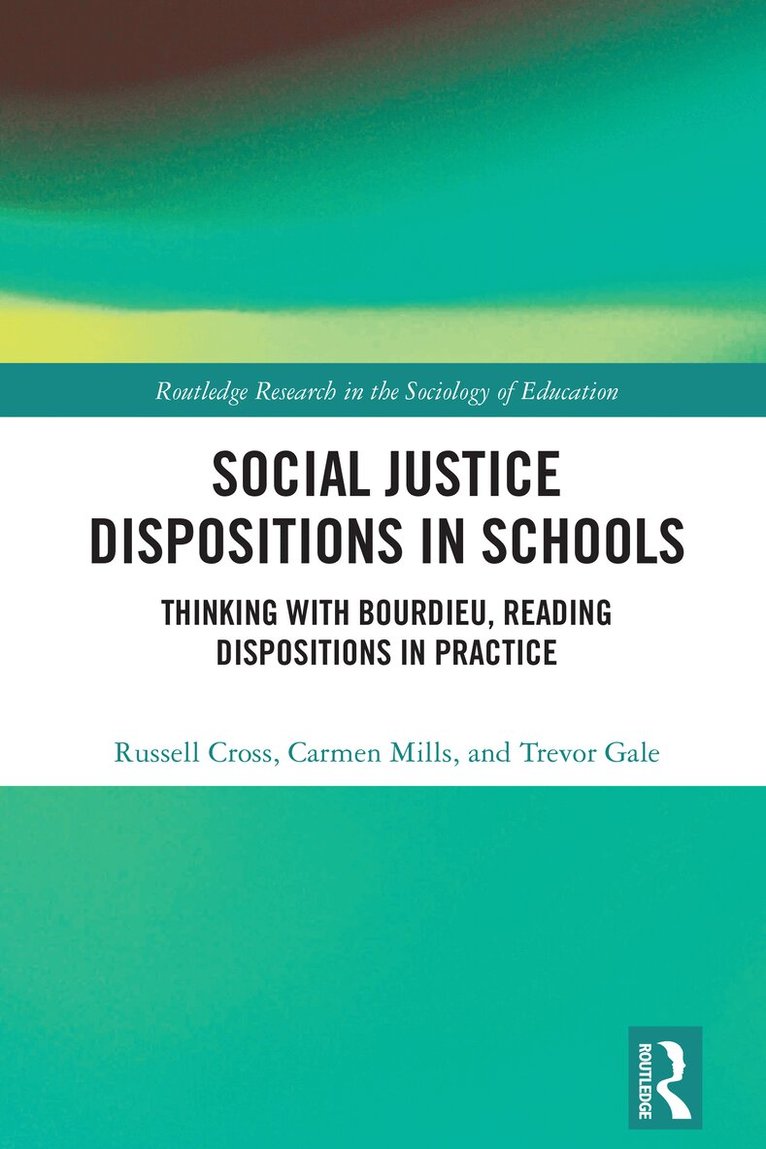
Russell Cross is Professor of Education at the University of Melbourne, Australia. He specialises in Vygotskian sociocultural accounts of teachers’ professional knowledge, practical expertise, and professional learning and development.Carmen Mills is Associate Professor at The University of Queensland, Australia. Her work within the field of the sociology of educaion draws on Bourdieu and focuses on educational inequality. Trevor Gale is Emeritus Professor of the Sociology of Education and Fellow of the Academy of Social Sciences, UK. His research is focused on the reproduction of inequalities through schooling and higher education.
'One of the most persistent and profound paradoxes of educational activity is its well-evidenced tendency to contribute to social inequality. To some extent this is a case of socioeconomic and other structural differences ‘registering’ in educational contexts, a process that may be amplified or mitigated by education policy. But what happens in schools also matters enormously. There is a great deal of research and advice about the values and practices that might make a difference here, but the fundamental problem remains. Is it possible to offer anything new in this difficult space? In Social Justice Dispositions in Schools, Cross, Mills and Gale show that it is. The book breaks new substantive and methodological ground through a careful and detailed examination of the nature of social justice dispositions in the pedagogic work of both teachers and leaders. They take seriously the idea that ‘the activity of teaching can be normatively distinguished by an outcome that should result in student learning, growth, and development’, and that ‘within the field of education, being fair, equitable, and/or inclusive – but failing to develop students’ capacity to succeed educationally – fails to redress overall disadvantage, perpetuating social injustice’ (p. 33). There is a constant emphasis on both practices and values here, explored in a sophisticated design where participants reflected and commented on their own and others’ practices. A detailed analysis identifies social justice dispositions (i.e., activist, deliberative, indifferent, resigned and egocentric) and then explores their manifestations and implications in different contexts (e.g., an activist social justice disposition in the context of a socioeconomically advantaged school). The authors are careful to remind readers that they are not describing the characteristics of people, but something more specific and contingent. The book is unique for its combination of concepts and approaches derived from Bourdieu and Vygotsky, and – in an era of too much decontextualised advice for teachers – for how it presents an account that is subtle, complex and real. There is also a strong message of hope: as some of the cases demonstrate, it is possible for teachers and leaders to operate in ways that align with positive social justice values, making a real difference to the outcomes and life-chances for their students.'David James, Emeritus Professor of Sociology of Education, Cardiff University, Wales, UK.'It is rare to find examples and illustrations about how equity discourses in education are practiced and realized by teachers, principals and schools. It is even rarer to find a sustained discussion about how such practices contribute to positive outcomes in the lives of young people. Social Justice Dispositions in Schools is this rare book, and it makes its timely contributions by explicitly connecting the ideas of Pierre Bourdieu to the everyday practices of education policy, structure, and context. The book provides both systems or macro-level analyses with the everyday micro-level interventions, which, when combined, produces multiple ways to understand the complexities, persistence and remediation of educational inequalities. I believe that those engaged in the hard work of education worldwide – researchers, policy makers, teachers, school administrators, teacher educators, teacher candidates, and graduate students – will find this text both informative and rewarding.'P. Taylor Webb, Professor, The University of British Columbia, Vancouver, Canada'This important, thought-provoking book brilliantly utilises Bourdieusian theory to illuminate how inequalities are perpetuated through school practices. Social Justice Dispositions in Schools reveals how, despite commitments to making a difference, teachers are still failing at fairness. At the heart of the book lies an enduring conundrum; the gulf between teachers’ espoused values and beliefs and actual practice. But Social Justice Dispositions in Schools is also a hopeful book, revealing how social justice can move from the periphery to the centre of teaching and learning in schools.'Diane Reay, Emeritus Professor of Education, University of Cambridge'Social justice dispositions in schools is a timely reminder of how much difference teachers, principals and schools can make to young people’s lives. When educators hold and enact strong social justice positions in their everyday practice, their actions have the potential to enhance students’ educational outcomes. Conversely, negative dispositions can increase the educational effects of socioeconomic disadvantage, thereby explaining why attainment gaps increase as students go through school education. Taking social justice dispositions as revealed in actions, informed by Bourdieu, as a point of departure, the authors provide an original framework for understanding how injustices and inequalities are maintained. The implications for pre and in-service ongoing education are significant. The researchers’ approaches to working with classroom data with teachers offer some insights for disruptive positive interventions. Highly recommended read for researchers and educators at all levels of education.'Barbara Comber, Emeritus Professor, University of South Australia
Kim Bower, Do Coyle, Russell Cross, Gary N. Chambers
Inbunden, 2020
1 685 kr
Gary N. Chambers, Russell Cross, Do Coyle, Kim Bower
390 kr
Kim Bower, Do Coyle, Russell Cross, Gary N. Chambers
Häftad, 2024
409 kr
Gary N. Chambers, Russell Cross, Do Coyle, Kim Bower
395 kr
Radhika Gorur, Paolo Landri, Romuald Normand
Inbunden, 2023
2 401 kr
Radhika Gorur, Paolo Landri, Romuald Normand
Häftad, 2025
661 kr
Graham McPhail, Richard Pountney, Leesa Wheelahan
Inbunden, 2024
2 401 kr
Graham McPhail, Richard Pountney, Leesa Wheelahan
Häftad, 2026
661 kr
Kirsten Elisa Petersen, Niels Rosendal Jensen
Inbunden, 2025
2 401 kr
Gary N. Chambers, Russell Cross, Do Coyle, Kim Bower
395 kr
Kim Bower, Do Coyle, Russell Cross, Gary N. Chambers
Inbunden, 2020
1 685 kr
Du är på sajten för privatpersoner.
Del i serien Routledge Research in the Sociology of Education
2 407 kr
Beställningsvara. Skickas inom 10-15 vardagar. Fri frakt över 249 kr.
Russell Cross is Professor of Education at the University of Melbourne, Australia. He specialises in Vygotskian sociocultural accounts of teachers’ professional knowledge, practical expertise, and professional learning and development.Carmen Mills is Associate Professor at The University of Queensland, Australia. Her work within the field of the sociology of educaion draws on Bourdieu and focuses on educational inequality. Trevor Gale is Emeritus Professor of the Sociology of Education and Fellow of the Academy of Social Sciences, UK. His research is focused on the reproduction of inequalities through schooling and higher education.
'One of the most persistent and profound paradoxes of educational activity is its well-evidenced tendency to contribute to social inequality. To some extent this is a case of socioeconomic and other structural differences ‘registering’ in educational contexts, a process that may be amplified or mitigated by education policy. But what happens in schools also matters enormously. There is a great deal of research and advice about the values and practices that might make a difference here, but the fundamental problem remains. Is it possible to offer anything new in this difficult space? In Social Justice Dispositions in Schools, Cross, Mills and Gale show that it is. The book breaks new substantive and methodological ground through a careful and detailed examination of the nature of social justice dispositions in the pedagogic work of both teachers and leaders. They take seriously the idea that ‘the activity of teaching can be normatively distinguished by an outcome that should result in student learning, growth, and development’, and that ‘within the field of education, being fair, equitable, and/or inclusive – but failing to develop students’ capacity to succeed educationally – fails to redress overall disadvantage, perpetuating social injustice’ (p. 33). There is a constant emphasis on both practices and values here, explored in a sophisticated design where participants reflected and commented on their own and others’ practices. A detailed analysis identifies social justice dispositions (i.e., activist, deliberative, indifferent, resigned and egocentric) and then explores their manifestations and implications in different contexts (e.g., an activist social justice disposition in the context of a socioeconomically advantaged school). The authors are careful to remind readers that they are not describing the characteristics of people, but something more specific and contingent. The book is unique for its combination of concepts and approaches derived from Bourdieu and Vygotsky, and – in an era of too much decontextualised advice for teachers – for how it presents an account that is subtle, complex and real. There is also a strong message of hope: as some of the cases demonstrate, it is possible for teachers and leaders to operate in ways that align with positive social justice values, making a real difference to the outcomes and life-chances for their students.'David James, Emeritus Professor of Sociology of Education, Cardiff University, Wales, UK.'It is rare to find examples and illustrations about how equity discourses in education are practiced and realized by teachers, principals and schools. It is even rarer to find a sustained discussion about how such practices contribute to positive outcomes in the lives of young people. Social Justice Dispositions in Schools is this rare book, and it makes its timely contributions by explicitly connecting the ideas of Pierre Bourdieu to the everyday practices of education policy, structure, and context. The book provides both systems or macro-level analyses with the everyday micro-level interventions, which, when combined, produces multiple ways to understand the complexities, persistence and remediation of educational inequalities. I believe that those engaged in the hard work of education worldwide – researchers, policy makers, teachers, school administrators, teacher educators, teacher candidates, and graduate students – will find this text both informative and rewarding.'P. Taylor Webb, Professor, The University of British Columbia, Vancouver, Canada'This important, thought-provoking book brilliantly utilises Bourdieusian theory to illuminate how inequalities are perpetuated through school practices. Social Justice Dispositions in Schools reveals how, despite commitments to making a difference, teachers are still failing at fairness. At the heart of the book lies an enduring conundrum; the gulf between teachers’ espoused values and beliefs and actual practice. But Social Justice Dispositions in Schools is also a hopeful book, revealing how social justice can move from the periphery to the centre of teaching and learning in schools.'Diane Reay, Emeritus Professor of Education, University of Cambridge'Social justice dispositions in schools is a timely reminder of how much difference teachers, principals and schools can make to young people’s lives. When educators hold and enact strong social justice positions in their everyday practice, their actions have the potential to enhance students’ educational outcomes. Conversely, negative dispositions can increase the educational effects of socioeconomic disadvantage, thereby explaining why attainment gaps increase as students go through school education. Taking social justice dispositions as revealed in actions, informed by Bourdieu, as a point of departure, the authors provide an original framework for understanding how injustices and inequalities are maintained. The implications for pre and in-service ongoing education are significant. The researchers’ approaches to working with classroom data with teachers offer some insights for disruptive positive interventions. Highly recommended read for researchers and educators at all levels of education.'Barbara Comber, Emeritus Professor, University of South Australia
Kim Bower, Do Coyle, Russell Cross, Gary N. Chambers
Inbunden, 2020
1 685 kr
Gary N. Chambers, Russell Cross, Do Coyle, Kim Bower
390 kr
Kim Bower, Do Coyle, Russell Cross, Gary N. Chambers
Häftad, 2024
409 kr
Gary N. Chambers, Russell Cross, Do Coyle, Kim Bower
395 kr
Radhika Gorur, Paolo Landri, Romuald Normand
Inbunden, 2023
2 401 kr
Radhika Gorur, Paolo Landri, Romuald Normand
Häftad, 2025
661 kr
Graham McPhail, Richard Pountney, Leesa Wheelahan
Inbunden, 2024
2 401 kr
Graham McPhail, Richard Pountney, Leesa Wheelahan
Häftad, 2026
661 kr
Kirsten Elisa Petersen, Niels Rosendal Jensen
Inbunden, 2025
2 401 kr
Gary N. Chambers, Russell Cross, Do Coyle, Kim Bower
395 kr
Kim Bower, Do Coyle, Russell Cross, Gary N. Chambers
Inbunden, 2020
1 685 kr