• Fri frakt över 249 kr
  • •
  • Snabba leveranser
  • •
  • Billiga böcker
Kundservice

Du är på sajten för privatpersoner.

Företag, bibliotek eller offentlig verksamhet?

Du handlar på classic.bokus.com, där alla dina funktioner finns intakta.
Till classic.bokus.com
Bokus logotyp. Gå till startsidan.
  • Erbjudanden
  • Nyheter
  • Student
  • Topplistor
  • Barn & ungdom
  • Bokus Play
  • E-böcker
  • Pocketböcker
  • Spel & pussel

10% rabatt på allt med kod: NYSTART10 →

Sidfot

Mina sidor

    Hjälp

    • Kundservice
    • Vanliga frågor och svar
    • Frakt och leverans
    • Retur vid ångerrätt
    • Reklamera vara
    • Betalning
    • Köpvillkor
    • Allmänna villkor
    • Information om webbplatsens tillgänglighet

    Om Bokus

    • Om oss
    • Pressrum
    • För studenter
    • För företag
    • För bibliotek och offentlig verksamhet
    • För leverantörer
    • Hållbarhet

    Populärt

    • Aktuella erbjudanden
    • Presentkort
    • Studentlitteratur
    • Nya böcker
    • Topplistor
    • Signerade böcker
    • Engelska böcker

    Inspiration

    • Boktips
    • BookTok
    • Populära bokserier
    • Barnbokskaraktärer
    • Populära författare
    Logotyp för Bokus
    Följ oss på Facebook (extern länk)Följ oss på Instagram (extern länk)Följ oss på YouTube (extern länk)Följ oss på TikTok (extern länk)
    bokus @ CookiesAnpassa cookiesIntegritetspolicyKöpvillkor
    Till Citymail hemsida (extern länk)Till Budbee hemsida (extern länk)Till Postnord hemsida (extern länk)Till Schenker hemsida (extern länk)Till Early Bird hemsida (extern länk)Till Walleys hemsida (extern länk)
    1. Samhälle och politik
    2. Samhälle och kultur
    3. Sociala grupper och identitet

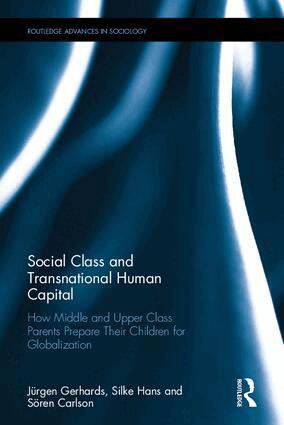
    Social Class and Transnational Human Capital

    How Middle and Upper Class Parents Prepare Their Children for Globalization

    AvJürgen Gerhards,Hans Silke

    Inbunden, Engelska, 2017

    Del i serien Routledge Advances in Sociology

    2 352 kr

    Beställningsvara. Skickas inom 10-15 vardagar. Fri frakt över 249 kr.

    Fler format och utgåvor

    Häftad

    667 kr

    Beskrivning

    Due to globalization processes, foreign language skills, knowledge about other countries and intercultural competences have increasingly become important for societies and people’s social positions. Previous research on social inequality, however, has dominantly focused on the reproduction of class structures within the boundaries of a particular nation-state without considering the importance of these specific skills and competences.Within Social Class and Transnational Human Capital authors Gerhards, Hans and Carlson refer to these skills as ‘transnational human capital’ and ask to what extent access to this increasingly sought-after resource depends on social class. Based on Pierre Bourdieu’s theory of class, they investigate this question via both quantitative and qualitative empirical analyses. In doing so the authors focus, among other examples, on the so-called school year abroad, i.e. students spending up to a year abroad while attending school – a practice which is rather popular in Germany, but also quite common in many other countries. Thus, this insightful volume explores how inequalities in the acquisition of transnational human capital and new forms of social distinction are produced within families, depending on their class position and the educational strategies parents pursue when trying to prepare their children for a globalizing world.An enlightening title, this book will appeal to undergraduate and postgraduate students, as well as postdoctoral researchers interested in fields such as sociology, social inequality research, globalization studies and educational studies.

    Produktinformation

    • Utgivningsdatum:2017-06-01
    • Mått:156 x 234 x 14 mm
    • Vikt:560 g
    • Format:Inbunden
    • Språk:Engelska
    • Serie:Routledge Advances in Sociology
    • Antal sidor:216
    • Förlag:Taylor & Francis Ltd
    • ISBN:9781138232020

    Utforska kategorier

    • Sociala grupper och identitet inom Samhälle och politik
    • Sociologi inom Samhälle och politik
    • Pedagogik inom Psykologi och pedagogik

    Mer om författaren

    Jürgen Gerhards is Professor of Sociology at Freie Universität Berlin.Silke Hans is Professor of Sociology at Georg-August-Universität Göttingen.Sören Carlson is Research Associate at the Department of Sociology at the Europa-Universität Flensburg.

    Recensioner i media

    This is a rigorous and empirically-rich study of the ways in which families go about accumulating transnational human capital – focussing, in particular, on the role of bilingual pre-school education and programmes that allow school children to spend up to a year abroad. It emphasises how access to such schemes is socially-patterned, and thus the important role they play in reproducing social inequalities across society. This is an important book for sociologists of education and others interested in the social impact of initiatives to ‘internationalise’ education.Rachel Brooks, Professor of Sociology, University of Surrey How does social reproduction change in an age of international mobility? Delving into a variety of original sources, Gerhards, Hans and Carlson’s book disentangles the strategies adopted by middle-upper class European families struggling to push their children into the ranks of the winners of globalization. An illuminating read.Ettore Recchi, Sciences Po ParisThis book provides a convincing theoretical and empirical perspective on the generation of inequality of transnational capital over the life course. Globalization has turned transnational human capital into an increasingly important individual resource. Those who speak foreign languages, possess intercultural skills or have acquired experiences abroad clearly have an edge on globalized labor markets today. Using a multimethod approach, the book offers a rich empirical analysis addressing the question of how transnational human capital depends on social class, as well as how this relationship is brought about within families and educational institutions. This is a must-read for everyone interested in emerging new forms of educational inequalities in modern societies.Hans-Peter Blossfeld, European University Institute, Florence Once again, the innovative empiricist, Jürgen Gerhards, leads a pathbreaking project beyond th

    Innehållsförteckning

    • 1. Prologue 1.1 Setting the Stage: Transnational Human Capital and Social Inequality1.2 Key Terms and Theoretical Framework1.3 The Current State of Research2. Changing Contexts: The Growing Demand for Transnational Human Capital and the Middle and Upper Class Quest for Distinction2.1 The Growing Relevance of Transnational Competences2.2 Transnational Human Capital as a Way of Gaining Distinction2.3 The Increasing Demand for Transnational Competences on the Labor Market3. Social Background Makes All the Difference: Types of Capital, Class Position and Chances for Acquiring Transnational Human Capital3.1 Why Some Students Get the Chance to go Abroad and Others do not3.2 Minor Educational Decisions, Major Consequences: Foreign Language Acquisition in Pre-School Daycare Centers3.3 Mobility Chances in Europe: How Country Characteristics Influence the Acquisition of Transnational Human Capital4. Strategic Investments: Families’ Class Position and Their Educational Practices in Everyday Life4.1 Step by Step: The School Year Abroad as the Result of a Multi-stage (Decision) Process4.2 Three Types of Families: The Transnationally Accomplished, the Excluded and the Ambitious5. The "Brokers": The Formation and Structure of a Social Field of Intermediaries of Transnational Human Capital5.1 Internationalization and the Commodification of Educational Services5.2 The Field of Intermediary Organizations for School Years Abroad6. Does Going Abroad Early on Pay Off? Returns to Transnational Human Capital6.1 Once Mobile, Always Mobile: The Tendency of the Rate of Profit to Rise 6.2 The Transformation of Transnational Competences into Other Types of Capital6.3 How Societies Benefit from Transnational Human Capital7. Epilogue Appendix: Data and Methods of Analysis