• Fri frakt över 249 kr
  • •
  • Snabba leveranser
  • •
  • Billiga böcker
Kundservice

Du är på sajten för privatpersoner.

Företag, bibliotek eller offentlig verksamhet?

Du handlar på classic.bokus.com, där alla dina funktioner finns intakta.
Till classic.bokus.com
Bokus logotyp. Gå till startsidan.
  • Erbjudanden
  • Nyheter
  • Student
  • Topplistor
  • Barn & ungdom
  • Bokus Play
  • E-böcker
  • Pocketböcker
  • Spel & pussel

Må bättre, för mindre! Upp till 50% rabatt på hälsoböcker

Sidfot

Mina sidor

    Hjälp

    • Kundservice
    • Vanliga frågor och svar
    • Frakt och leverans
    • Retur vid ångerrätt
    • Reklamera vara
    • Betalning
    • Köpvillkor
    • Allmänna villkor
    • Information om webbplatsens tillgänglighet

    Om Bokus

    • Om oss
    • Pressrum
    • För studenter
    • För företag
    • För bibliotek och offentlig verksamhet
    • För leverantörer
    • Hållbarhet

    Populärt

    • Aktuella erbjudanden
    • Presentkort
    • Studentlitteratur
    • Nya böcker
    • Topplistor
    • Signerade böcker
    • Engelska böcker

    Inspiration

    • Boktips
    • BookTok
    • Populära bokserier
    • Barnbokskaraktärer
    • Populära författare
    Logotyp för Bokus
    Följ oss på Facebook (extern länk)Följ oss på Instagram (extern länk)Följ oss på YouTube (extern länk)Följ oss på TikTok (extern länk)
    bokus @ CookiesAnpassa cookiesIntegritetspolicyKöpvillkor
    Till Citymail hemsida (extern länk)Till Budbee hemsida (extern länk)Till Postnord hemsida (extern länk)Till Schenker hemsida (extern länk)Till Early Bird hemsida (extern länk)Till Walleys hemsida (extern länk)
    1. Samhälle och politik
    2. Sociologi och antropologi
    3. Antropologi

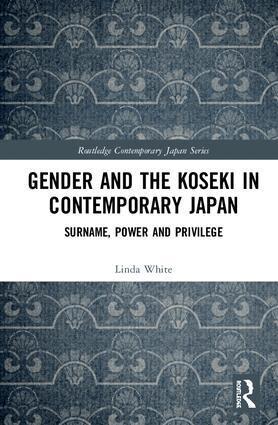
    Gender and the Koseki In Contemporary Japan

    Surname, Power, and Privilege

    AvLinda White

    Inbunden, Engelska, 2018

    Del i serien Routledge Contemporary Japan Series

    2 227 kr

    Beställningsvara. Skickas inom 10-15 vardagar. Fri frakt över 249 kr.

    Fler format och utgåvor

    Häftad

    613 kr

    E-bok

    725 kr

    E-bok

    725 kr

    Beskrivning

    The Japanese koseki system is the legal and social structure keeping record of all Japanese citizens. Determined by the Civil Code and the Koseki Law, for activists challenging it, the koseki is also an ideological structure, which has produced patriarchal control through single-surname households.Based on ethnographic fieldwork in Tokyo, this book engages with issues of gender hierarchy and structural inequality in Japanese society. Studying several decades of feminist activism and critique of the koseki system, it analyses the strategies of activists who have creatively circumvented koseki rules in order to maintain their natal names in marriage. It examines the case studies of members of the fūfubessei (separate surname movement) and the movement to end discrimination against children born out of wedlock, and in so doing this book illuminates the contradictions in current family law and koseki practice that have animated a generation of feminists in Japan.Demonstrating the effect of the koeski on family, gender, and national identity, this book will be useful for students and scholars of Cultural Anthropology, Gender Studies, and Japanese Studies in general.

    Produktinformation

    • Utgivningsdatum:2018-04-26
    • Mått:156 x 234 x 13 mm
    • Vikt:342 g
    • Format:Inbunden
    • Språk:Engelska
    • Serie:Routledge Contemporary Japan Series
    • Antal sidor:120
    • Förlag:Taylor & Francis Ltd
    • ISBN:9781138674349

    Utforska kategorier

    • Antropologi inom Samhälle och politik
    • Genusvetenskap inom Samhälle och politik
    • Civilrätt inom Juridik

    Mer om författaren

    Linda White is Associate Professor and Chair of Japanese Studies at Middlebury College, USA. Trained as a cultural anthropologist, she has conducted ethnographic research with grassroots organizations in the Tokyo area during the past several decades.

    Innehållsförteckning

    • Introduction 1. The Matter of Names and Why Names Matter 2. Separate Surname Activism 3. Common-law marriage as a form of koseki resistance 4. Illegitimacy and male privilege: the underlying logic of the koseki 5. Beyond the scope of the koseki: Families out of bounds