• Fri frakt över 249 kr
  • •
  • Snabba leveranser
  • •
  • Billiga böcker
Kundservice

Du är på sajten för privatpersoner.

Företag, bibliotek eller offentlig verksamhet?

Du handlar på classic.bokus.com, där alla dina funktioner finns intakta.
Till classic.bokus.com
Bokus logotyp. Gå till startsidan.
  • Erbjudanden
  • Nyheter
  • Student
  • Topplistor
  • Barn & ungdom
  • Bokus Play
  • E-böcker
  • Pocketböcker
  • Spel & pussel

10% rabatt på allt med kod: NYSTART10 →

Sidfot

Mina sidor

    Hjälp

    • Kundservice
    • Vanliga frågor och svar
    • Frakt och leverans
    • Retur vid ångerrätt
    • Reklamera vara
    • Betalning
    • Köpvillkor
    • Allmänna villkor
    • Information om webbplatsens tillgänglighet

    Om Bokus

    • Om oss
    • Pressrum
    • För studenter
    • För företag
    • För bibliotek och offentlig verksamhet
    • För leverantörer
    • Hållbarhet

    Populärt

    • Aktuella erbjudanden
    • Presentkort
    • Studentlitteratur
    • Nya böcker
    • Topplistor
    • Signerade böcker
    • Engelska böcker

    Inspiration

    • Boktips
    • BookTok
    • Populära bokserier
    • Barnbokskaraktärer
    • Populära författare
    Logotyp för Bokus
    Följ oss på Facebook (extern länk)Följ oss på Instagram (extern länk)Följ oss på YouTube (extern länk)Följ oss på TikTok (extern länk)
    bokus @ CookiesAnpassa cookiesIntegritetspolicyKöpvillkor
    Till Citymail hemsida (extern länk)Till Budbee hemsida (extern länk)Till Postnord hemsida (extern länk)Till Schenker hemsida (extern länk)Till Early Bird hemsida (extern länk)Till Walleys hemsida (extern länk)
    1. Psykologi och pedagogik
    2. Psykologi
    3. Åldrandets psykologi

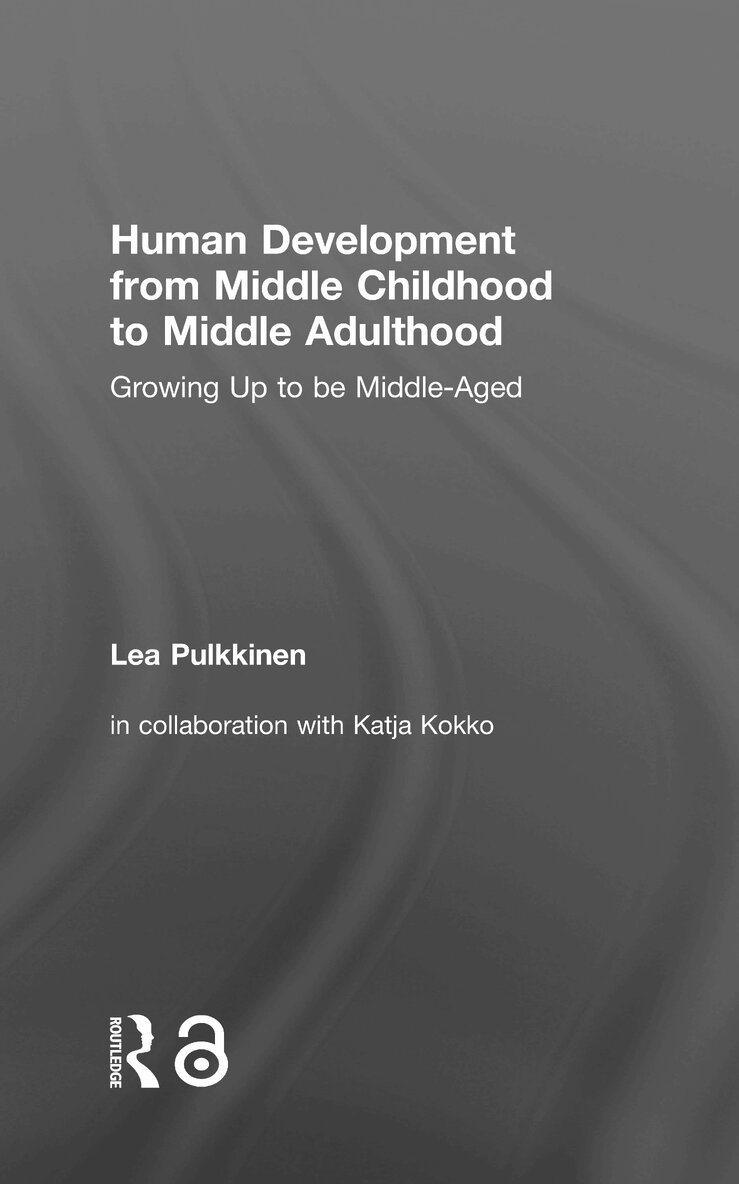
    Human Development from Middle Childhood to Middle Adulthood

    Growing Up to be Middle-Aged

    AvLea Pulkkinen

    Häftad, Engelska, 2017

    788 kr

    Beställningsvara. Skickas inom 10-15 vardagar. Fri frakt över 249 kr.

    Fler format och utgåvor

    Inbunden

    2 493 kr

    Beskrivning

    This seminal work focuses on human development from middle childhood to middle adulthood, through analysis of the research findings of the groundbreaking Jyväskylä Longitudinal Study of Personality and Social Development (JYLS). The JYLS project, which began in 1968, has generated extensive publications over many years but this is the first comprehensive summary that presents the conceptual framework, the research design and methodology, and the findings. The study looks at the development over time of issues related to personality, identity, health, anti-social behavior, and well-being and is unparalleled in its duration, intensity, comprehensiveness and psychological richness.The thorough synthesis of this study illustrates that there are different paths to adulthood and that human development cannot be described in average terms. The 42-year perspective that the JYLS provides shows the developmental consequences of children’s differences in socioemotional behavior over time, and the great significance of children’s positive socioemotional behavior for their further development until middle age. Not only will the book be an invaluable tool for those considering research methods and analysis on large datasets, it is ideal reading for students on lifespan courses and researchers methodologically interested in longitudinal research.

    Produktinformation

    • Utgivningsdatum:2017-05-23
    • Mått:156 x 234 x 19 mm
    • Vikt:500 g
    • Format:Häftad
    • Språk:Engelska
    • Antal sidor:318
    • Förlag:Taylor & Francis Ltd
    • ISBN:9781138840157

    Utforska kategorier

    • Åldrandets psykologi inom Psykologi och pedagogik
    • Psykologi: jaget, identitet och personlighet inom Psykologi och pedagogik
    • Folkhälsa och hälsopedagogik inom Medicin

    Mer om författaren

    Lea Pulkkinen, PhD, is Professor of Psychology Emerita at the University of Jyväskylä, Finland. For 40 years, she has conducted a longitudinal study on personality and social development. Her interest has focused on the continuity of positive and problem behaviors over time, and transformation of findings into policy for improving the quality of life in childhood and adulthood.

    Recensioner i media

    "The Jyvaskyla Longitudinal Study of Personality and Social Development is one of the most important longitudinal studies of antisocial behaviour conducted anywhere in the world. It is one of the very few projects with repeated personal assessments of hundreds of individuals from childhood up to middle adulthood. This outstandingly important project has greatly advanced knowledge about development through life, and especially about the influence of personality on antisocial behaviour and social functioning. It is extremely important to have the major findings from a wide-ranging longitudinal study, which are often scattered over hundreds of articles, synthesized into one book." – David P. Farrington, Emeritus Professor of Psychological Criminology, Cambridge University, UK

    Innehållsförteckning

    • List of figuresList of tablesList of boxesPrefacePART I: Introduction to the Jyväskylä Longitudinal Study of Personality and Social Development Chapter 1: How the longitudinal study began A historical context for the study of aggression Positive behavior in an impulse control model and the goals of the study The search for alternatives to aggression The impulse control model The goals of the longitudinal study Research conditions in Finland and in the longitudinal study Chapter 2: The execution of the longitudinal study The research sample and the major waves of data collection Attrition and the representativeness of the sample Additional data collections Assessment methods Peer nomination and teacher rating Personal interview Self-reports and other methods Data analysis Chapter 3: Reflections on the research process The evaluation of choices Recommendations for launching a longitudinal study What is development? PART II: The development of personality and psychological functioningChapter 4: Theoretical frameworks for the study of socioemotional development From cognitive control of impulses to self-control Updated framework The model for the Unfolding of Socioemotional Behavior Self-regulation and executive functions Towards cumulative theoretical reasoning Three layers of personality for organizing research findings Chapter 5: The person as social actor Questions to be answered Socioemotional behavior in childhood and adolescence Agreement between informants 2 Continuity in socioemotional behavior The person-situation controversy Children grow and adult styles of life emerge The two-dimensional framework across generations The unfolding of the styles of life from age 8 to 27 The developmental background of the styles of life A person-oriented approach to personal styles at age 27 Personality profiles at ages 33 to 50 Maturation, adjustment, or growth in adult personality Childhood socioemotional behaviors as predictors of adult personality characteristics Roots of the personality profiles and the clusters of personal styles The roots of adult agreeableness and continuity in aggression Paths from childhood socioemotional behavior to adult personality Chapter 6: The person as motivated agent The transition to adulthood Age-stratified or individualistic transitions? Life changes in early adulthood Patterns and timing of adult transitions The length and timing of one’s education The structure of education Predictors of the choice of education "Off-time" education and other post-comprehesive educational trajectories Goals and values Common elements in the life structure of adults Values in middle age Individual life structures and unifying life themes Chapter 7: The person as autobiographical author and an "experiencer" of life A holistic approach to personality Self-reflections Identity formation Personal control over one’s own life Optimism and self-esteem Turning points A study of turning points Individual differences in the experience of turning points A qualitative analysis of turning points Chapter 8: Personality and psychological functioning Personality and well-being The concept of mental well-being Continuity in well-being The personality traits associated with mental well-being The model for personality and psychological functioning Explanations for the associations between personality traits and psychological functioning PART III: The development of social functioningChapter 9: Social development and social functioning Conceptual approaches to social functioning The spheres of life Processes in social functioning Chapter 10: Problems in social functioning Antisocial development Antisocial behavior From aggression to antisocial behavior Proactive and reactive aggression as predictors of criminal offending Accumulation of problems Multi-problem predictors of problem behaviorsDynamic processes in the accumulation of problemsContinuity from risk factors to social functioning problems Offender groups compared Offender groups Differences in personality Social background Life success of the offender groups in adulthood Conclusions and suggestions for prevention Chapter 11: Health behavior Substance use The start and continuity of the use of alcohol Problem drinking in middle age Socioemotional characteristics associated with drinking Social backgrounds of the use of alcohol Smoking cigarettes Health risks Health in early adulthood The predictors of accidents and impairment Subjective health and metabolic syndrome in middle age Temperance in adulthood Chapter 12: The family and its care functions A partnership in the family The structure of the family The relationship between the partners Adult attachment Parenting Delights and stresses in parenting Parental identity Child-rearing practices Relationships in the chain of generations Chapter 13: Work as a sphere of life Occupational status and career line in women and men Success in career path Constructive behavior in childhood as the antecedent of success in the work domain Satisfaction with work Occupational well-being and personality Job insecurity Unemployment and psychological distress: selection or causation? Health consequences of the unstable career line The consequences of economic strain for the family and parenting Work-family balance A stress theory approach to work-family interface A role enhancement theory approach to work-family interface Successful reconciliation Recovery from work and the content of free time PART IV: EpilogueChapter 14: Navigating through the spheres of life Middle age: a prime time Midlife transition The person functioning in the different spheres of life Chapter 15: The integrated model for individual differences in social and psychological functioningChapter 16: A credoReferencesAuthor indexSubject index