• Fri frakt över 249 kr
  • •
  • Snabba leveranser
  • •
  • Billiga böcker
Kundservice

Du är på sajten för privatpersoner.

Företag, bibliotek eller offentlig verksamhet?

Du handlar på classic.bokus.com, där alla dina funktioner finns intakta.
Till classic.bokus.com
Bokus logotyp. Gå till startsidan.
  • Erbjudanden
  • Nyheter
  • Student
  • Topplistor
  • Barn & ungdom
  • Bokus Play
  • E-böcker
  • Pocketböcker
  • Spel & pussel

10% rabatt på allt med kod: NYSTART10 →

Sidfot

Mina sidor

    Hjälp

    • Kundservice
    • Vanliga frågor och svar
    • Frakt och leverans
    • Retur vid ångerrätt
    • Reklamera vara
    • Betalning
    • Köpvillkor
    • Allmänna villkor
    • Information om webbplatsens tillgänglighet

    Om Bokus

    • Om oss
    • Pressrum
    • För studenter
    • För företag
    • För bibliotek och offentlig verksamhet
    • För leverantörer
    • Hållbarhet

    Populärt

    • Aktuella erbjudanden
    • Presentkort
    • Studentlitteratur
    • Nya böcker
    • Topplistor
    • Signerade böcker
    • Engelska böcker

    Inspiration

    • Boktips
    • BookTok
    • Populära bokserier
    • Barnbokskaraktärer
    • Populära författare
    Logotyp för Bokus
    Följ oss på Facebook (extern länk)Följ oss på Instagram (extern länk)Följ oss på YouTube (extern länk)Följ oss på TikTok (extern länk)
    bokus @ CookiesAnpassa cookiesIntegritetspolicyKöpvillkor
    Till Citymail hemsida (extern länk)Till Budbee hemsida (extern länk)Till Postnord hemsida (extern länk)Till Schenker hemsida (extern länk)Till Early Bird hemsida (extern länk)Till Walleys hemsida (extern länk)
    1. Samhälle och politik
    2. Samhälle och kultur
    3. Kultur och medier
    4. Referensverk och tvärvetenskap

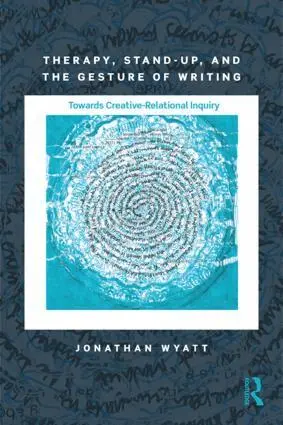
    Therapy, Stand-Up, and the Gesture of Writing

    Towards Creative-Relational Inquiry

    AvJonathan Wyatt

    Häftad, Engelska, 2018

    Del i serien Writing Lives: Ethnographic Narratives

    701 kr

    Beställningsvara. Skickas inom 10-15 vardagar. Fri frakt över 249 kr.

    Fler format och utgåvor

    Inbunden

    2 493 kr

    E-bok

    782 kr

    E-bok

    928 kr

    Beskrivning

    Therapy, Stand-Up, and the Gesture of Writing is a sharp, lively exploration of the connections between therapy, stand-up comedy, and writing as a method of inquiry; and of how these connections can be theorized through the author’s new concept: creative-relational inquiry. Engaging, often poignant, stories combine with rich scholarship to offer the reader provocative, original insights. Wyatt writes about his work as a therapist with his client, Karl, as they meet and talk together. He tells stories of his experiences attending comedy shows in Edinburgh and of his own occasional performances. He brings alive the everyday profound through vignettes and poems of work, travel, visiting his mother, mourning his late father, and more. The book’s drive, however, is in bringing together therapy, stand-up, and writing as a method of inquiry to mobilise theory, drawing in particular from Deleuze and Guattari, the new materialisms, and affect theory. Through this diffractive work, the text formulates and develops creative-relational inquiry. With its combination of fluent story-telling and smart, theoretical propositions, Therapy, Stand-up, and the Gesture of Writing offers compelling possibilities both for qualitative scholars who have an interest in narrative, performative, and embodied scholarship, and those who desire to bring current, complex, theories to bear upon their research practices.

    Produktinformation

    • Utgivningsdatum:2018-12-17
    • Mått:152 x 229 x 13 mm
    • Vikt:317 g
    • Format:Häftad
    • Språk:Engelska
    • Serie:Writing Lives: Ethnographic Narratives
    • Antal sidor:214
    • Förlag:Taylor & Francis Ltd
    • ISBN:9781138897700

    Utforska kategorier

    • Referensverk och tvärvetenskap inom Samhälle och politik
    • Psykoterapi som behandlingsmetod inom Medicin
    • Arbetsterapi inom Medicin

    Mer om författaren

    Jonathan Wyatt is Professor of Qualitative Inquiry and Director of the Centre for Creative-Relational Inquiry at The University of Edinburgh. Originally an English teacher and youth worker, he worked for ten years as a counsellor in a doctors’ surgery alongside being Head of Professional Development at the University of Oxford, before heading north to Scotland in 2013.

    Recensioner i media

    Luminous, playful, intimate, poetic and surprising—this book will touch you, it will take you over, take you inside yourself and outside yourself. It invites you to lose yourself in the material, relational fleshiness of life. Wyatt catches moments of being and becoming in the way only great writers can do. He experiments with thinking otherwise, and asks the reader to encounter the words on the page so they (and you) come alive, escaping into the new, the unexpected, and the vital. He takes you inside a magic circle where anything can happen—and does. Bronwyn Davies, Emeritus Professor, Western Sydney University Jonathan Wyatt’s Therapy, Stand-Up, and the Gesture of Writing comes to me like a compelling poem. In general, the book is about the unfolding and enfolding of therapy, stand-up and writing, and indeed the book teaches me a great deal about those subjects, but it is equally about thinking and feeling in the ongoing process of becoming. It is a poetic gift. Its gentle rhythms find their own form. Its language surrounds, seduces. Its "creative-relational inquiry," to use Wyatt’s rich term, opens new ways of moving through the world. Ronald J. Pelias, Professor Emeritus, Southern Illinois University This is a wonderful book; a book full of elicitations of wonder. Jonathan writes in a style that is seductively conversational, a style that is imbued with affect in a book that never stumbles into proclivities of simply human concerns and emotional response. The book is powerfully energised by the everyday; Jonathan is a hugely adept storyteller and so these vignettes, accounts and exemplifications carry the reader with them into almost unwitting engagements with exciting, profound theorisings with practices of life and facilitations of worlding. Here there are encounters inhabited and animated by clients, family, audiences at stand-up gigs and, through enunciations of these, Jonathan offers diffractive pathways into practices of creative-relational inquiry. This is a book that picks you up, then needs to be carried and can’t be put down. Ken Gale, Lecturer, University of Plymouth, UK I love this book. It is going to be a classic in our field. The writing is so inviting, so visceral, so open. The topics the book explores are familiar ones, but Wyatt looks at them in fresh ways that are inspiring both to senior researchers and to those new to qualitative inquiry. And I have never read a better introduction to Deleuze and Guattari: he makes their vocabulary understandable at an ethnographic, bodily and emotional level. I especially love Wyatt’s metaphors, like the idea of the ‘white chalk circle’ on the floor for the stand-up comedian being also understood as the chalk circle in a therapeutic session, and in the writer's relationships with real and imagined co-writers and readers. All these are sacred spaces where surprises might happen. One of the things about the book I loved is how Wyatt handles the issue of ‘trust’. We trust the therapist, the writer, the stand-up. That trust is necessary for qualitative researchers to do their work, and with trust comes other ethical questions: What do we reveal? What do we hide? How do we decide? I trust that Jonathan has led us towards creative-relational inquiry. That is what is most important. Laurel Richardson, Professor Emerita, Ohio State University This book is a wholly original gesture at a world of circuits breathing with the rhythms of something happening, refrains working thresholds of matter and meaning. An ordinary room is a milieu of compositions: the this-ness of the mic, the alcohol, the weather, that shirt. A beautiful, brilliant book, it catches up the reader in the worldly thinking of a shoulder shrugged, a joke, the resonance of a word in a room. Kathleen Stewart, Professor, University of Texas at Austin The form and content of Therapy, Stand-up, and the Gesture of Writing offers embodied insight into a creative-relational inquiry revealing new paths in the development of qualitative methodologies. With deft reflexivity Wyatt reveals connections and slippages among seemingly disparate experiences of therapy, humor, and writing as inquiry; such connections are a hallmark of groundbreaking qualitative research. This is a transdisciplinary must-read for writers and researchers. Tami Spry, Professor, St. Cloud State UniversityThis is a powerful and thought provoking book. It gives shape and form to innovative modes of inquiry to open up significant perspectives on comedy, therapy and writing. Like a good stand up routine, the risks pay off. The writing enlivens thinking, method and theory. A major contributionIain MacRury, Faculty of Media and Communication, Bournemouth University"The book transports its reader into the richly-textured, aesthetically-conjured moments of materialities in which the author gropes feels, breathes, thinks, and perceives amongst relational others. It disorientates our inclination towards the familiar and the graspable, towards tapping into the awareness of how affective subtlety is the current of life, of relational sensitivity, of creative forces with which we, as qualitative researchers, cannot do without."Nini Fang- Qualitative Social Research Forum"With a pleasing serendipity, I found myself opening Jonathan Wyatt's book as I was closing Virginia Woolf's To the Lighthouse [...] A considerable amount of the book is given over to Deleuzoguattarian concepts that seek to connect our subjec-tivity with the external, that aim to form our position in a chaotic world, that bring together a multiplicity of partial objects in a momentary self, that provide us with the illusion of a capacity to make sense of everything. It would take a better man than I to, in the space available, explain Deleuze and Guattari, let alone how Wyatt draws their theories to wrap around his three putative central themes, so I hope he'll forgive me if I end as I began, with Woolf: “In the midst of the chaos there was shape; this eternal passing and flowing . . . was struck into stability” (Woolf, 1992, p. 176)."Nick Campion, Sherwood Psychotherapy Training Institute, Nottingham, UK"Jonathan is careful to spell out the political "mutual indebtedness" in this co-creation. It is the Cailleach that does this work with him in his writing. Jonathan thinks with her, not with theory in this case, but with her stories, with her person, with her more than human powers which evoke a speculative inquiry, a magical realist inquiry. He puts this to work in his writing and it leads me to wonder about other stories from these shores, other ontologies, that might be thought with, that might be resonated with."David A.G. Clarke and Nova Southeastern University

    Innehållsförteckning

    • Part 1: Openings Chapter 1. An Introduction Chapter 2. Something Might Happen Chapter 3. Always More Interval. Towards Creative-Relational Inquiry (1): Take it to Heart Part 2: RefrainsChapter 4. What Has Stand-Up Ever Done for Writing as Inquiry? The Refrain, Surprise, Pete and his Lemons Chapter 5. The Refrains of Therapy and the Everyday Chapter 6. Three Shits: A Connection of Some Kind Chapter 7. Counselling on a Scale of 1 To 5 Chapter 8. Out Here a Man Settles his Own Problems: Learning from John Wayne Interval. Towards Creative-Relational Inquiry (2): The Problem and Promise of the PersonalPart 3: Reframings Chapter 9. Once Upon a Time a Story Hit Back Chapter 10. Shadow Bands: Thinking Therapy Diffractively Chapter 11. W/b/rought to Life Interval. Towards Creative-Relational Inquiry (3): The Poetics of the Hyphen Part 4: Reframings (Continued): Shame Chapter 12. Two Stories of Shame: Calling Upon The Cailleach Chapter 13. Meditation on a Green Light BulbChapter 14. A Third Story of Shame: Hannah GadsbyEpilogue