• Fri frakt över 249 kr
  • •
  • Snabba leveranser
  • •
  • Billiga böcker
Kundservice

Du är på sajten för privatpersoner.

Företag, bibliotek eller offentlig verksamhet?

Du handlar på classic.bokus.com, där alla dina funktioner finns intakta.
Till classic.bokus.com
Bokus logotyp. Gå till startsidan.
  • Erbjudanden
  • Nyheter
  • Student
  • Topplistor
  • Barn & ungdom
  • Bokus Play
  • E-böcker
  • Pocketböcker
  • Spel & pussel

10% studentrabatt med kod TERM26

Sidfot

Mina sidor

    Hjälp

    • Kundservice
    • Vanliga frågor och svar
    • Frakt och leverans
    • Retur vid ångerrätt
    • Reklamera vara
    • Betalning
    • Köpvillkor
    • Allmänna villkor
    • Information om webbplatsens tillgänglighet

    Om Bokus

    • Om oss
    • Pressrum
    • För studenter
    • För företag
    • För bibliotek och offentlig verksamhet
    • För leverantörer
    • Hållbarhet

    Populärt

    • Aktuella erbjudanden
    • Presentkort
    • Studentlitteratur
    • Nya böcker
    • Topplistor
    • Signerade böcker
    • Engelska böcker

    Inspiration

    • Boktips
    • BookTok
    • Populära bokserier
    • Barnbokskaraktärer
    • Populära författare
    Logotyp för Bokus
    Följ oss på Facebook (extern länk)Följ oss på Instagram (extern länk)Följ oss på YouTube (extern länk)Följ oss på TikTok (extern länk)
    bokus @ CookiesAnpassa cookiesIntegritetspolicyKöpvillkor
    Till Citymail hemsida (extern länk)Till Budbee hemsida (extern länk)Till Postnord hemsida (extern länk)Till Schenker hemsida (extern länk)Till Early Bird hemsida (extern länk)Till Walleys hemsida (extern länk)
    1. Naturvetenskap och teknik
    2. Geovetenskap
    3. Miljövetenskap och miljöpolitik

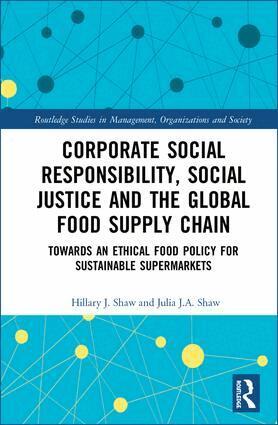
    Corporate Social Responsibility, Social Justice and the Global Food Supply Chain

    Towards an Ethical Food Policy for Sustainable Supermarkets

    AvHillary Shaw,Julia Shaw

    Inbunden, Engelska, 2019

    Del i serien Routledge Studies in Management, Organizations and Society

    2 506 kr

    Beställningsvara. Skickas inom 10-15 vardagar. Fri frakt över 249 kr.

    Fler format och utgåvor

    Häftad

    690 kr

    Beskrivning

    Food is a source of nourishment, a cause for celebration, an inducement to temptation, a means of influence, and signifies good health and well-being. Together with other life enhancing goods such as clean water, unpolluted air, adequate shelter and suitable clothing, food is a basic good which is necessary for human flourishing. In recent times, however, various environmental and social challenges have emerged, which are having a profound effect on both the natural world and built environment – such as climate change, feeding a growing world population, nutritional poverty and obesity. Consequently, whilst the relationships between producers, supermarkets, regulators and the individual have never been more important, they are becoming increasingly complicated. In the context of a variety of hard and soft law solutions, with a particular focus on corporate social responsibility (CSR), the authors explore the current relationship between all actors in the global food supply chain. Corporate Social Responsibility, Social Justice and the Global Food Supply Chain also provides a comprehensive and interdisciplinary response to current calls for reform in relation to social and environmental justice, and proposes an alternative approach to current CSR initiatives. This comprises an innovative multi-agency proposal, with the aim of achieving a truly responsible and sustainable food retail system. Because only by engaging in the widest possible participatory exercise and reflecting on the urban locale in novel, material and cultural ways, is it possible to uncover new directions in understanding, framing and tackling the modern phenomena of, for instance, food deserts, obesity, nutritional poverty and social injustice. Corporate Social Responsibility, Social Justice and the Global Food Supply Chain engages with a variety of disciplines, including, law, economics, management, marketing, retailing, politics, sociology, psychology, diet and nutrition, consumer behaviour, environmental studies and geography. It will be of interest to both practitioners and academics, including postgraduate students, social scientists and policy-makers.

    Produktinformation

    • Utgivningsdatum:2019-02-04
    • Mått:152 x 229 x 17 mm
    • Vikt:540 g
    • Format:Inbunden
    • Språk:Engelska
    • Serie:Routledge Studies in Management, Organizations and Society
    • Antal sidor:198
    • Förlag:Taylor & Francis Ltd
    • ISBN:9781138935532

    Utforska kategorier

    • Miljövetenskap och miljöpolitik inom Naturvetenskap och teknik
    • Affärsförhandlingar inom Ekonomi och Ledarskap
    • Tillverkningsindustri inom Ekonomi och Ledarskap

    Mer om författaren

    Hillary J. Shaw is Visiting Professor in the Department of Politics and Public Policy at De Montfort University, Leicester, UK. His research spans sustainable economic development, corporate social responsibility, and the integration of global and local food systems. He is the author of many journal articles, essays, reviews, reports and books, including The Consuming Geographies of Food: Diet, Food Deserts and Obesity (Routledge, 2014).Julia J.A. Shaw is Professor of Law and Social Justice in the School of Law at De Montfort University, Leicester, UK. Her research is interdisciplinary, and publications include Jurisprudence (3rd edition, Pearson 2018) and Law and the Passions: A Discrete History (Routledge, 2019).

    Innehållsförteckning

    • Introduction: Why do companies exist?Chapter 1: Feasting Cavemen and Responsible Giants1.1The eternal modern feast of supermarkets1.2 The growth of the supermarkets1.3 Food hedonism1.4 The growing obesity epidemic1.5 The multiple dimensions of economies of scale in supermarkets1.6 What is CSR?1.7 ‘Provisions’ as a Fourth Bottom Line; why we need enhanced supermarket CSR1.8 Is anything wrong with supermarket corporate social responsibility?1.9 The need for more accountable, comparable and long-term CSR 1.10 The need for other actors in the realm of supermarket corporate social responsibility Chapter 2: Food justice as social justice: towards a new regulatory framework in support of a basic human right to healthy food2.1 The need for regulatory reform to address food injustice2.2 Hungry for justice: the right to nutritional food and a healthy diet2.3 Social stratification, poverty and the unequal burden of family health and nutrition2.4 A Rawlsian approach to alleviating food poverty as a fundamental principle of social justice2.5 The reciprocal influence of egalitarian institutions as a basic requirement of social justice2.6 Between theory and reality: from moral law to soft law solutions2.7 The potential and limits of corporate social responsibility2.8 Beyond CSR, soft law and traditional regulatory models 2.9 ‘Proximity’ via Levinas and the law of tort: social responsibility begins in the neighbourhood2.10 Can there ever be a human right to healthy food? Chapter 3 Food Retailing, Society and the Economy3.1 From laissez-faire to planning regulations3.2 Behemoths versus Boroughs3.3 Supermarket land banks3.4. Other supermarket planning issues3.5. Respect for other nations’ laws and culture3.6. Supermarkets and competition with other retailers3.7 Supermarket competition with retailers in the developing world3.8. Supermarkets and job creation3.9 Supermarket pay levelsChapter 4 Food retailing and the environment4.1 Energy use in the food chain4.2 Food miles4.3 Water usage4.4. Sustainability of the food chain4.5 Sustainability of fishing4.6 Sustainability of the rainforest4.7 Plastic pollution4.8 Binning the plastic4.9 Food waste Chapter 5 Food retailing and supermarket suppliers5.1. Supermarket monopsonies and farm prices5.2. The price of milk5.3 Other supermarket food prices5.4 Supermarket clothing prices5.5 Supermarket payments to suppliers5.6. The pressures on rural society5.7 Animal welfare5.8 Food LabellingChapter 6 Food Retailing, Community and Consumers6.1 Assistance for customers6.2. Local charity donations6.3. Food banks6.4. Tesco Computers for Schools 6.5. Other supermarket charitable donations6.6. Supermarket customer data 6.7. Effort made by supermarkets to ensure the food from food processors is healthier.6.8. Marketing to children6.9. Supermarket food labellingChapter 7 Other food suppliers and food promoters7.1. Schools, prisons and the military7.2. Hospitals and care homes7.3. Television and other advertising.7.4. TaxationChapter 8: Supermarket CSR initiatives now, and change for future health and sustainability 8.1. A classification of current supermarket CSR initiatives8.2. The feel-good factor of CSR8.3. Refocussing CSR towards health and sustainability8.4. Keeping the supermarkets intact, candid, responsible and responsive