• Fri frakt över 249 kr
  • •
  • Snabba leveranser
  • •
  • Billiga böcker
Kundservice

Du är på sajten för privatpersoner.

Företag, bibliotek eller offentlig verksamhet?

Du handlar på classic.bokus.com, där alla dina funktioner finns intakta.
Till classic.bokus.com
Bokus logotyp. Gå till startsidan.
  • Erbjudanden
  • Student
  • Topplistor
  • Barn & ungdom
  • Bokus Play
  • E-böcker
  • Ljudböcker
  • Pocketböcker
  • Spel & pussel

10% rabatt på allt med kod NYSTART10 →

Sidfot

Mina sidor

    Hjälp

    • Kundservice
    • Vanliga frågor och svar
    • Frakt och leverans
    • Retur vid ångerrätt
    • Reklamera vara
    • Betalning
    • Köpvillkor
    • Allmänna villkor
    • Information om webbplatsens tillgänglighet

    Om Bokus

    • Om oss
    • Pressrum
    • För studenter
    • För företag
    • För bibliotek och offentlig verksamhet
    • För leverantörer
    • Hållbarhet

    Populärt

    • Aktuella erbjudanden
    • Presentkort
    • Studentlitteratur
    • Nya böcker
    • Topplistor
    • Signerade böcker
    • Engelska böcker

    Inspiration

    • Boktips
    • BookTok
    • Populära bokserier
    • Barnbokskaraktärer
    • Populära författare
    Logotyp för Bokus
    Följ oss på Facebook (extern länk)Följ oss på Instagram (extern länk)Följ oss på YouTube (extern länk)Följ oss på TikTok (extern länk)
    bokus @ CookiesAnpassa cookiesIntegritetspolicyKöpvillkor
    Till Citymail hemsida (extern länk)Till Budbee hemsida (extern länk)Till Postnord hemsida (extern länk)Till Schenker hemsida (extern länk)Till Early Bird hemsida (extern länk)Till Walleys hemsida (extern länk)
    1. Samhälle och politik
    2. Sociologi och antropologi
    3. Antropologi

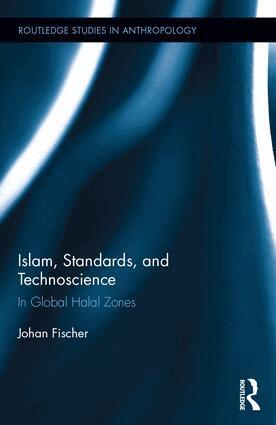
    Islam, Standards, and Technoscience

    In Global Halal Zones

    AvJohan Fischer

    Inbunden, Engelska, 2015

    Del i serien Routledge Studies in Anthropology

    2 650 kr

    Beställningsvara. Skickas inom 10-15 vardagar. Fri frakt över 249 kr.

    Fler format och utgåvor

    Häftad

    780 kr

    E-bok

    922 kr

    E-bok

    922 kr

    Beskrivning

    Halal (literally, "permissible" or "lawful") production, trade, and standards have become essential to state-regulated Islam and to companies in contemporary Malaysia and Singapore, giving these two countries a special position in the rapidly expanding global market for halal products: in these nations state bodies certify halal products as well as spaces (shops, factories, and restaurants) and work processes, and so consumers can find state halal-certified products from Malaysia and Singapore in shops around the world. Building on ethnographic material from Malaysia, Singapore, and Europe, this book provides an exploration of the role of halal production, trade, and standards. Fischer explains how the global markets for halal comprise divergent zones in which Islam, markets, regulatory institutions, and technoscience interact and diverge. Focusing on the "bigger institutional picture" that frames everyday halal consumption, Fischer provides a multisited ethnography of the overlapping technologies and techniques of production, trade, and standards that together warrant a product as "halal," and thereby help to format the market. Exploring global halal in networks, training, laboratories, activism, companies, shops and restaurants, this book will be an essential resource to scholars and students of social science interested in the global interface zones between religion, standards, and technoscience.

    Produktinformation

    • Utgivningsdatum:2015-12-11
    • Mått:152 x 229 x 17 mm
    • Vikt:453 g
    • Format:Inbunden
    • Språk:Engelska
    • Serie:Routledge Studies in Anthropology
    • Antal sidor:224
    • Förlag:Taylor & Francis Ltd
    • ISBN:9781138954182

    Utforska kategorier

    • Antropologi inom Samhälle och politik
    • Islam inom Filosofi och religion
    • Sociologi inom Samhälle och politik

    Mer om författaren

    Johan Fischer is Associate Professor in the Department of Society and Globalisation at Roskilde University.

    Recensioner i media

    "Although unfamiliar to non-Muslim publics, the Islamic classification of goods and actions into the categories of ‘lawful’ and ‘forbidden’ has in recent years become a religious and techno-scientific industry in its own right. In this fascinating and original work, Johan Fischer explores the politics, ethics, and technoscience of halal certification in Southeast Asia and Europe. The account tells us much about the emergent interface of science, authority, and ethics in the contemporary Muslim world. This is a thoughtful and thought-provoking study."- Robert W. Hefner, Director, Institute on Culture, Religion, and World Affairs, Boston University"Johan Fischer’s latest book provides an engaging, sophisticated, and deeply nuanced account of the intersection of Islamic technoscience, state power, and globalizing religious and economic development in Malaysia, Singapore, London, and beyond. Clearly written and well argued, this multi-sited ethnography simultaneously offers incisive perspectives on Islamization, class formation, audit regimes and their proliferation, and the sacralization of commodities produced for global religious markets. It will be welcomed by specialists across a number of different academic disciplines and also has great potential for use in the classroom."- Michael G. Peletz, Emory University"In fascinating ethnographic detail Johan Fischer shows the entanglement of the religious notion of halal with scientific technologies for certification in Malaysia and Singapore. The book demonstrates how halal is a marker of Muslim distinctiveness, but nevertheless as a globalized commodity cannot escape secular audit standards. This is a must read for any interested in the intersection of Islam and the global economy."- Peter van der Veer, Max Planck Institute for the Study of Religious and Ethnic Diversity, author of the Modern Spirit of Asia

    Innehållsförteckning

    • Introduction: Halal Between Islam, Standards, and Technoscience 1. In the Halal Zones of Malaysia and Singapore 2. Global Halal Networks 3. Halal Training 4. In the Halal Lab 5. Halal Activism 6. Manufacturing Companies 7. Shops and Restaurants. Conclusion.