• Fri frakt över 249 kr
  • •
  • Snabba leveranser
  • •
  • Billiga böcker
Kundservice

Du är på sajten för privatpersoner.

Företag, bibliotek eller offentlig verksamhet?

Du handlar på classic.bokus.com, där alla dina funktioner finns intakta.
Till classic.bokus.com
Bokus logotyp. Gå till startsidan.
  • Erbjudanden
  • Student
  • Topplistor
  • Barn & ungdom
  • Bokus Play
  • E-böcker
  • Ljudböcker
  • Pocketböcker
  • Spel & pussel

10% rabatt på allt med kod NYSTART10 →

Sidfot

Mina sidor

    Hjälp

    • Kundservice
    • Vanliga frågor och svar
    • Frakt och leverans
    • Retur vid ångerrätt
    • Reklamera vara
    • Betalning
    • Köpvillkor
    • Allmänna villkor
    • Information om webbplatsens tillgänglighet

    Om Bokus

    • Om oss
    • Pressrum
    • För studenter
    • För företag
    • För bibliotek och offentlig verksamhet
    • För leverantörer
    • Hållbarhet

    Populärt

    • Aktuella erbjudanden
    • Presentkort
    • Studentlitteratur
    • Nya böcker
    • Topplistor
    • Signerade böcker
    • Engelska böcker

    Inspiration

    • Boktips
    • BookTok
    • Populära bokserier
    • Barnbokskaraktärer
    • Populära författare
    Logotyp för Bokus
    Följ oss på Facebook (extern länk)Följ oss på Instagram (extern länk)Följ oss på YouTube (extern länk)Följ oss på TikTok (extern länk)
    bokus @ CookiesAnpassa cookiesIntegritetspolicyKöpvillkor
    Till Citymail hemsida (extern länk)Till Budbee hemsida (extern länk)Till Postnord hemsida (extern länk)Till Schenker hemsida (extern länk)Till Early Bird hemsida (extern länk)Till Walleys hemsida (extern länk)
    1. Språk och ordböcker
    2. Språkvetenskap och lingvistik

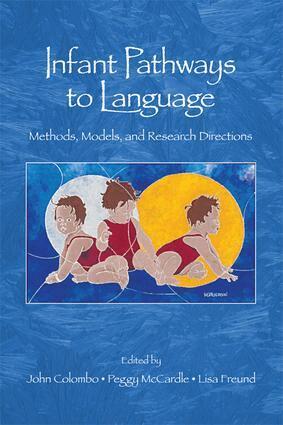
    Infant Pathways to Language

    Methods, Models, and Research Directions

    AvJohn Colombo,Peggy McCardle

    Häftad, Engelska, 2016

    540 kr

    Beställningsvara. Skickas inom 10-15 vardagar. Fri frakt över 249 kr.

    Beskrivning

    The recent progress in cognitive neuroscience, and the importance of genetic factors and gene-environment interactions in shaping behavioral functions in early childhood, have both underscored the primacy of early experience and development on brain development and function.The contributors to this volume discuss different paradigms and approaches in infant language and cognition, pushing the frontiers of research by innovatively combining methods, introducing new measures, and demonstrating the use of technologies and measurement approaches that can inform the study of word learning and categorization, gaze, attention, gesture, and physiological functions. The volume offers a blend of theories and empirical evidence to support, refute, or modify them. Most chapters examine the link between theory and methodology, and their appearance together in a single volume serves to inform and engage multiple disciplines, to engage everyone to think across disciplines and paradigms, to embrace the integration of creativity and science as the field continues to study in greater depth and with innovative measures and approaches, the infant pathways to language.The volume is essential reading for a wide range of students, researchers, and professionals with an interest in infant cognitive and language development.

    Produktinformation

    • Utgivningsdatum:2016-08-26
    • Mått:152 x 229 x 18 mm
    • Vikt:453 g
    • Format:Häftad
    • Språk:Engelska
    • Antal sidor:336
    • Förlag:Taylor & Francis Ltd
    • ISBN:9781138972711

    Utforska kategorier

    • Språkvetenskap och lingvistik inom Språk och ordböcker
    • Barnpsykologi och utvecklingspsykologi inom Psykologi och pedagogik
    • Biovetenskap inom Naturvetenskap och teknik

    Mer om författaren

    John Colombo, Peggy McCardle, Lisa Freund

    Innehållsförteckning

    • Introduction. P. McCardle, J. Colombo, L. Freund, Measuring Infant Language. Part 1. Recognizing Patterns . R.N. Aslin, E.I. Newport, What Statistical Learning Can and Can’t Tell Us About Language Acquisition. J.R. Saffran, Acquiring Grammatical Patterns: Constraints on Learning. L. Gerken, Are Infants Constrained in Their Linguistic Generalizations? Some Theoretical and Methodological Observations. M. Rice, How Different is Disordered Language? Part 2. From Patterns to Meaning . J.F. Werker, C.T. Fennell, Infant Speech Perception and Later Language Acquisition: Methodological Underpinnings. S. Waxman, How Infants Discover Distinct Word Types and Map Them to Distinct Meanings. J.S. Deloache, P.A. Ganea, V.K. Jaswal, Early Learning Through Language. Part 3. Predictors of Language Emergence . J. Colombo, D.J. Shaddy, O.M. Blaga, C.J. Anderson, K.N. Kannass, W.A. Richman, Early Attentional Predictors of Vocabulary in Childhood. A.N. Meltzoff, R. Brooks, Social Cognition and Language: The Role of Gaze Following in Early Word Learning. S. Goldin-Meadow, Using the Hands to Study How Children Learn Language. Part 4. Models and Methods to Study Infant Language. P.K. Kuhl, Linking Infant Speech Perception to Language Acquisition: Phonetic Learning Predicts Language Growth. L.B. Cohen, J. Brunt, Early Word Learning and Categorization: Methodological Issues and Recent Empirical Evidence. G. Marcus, H. Rabagliatti, Language Acquisition, Domain Specificity, and Descent with Modification. L. Freund, Neuroimaging Tools for Language Study. Finale . P. McCardle, L. Freund, G. Marcus, Pathways to Infant Language Research: Commentary and Future Directions.