• Fri frakt över 249 kr
  • •
  • Snabba leveranser
  • •
  • Billiga böcker
Kundservice

Du är på sajten för privatpersoner.

Företag, bibliotek eller offentlig verksamhet?

Du handlar på classic.bokus.com, där alla dina funktioner finns intakta.
Till classic.bokus.com
Bokus logotyp. Gå till startsidan.
  • Erbjudanden
  • Nyheter
  • Student
  • Topplistor
  • Barn & ungdom
  • Bokus Play
  • E-böcker
  • Pocketböcker
  • Spel & pussel

10% rabatt på allt med kod: NYSTART10 →

Sidfot

Mina sidor

    Hjälp

    • Kundservice
    • Vanliga frågor och svar
    • Frakt och leverans
    • Retur vid ångerrätt
    • Reklamera vara
    • Betalning
    • Köpvillkor
    • Allmänna villkor
    • Information om webbplatsens tillgänglighet

    Om Bokus

    • Om oss
    • Pressrum
    • För studenter
    • För företag
    • För bibliotek och offentlig verksamhet
    • För leverantörer
    • Hållbarhet

    Populärt

    • Aktuella erbjudanden
    • Presentkort
    • Studentlitteratur
    • Nya böcker
    • Topplistor
    • Signerade böcker
    • Engelska böcker

    Inspiration

    • Boktips
    • BookTok
    • Populära bokserier
    • Barnbokskaraktärer
    • Populära författare
    Logotyp för Bokus
    Följ oss på Facebook (extern länk)Följ oss på Instagram (extern länk)Följ oss på YouTube (extern länk)Följ oss på TikTok (extern länk)
    bokus @ CookiesAnpassa cookiesIntegritetspolicyKöpvillkor
    Till Citymail hemsida (extern länk)Till Budbee hemsida (extern länk)Till Postnord hemsida (extern länk)Till Schenker hemsida (extern länk)Till Early Bird hemsida (extern länk)Till Walleys hemsida (extern länk)
    1. Kultur
    2. Designböcker
    3. Typografi och kalligrafi

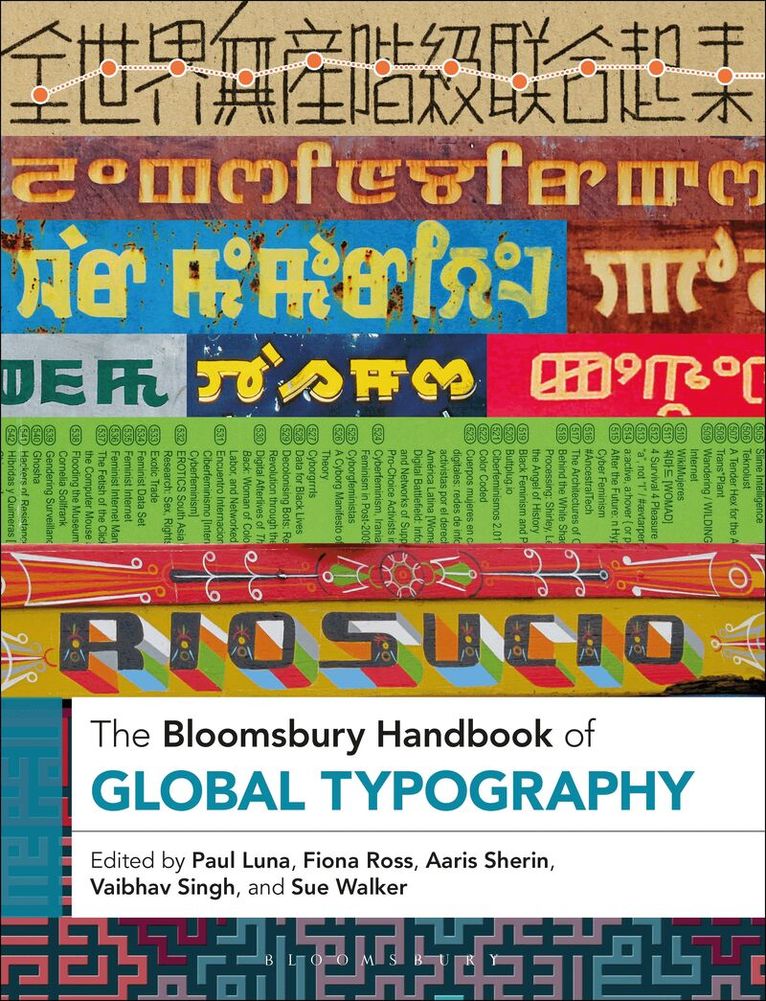
    Bloomsbury Handbook of Global Typography

    AvPaul Luna,Fiona Ross

    Inbunden, Engelska, 2026

    Del i serien Bloomsbury Visual Arts Handbooks

    1 839 kr

    Beställningsvara. Skickas inom 5-8 vardagar. Fri frakt över 249 kr.

    Beskrivning

    This new handbook takes the broadest possible view of typography, defining it as ‘design for reading’. It considers all kinds of reading matter and visual communication systems; digital, environmental, printed, and produced by hand.By offering a rich collection of texts that are genuinely international in authorship and in scope, it seeks to rebalance the Western bias of so many books on the subject. It gives space to new voices and emerging standpoints about the global nature of design, the needs of particular communities of readers, and about the need for inclusivity and historical understanding in design practice and research.Thirty-seven chapters by forty-three contributors show the interdisciplinary range of research in typography today, exemplifying the relationship between history, theory, and practice that is at the heart of the discipline. They feature over 500 illustrations, mostly in colour, and full bibliographic references.Topics include:Typography and sociolinguisticsFrameworks for considering scripts and multilingual documentsHistorical and contemporary Arabic-script typographic practiceDesigning fonts for marginalized communities in Asia, Africa, and North AmericaThe earliest movable type in China in the tenth centuryUnderstanding Japanese and Korean typographyApproaches to legibilityWestern influence on the typography of indigenous writing systemsPolitical and technological factors that shape typographyExperimental and commercial publishing contextsThe type design industry todayTypography in the environment

    Produktinformation

    • Utgivningsdatum:2026-02-19
    • Mått:192 x 248 x 38 mm
    • Vikt:1 640 g
    • Format:Inbunden
    • Språk:Engelska
    • Serie:Bloomsbury Visual Arts Handbooks
    • Antal sidor:528
    • Förlag:Bloomsbury Publishing PLC
    • ISBN:9781350336384

    Utforska kategorier

    • Typografi och kalligrafi inom Kultur
    • Bokkonst, bokformgivning inom Kultur
    • Designhistoria inom Kultur

    Mer om författaren

    Paul Luna is Emeritus Professor at the University of Reading, UK, and author of Typography: A Very Short Introduction (2018). He has written on the relationship between typography and lexicography, and for many years directed the design of English and bilingual dictionaries at Oxford University Press.Fiona Ross is Professor in Type Design at the University of Reading, UK. With a background in languages and Indian palaeography, she specializes in type design for Arabic, South Asian, and Thai writing systems. Fiona has received the SoTA Typography Award (2014) and the Type Director’s Club Medal (2018).Aaris Sherin is an educator, writer, and designer. She is Professor of Graphic Design at St John’s University, New York, USA, and the author of Sustainable Thinking (Bloomsbury, 2017) and Introduction to Graphic Design (Bloomsbury, 2017).Vaibhav Singh is an independent researcher, typographer, and type designer. Previously a British Academy Postdoctoral Fellow and chairman of the Printing Historical Society, he is the editor of the journal Contextual Alternate and co-editor of the Bloomsbury research series Notes on Typography.Sue Walker is co-director of the interdisciplinary Centre for Book Cultures and Publishing, and director of the Lettering, Printing, and Graphic Design Collections in the Department of Typography and Graphic Communication at the University of Reading, UK. Her research interests are in book design for young people and the relationship between typography and language.

    Recensioner i media

    This substantial volume establishes a new benchmark within the field, offering detailed historical and empirical research and critical scholarly analysis not only of the myriad variations in letterforms, but also of the underlying typographic systems employed in typesetting. This book is an indispensable resource for scholars, designers, and practitioners involved in typography as the production of language.

    Innehållsförteckning

    • Introduction1. The skeletons and dresses of writing systems: A (grapho)linguistic perspective on graphic structure and variationDimitrios Meletis2. Putting the world’s writing systems into print: Triumphs and tribulationsGraham Shaw3. The origin and development of early Chinese movable typeXunchang Cheng4. Type design as a collaborative process with particular reference to South Asian scriptsFiona Ross5. A framework for research-informed typeface design: Starting with GreekGerry Leonidas6. Analysing the typography of bilingual documents: Descriptive frameworks for graphical and spatial attributes of textKeith Tam7. Some influences on legibility: Who or what has changed notions of legibility through time?Mary C. Dyson , Niki Sioki, and Mila Waldeck8. The work of text in the age of digital information: Who (or what) makes typographic decisions?John Hudson9. The process of shaping text: An engineer’s perspectiveSimon Cozens10. Change in the digital type industryDan Rhatigan, Doug Wilson , and David Lemon11. The straitjacket of modernity : The New Nagari project and typeface design in IndiaVaibhav Singh12. Hebrew type designs of the 1950s : Typographic building blocks of a new nationAdi Stern13. The impact of Latinization on Armenian reading matter: A case study in newspapersElena Papassissa14. The peculiarities of Cyrillic letterforms: Design variation and correlation in Russian typefacesMaxim Zhukov15. Cyrillic beyond Russia: Four reflections in historyJohn Hudson16. Latin American vernacular letteringPriscila L. Farias17. Sea facing: Typography at the English seasideJustin Burns18. Drawing Ireland’s new typographic horizonsClare Bell19. Type-like: The special case of stencil workEric Kindel20. Analysing typographic meaning-making in urban spaces: Four illustrative case studiesIrmi Wachendorff21. Twentieth-century Black American design in contextGreg Bunbury22. The calligraphy, lettering, and typography of Louise E. Jefferson: A Black woman designer in twentieth-century AmericaTasheka Arceneaux-Sutton23. Experimental publishing: Alternative networked cultures and new archival initiativesRuth Blacksell24. The clothes words wear: Mapping meaning in dictionaries through typographyPaul Luna25. Aspects of inclusive text designSofie Beier26. Towards understanding diversity in Arabic typestyles: A study of readers’ preferences in Arabic typefaces for text compositionMohamad Dakak27. Infinite loops: On the contours of Chinese typeCaspar Lam and YuJune Park28. A Japanese typography primer: Unity from diversityMariko Takagi29. Hangeul, the script of expansion and harmonizationYanghee Ryu30. From reed to steel: The origins of nasta‘liq type-making in nineteenth-century Istanbul and CairoBorna Izadpanah31. Reading text in Square Kufic: Deciphering calligraphy in complex graphic formsMamoun Sakkal32. Secondary styles in Georgian typographyAna Sanikidze33. Modified Arabic scripts used by Uyghur, Kazakh, and Kyrgyz speakers in Xinjiang, ChinaHuati Wulan34. Democratizing effective typographic expression: The role of Meitei Mayek in local and global communicationNeelakash Kshetrimayum35. Native American typography: Reinforcing cultural identityJuliet Shen36. A typeface design for Africa: Designing a multi-script typeface familyMark Jamra and Neil Patel37. Typography’s duty to language: Figurations of language in twentieth-century typographic discourseRobin Fuller