• Fri frakt över 249 kr
  • •
  • Snabba leveranser
  • •
  • Billiga böcker
Kundservice

Du är på sajten för privatpersoner.

Företag, bibliotek eller offentlig verksamhet?

Du handlar på classic.bokus.com, där alla dina funktioner finns intakta.
Till classic.bokus.com
Bokus logotyp. Gå till startsidan.
  • Erbjudanden
  • Nyheter
  • Student
  • Topplistor
  • Barn & ungdom
  • Bokus Play
  • E-böcker
  • Pocketböcker
  • Spel & pussel

10% rabatt på allt med kod: NYSTART10 →

Sidfot

Mina sidor

    Hjälp

    • Kundservice
    • Vanliga frågor och svar
    • Frakt och leverans
    • Retur vid ångerrätt
    • Reklamera vara
    • Betalning
    • Köpvillkor
    • Allmänna villkor
    • Information om webbplatsens tillgänglighet

    Om Bokus

    • Om oss
    • Pressrum
    • För studenter
    • För företag
    • För bibliotek och offentlig verksamhet
    • För leverantörer
    • Hållbarhet

    Populärt

    • Aktuella erbjudanden
    • Presentkort
    • Studentlitteratur
    • Nya böcker
    • Topplistor
    • Signerade böcker
    • Engelska böcker

    Inspiration

    • Boktips
    • BookTok
    • Populära bokserier
    • Barnbokskaraktärer
    • Populära författare
    Logotyp för Bokus
    Följ oss på Facebook (extern länk)Följ oss på Instagram (extern länk)Följ oss på YouTube (extern länk)Följ oss på TikTok (extern länk)
    bokus @ CookiesAnpassa cookiesIntegritetspolicyKöpvillkor
    Till Citymail hemsida (extern länk)Till Budbee hemsida (extern länk)Till Postnord hemsida (extern länk)Till Schenker hemsida (extern länk)Till Early Bird hemsida (extern länk)Till Walleys hemsida (extern länk)
    1. Historia och arkeologi
    2. Historia
    3. Historia: särskilda händelser och ämnen
    4. Kolonialism och imperialism

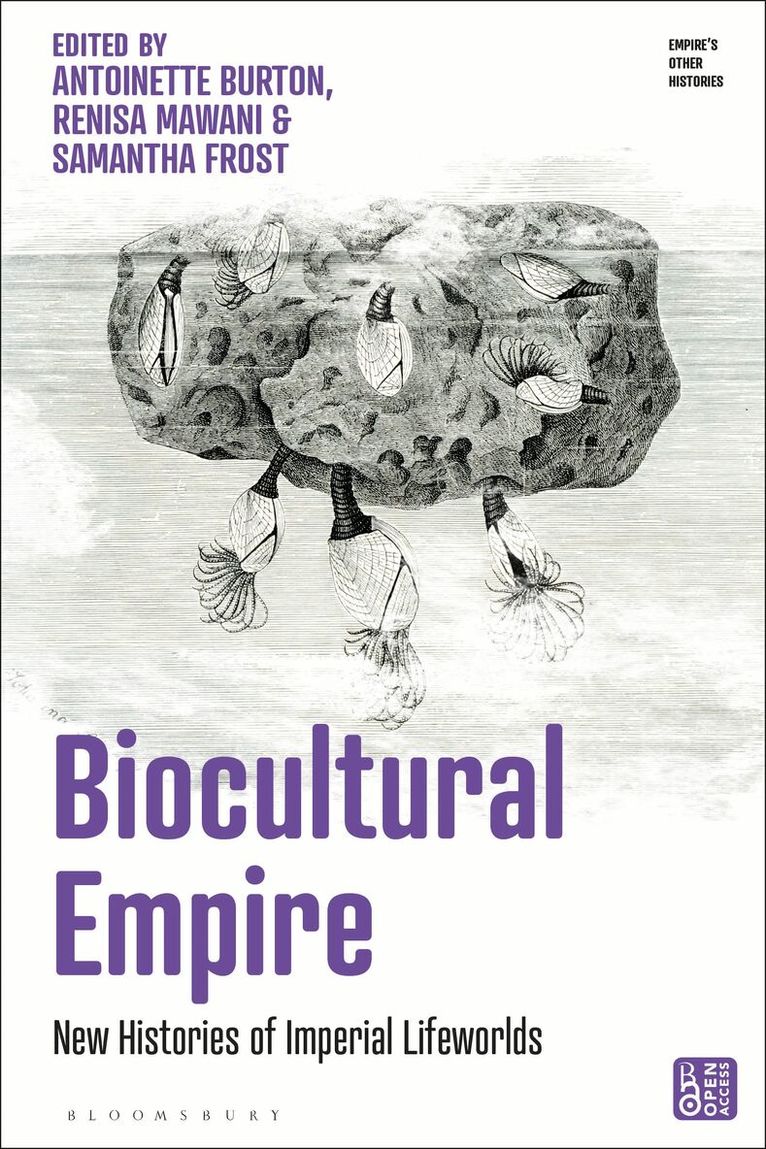
    Biocultural Empire

    New Histories of Imperial Lifeworlds

    AvAntoinette Burton,Renisa Mawani

    Inbunden, Engelska, 2024

    Del i serien Empire’s Other Histories

    1 222 kr

    Beställningsvara. Skickas inom 10-15 vardagar. Fri frakt över 249 kr.

    Beskrivning

    Human species supremacy is one of the most persistent fictions at work in the field of modern British imperial history today. This open access collection challenges that assumption, and investigates what histories of empire look like if reimagined as the effect of biocultural, chemical and cultural processes, rather than the result of effects by humans that have been visited upon cultural landscapes, fauna and biomes.In understanding the boundaries between human and nonhuman worlds as porous and open to mutual transformation, and foregrounding interspecies interactions, Biocultural Empire seeks to understand the conditions of imperial power, experience and knowledge as a remix of ‘nature’ and ‘culture’. Bringing empire’s ‘biocultural histories’ to the fore, it asks imperial historians to reckon with an interpretative framework which refuses the sovereignty and boundedness of the imperial subject by seeing it as inseparable from its social and ecological formations. Through this biocultural framework this collection highlights how relentlessly the human species bias of western liberal thought persists at the heart of imperial projects and their histories, and offers a new anti-colonial method that represents a significant intervention in the field of British imperial history.The ebook editions of this book are available open access under a CC BY-NC-ND 4.0 licence on bloomsburycollections.com. Open access was funded by University of Illinois, USA and University of British Columbia, Canada.

    Produktinformation

    • Utgivningsdatum:2024-12-12
    • Mått:155 x 231 x 18 mm
    • Vikt:520 g
    • Format:Inbunden
    • Språk:Engelska
    • Serie:Empire’s Other Histories
    • Antal sidor:240
    • Förlag:Bloomsbury Publishing PLC
    • ISBN:9781350451056

    Utforska kategorier

    • Kolonialism och imperialism inom Historia och arkeologi
    • Miljövetenskap och miljöpolitik inom Naturvetenskap och teknik
    • Etnicitet inom Samhälle och politik

    Mer om författaren

    Antoinette Burton is Professor of History and Swanlund Endowed Professor at University of Illinois Urbana-Champaign, USA. A feminist historian of the British Empire whose work has focused on women, gender, race and intersectional approaches, she is the author of six monographs and many edited collections including (with Renisa Mawani) Animalia: An Anti-Imperial Bestiary for Our Times (2020).Renisa Mawani is Canada Research Chair in Colonial Legal Histories and Professor of Sociology at the University of British Columbia, Canada, located on the unceded territories of the Musqueam peoples. She is the author of Colonial Proximities (2009) and Across Oceans of Law (2018), which was a finalist for the U.K. Socio-Legal Studies Association Theory and History Book Prize (2020) and winner of the Association of Asian American Studies Book Prize for Outstanding Contribution to History (2020). With Antoinette Burton, she is co-editor of Animalia: An Anti-Imperial Bestiary for Our Times (2020).Samantha Frost is Professor of political theory in the Department of Political Science, the Department of Gender and Women’s Studies, and the Unit for Criticism and Contemporary Theory at the University of Illinois, Urbana-Champaign, USA. She is the author of Biocultural Creatures: Toward A New Theory of the Human (2016), which elucidates the conceptual significance of the plasticity of the biological body.

    Recensioner i media

    This provocative collection takes imperial history where it has seldom been before, re-imagining empire as a consequence of biocultural processes. Compelling essays illustrate this approach whether through keratin, chromosomes, whales, plants, water, mud and more. An essential guide for doing radical imperial history in the age of the Anthropocene.

    Innehållsförteckning

    • List of FiguresAcknowledgementsIntroduction: Biocultural Empires as an Anti-colonial Method, Antoinette Burton (University of Illinois, USA) Renisa Mawani (University of British Columbia, Canada), Samantha Frost (University of Illinois, USA)1. Very Like a Whale: Animal Metaphors and the Biocultural Imagination, Jamie Jones (University of Illinois, USA)2. Biocultural Histories of the Black Anthropocene: Energy, Consumption, and Non-Human Worlds in The History of Barbados and The History of Mary Prince, Anna Feuerstein, (University of Hawai'i-Manoa, USA)3. A Victorian Parliament of Animals; or, the Biocultural as Imperial Political Form, Antoinette Burton (University of Illinois, USA)4. Ganja and the Godhead: Plant Matter and the Sacral Binds of the Excise Principle in British India, Utathya Chattopadhyaya (UC-Santa Barbara, USA)5. The Royal Sacred Hairy Family of Burmah: Human Difference and Biocultural Empire in the Nineteenth Century, Jonathan Saha, (Durham University, UK)6. History in the Water(s): Water and Empire in North America’s Wet Centre”, Adele Perry, (University of Manitoba, Canada)7. Strangers, Difference and the Darkness of Empire: The HMB Endeavour in New Zealand, Tony Ballantyne (University of Otago, New Zealand)8. Papering over Muddy Histories: Imperial Logics of Space in the Anthropocene, Debjani Bhattacharya (University of Zurich, Switzerland)BibliographyIndex