E-bok, Engelska, 2017
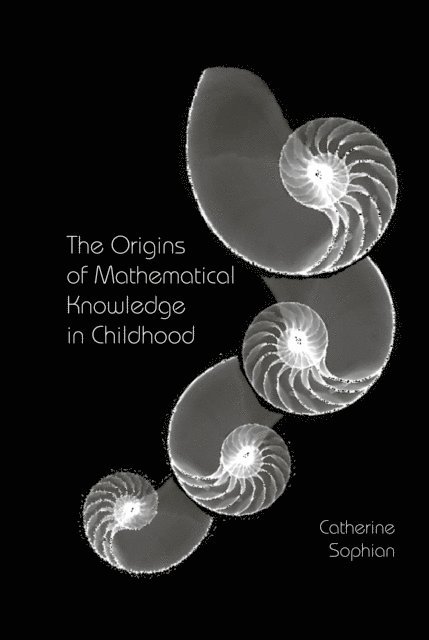
Origins of Mathematical Knowledge in Childhood
1161 kr
Läs direkt i Bokus Reader – eller ladda ned till din enhet
Beskrivning
This book examines the origins and development of children''s mathematical knowledge. It contrasts the widely held view that counting is the starting point for mathematical development with an alternative comparison-of-quantities position. According to the comparison-of-quantities position, the concept of number builds upon more basic concepts of equality, inequality, and less-than and greater-than relations, which derive from comparisons between unenumerated quantities such as lengths. The concept of number combines these basic comparative concepts with the concept of a unit of measure, which allows one quantity to be described as a multiple of another.
Sophian examines these alternative accounts of children''s developing mathematical knowledge in the light of research:
- on children''s counting;
- on their reasoning about continuous quantities such as length and area;
- on the development of the concept of unit;
- on additive and multiplicative reasoning; and
- on knowledge about fractions.
In the closing chapters, Sophian draws out the developmental and the educational implications of the research and theory presented. Developmentally, the comparison-of-quantities position undermines the idea that numerical knowledge develops through domain-specific learning mechanisms in that it links numerical development both to physical knowledge about objects, which is the starting point for the concept of unit, and to the acquisition of linguistic number terms. Instructionally, the comparison-of-quantities perspective diverges from the counting-first perspective in that it underscores the continuity between whole-number arithmetic and fraction learning that stems from the importance of the concept of unit for both. Building on this idea, Sophian advances three instructional recommendations: First, instruction about numbers should always be grounded in thinking about quantities and how numbers represent the relations between them; second, instruction in the early years should always be guided by a long-term perspective in which current objectives are shaped by an understanding of their role in the overall course of mathematics learning; and third, instruction should be directly toward promoting the acquisition of the most general mathematical knowledge possible.
The Origins of Mathematical Knowledge in Childhood is intended for researchers, professionals, and graduate students in developmental psychology, educational psychology, and mathematics education, and as a supplementary text for advanced undergraduate courses in cognitive development, educational psychology, and mathematics education.
Produktinformation
- Utgivningsdatum: 2017-09-25
- Språk: Engelska
- Filformat: EPUB
- Kopieringsskydd: LCP
- ISBN: 9781351541749
- Förlag: Taylor & Francis
Utforska kategorier
Betyg & recensioner
0 recensioner
Inga recensioner tillgängliga.