• Fri frakt över 249 kr
  • •
  • Snabba leveranser
  • •
  • Billiga böcker
Kundservice

Du är på sajten för privatpersoner.

Företag, bibliotek eller offentlig verksamhet?

Du handlar på classic.bokus.com, där alla dina funktioner finns intakta.
Till classic.bokus.com
Bokus logotyp. Gå till startsidan.
  • Erbjudanden
  • Nyheter
  • Student
  • Topplistor
  • Barn & ungdom
  • Bokus Play
  • E-böcker
  • Pocketböcker
  • Spel & pussel

10% rabatt på allt med kod NYSTART10 →

Sidfot

Mina sidor

    Hjälp

    • Kundservice
    • Vanliga frågor och svar
    • Frakt och leverans
    • Retur vid ångerrätt
    • Reklamera vara
    • Betalning
    • Köpvillkor
    • Allmänna villkor
    • Information om webbplatsens tillgänglighet

    Om Bokus

    • Om oss
    • Pressrum
    • För studenter
    • För företag
    • För bibliotek och offentlig verksamhet
    • För leverantörer
    • Hållbarhet

    Populärt

    • Aktuella erbjudanden
    • Presentkort
    • Studentlitteratur
    • Nya böcker
    • Topplistor
    • Signerade böcker
    • Engelska böcker

    Inspiration

    • Boktips
    • BookTok
    • Populära bokserier
    • Barnbokskaraktärer
    • Populära författare
    Logotyp för Bokus
    Följ oss på Facebook (extern länk)Följ oss på Instagram (extern länk)Följ oss på YouTube (extern länk)Följ oss på TikTok (extern länk)
    bokus @ CookiesAnpassa cookiesIntegritetspolicyKöpvillkor
    Till Citymail hemsida (extern länk)Till Budbee hemsida (extern länk)Till Postnord hemsida (extern länk)Till Schenker hemsida (extern länk)Till Early Bird hemsida (extern länk)Till Walleys hemsida (extern länk)
    1. Samhälle och politik
    2. Politik och statsskick
    3. Statsskick och politiska processer
    4. Statsskick: demokrati

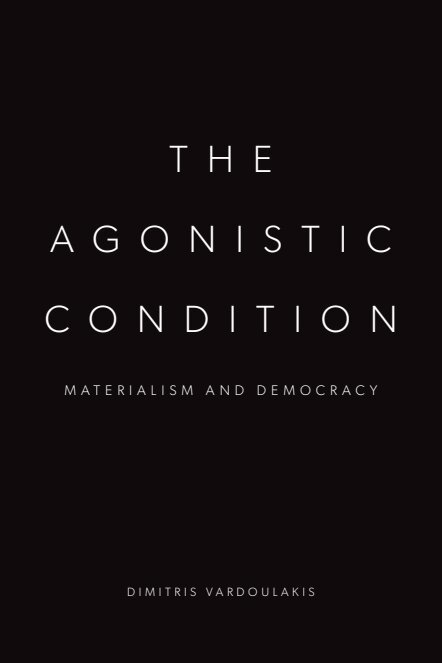
    Agonistic Condition

    Materialism and Democracy

    AvDimitris Vardoulakis

    Inbunden, Engelska, 2025

    1 289 kr

    Beställningsvara. Skickas inom 7-10 vardagar. Fri frakt över 249 kr.

    Fler format och utgåvor

    Häftad

    Kommande

    Beskrivning

    Political theory influenced by philosophy examines the political as the sphere of human interaction that is distinct from politics, the sphere of political institutions and parties. The political is usually described in conflictual terms, such as Marx's class struggle, Heidegger's polemos, Ranciere's dissensus, or the discourse of agonistic democracy.This book challenges the premise of such constructions of agonism, namely, that the political is essentially distinct from means and ends calculations. He argues that this premise is derived from the critique of instrumental reason, which assumes that utilitarianism is correct that instrumental ends are measurable. This forgets an ancient tradition that describes phronesis as the primary ethical and political virtue because it calculates the good, which is however impossible to measure with any certainty.The Agonistic Condition shows that a new consideration of phronesis can help political philosophy and theory to develop more robust conceptions of power that better describe the world we live in.

    Produktinformation

    • Utgivningsdatum:2025-06-30
    • Mått:156 x 234 x 24 mm
    • Vikt:614 g
    • Format:Inbunden
    • Språk:Engelska
    • Antal sidor:320
    • Förlag:Edinburgh University Press
    • ISBN:9781399549608

    Utforska kategorier

    • Statsskick: demokrati inom Samhälle och politik
    • Statsvetenskap och politisk teori inom Samhälle och politik
    • Filosofiska discipliner inom Filosofi och religion

    Mer om författaren

    Dimitris Vardoulakis is Professor of Philosophy at Western Sydney University. He is the author of The Doppelgänger: Literature’s Philosophy (2010), Sovereignty and its Other: Toward the Dejustification of Violence (2013), Freedom from the Free Will: On Kafka’s Laughter (SUNY, 2016) and Stasis Before the State: Nine Theses on Agonistic Democracy (2018). He has edited or co-edited numerous books, including Spinoza Now (2011) and Spinoza’s Authority (two volumes, 2018). He is co-series editor of Incitements and founding editor of the journal Philosophy, Politics and Critique, both at Edinburgh University Press.

    Recensioner i media

    In The Agonistic Condition Dimitris Vardoulakis offers a deep and powerful critique of what he calls “ineffectualism,” the idea, promoted by many left leaning philosophers, of the value of non-instrumentality. For Vardoulakis, this allows for a return of metaphysics, a disengagement with the actual world as such that leads to various forms of domination and control. By fundamentally accepting the Nietzschean concept of the death of God, Vardoulakis calls for a radical affirmation of instrumentality, not in terms (once again) of domination, but precisely for the opposite reason. Vardoulakis claims—very convincingly—that we must embrace instrumentality as being the basis for a human centered form of judgment that has no truck with the transcendental. This is the basis for the agonistic--i.e. human--condition itself. This book should be on the shelf of every scholar who is interested in having a radical rethinking of the entire basis of leftist anti metaphysics and the politics that result from it.

    Innehållsförteckning

    • PrefacePreamble, The Agonistic ConditionIntroduction: Agonism and Democracy[1] Agonistic Democracy[2] What is Agon?[3] The Repression of Instrumentality[4] Agonism and the Phronetic Tradition1. The Political as Irreducible to the Institutional[5] The Problematic of the Confinement of the Political to Institutions[6] The Expansion of Power (Nietzsche)[7] Pluralism, or the Materialism of Differentiation (Connolly)[8] The Agonistic Interplay of Law and Culture (Tully)[9] Natality and Agonism (Arendt)[10] (Re)founding (Honig)[11] The Ontologization of the Political (Schmitt)[12] The Ever Present Possibility of Antagonism (Mouffe)[13] The Political Difference (Marchart)[14] Monism and Instrumentality (the first sense of agonism)2. Consensus as Incommensurate with the Political[15] The Problematic of the Politics of Consensus[16] Power or Consensus? (Nietzsche)[17] Genealogy and Resentment (Connolly)[18] Consensus or Recognition? (Tully)[19] The Rise of the Social (Arendt)[20] Agonism as Disruption (Honig)[21] The Double Sense of Agonism (Schmitt)[22] Pluralism or Consensus? (Mouffe)[23] The Rise of the Political (Marchart)[24] Stasis (the second sense of agonism)3. Instrumentality and Agonism[25] The Problematic of the Repression of Instrumentality[26] The Calculating Animal (Nietzsche)[27] Becoming and the Ineffectual (Connolly)[28] Use Without Ends (Tully)[29] The Slavery of Modernity (Arendt)[30] Paradoxes of Excess (Honig)[31] Total Peace (Schmitt)[32] Liberalism, the Frenemy, and the Instrumentality Without Ends (Mouffe)[33] The Two Negations (Marchart)[34] The Conflation of Causality and Instrumentality (repression)5. The Ruse of Power[35] The Problematic of the Ruse of Power[36] The Magic Trick of the Ascetic Ideal (Nietzsche)[37] Agonistic Respect and Existential Faith (Connolly)[38] Not European Enough (Tully)[39] The Inverse Relation of Power and Violence (Arendt)[40] The ruse of power and neoliberalism (Honig)[41] Where does War End? (Schmitt)[42] The Logic of the Whatever (Mouffe)[43] The Persistence of Political Judgment (Marchart)[44] Violence and Political Change (the Epicurean “Social Contract”)Afterword[45] Afterword: In Defense of Instrumentality, or, the Persistence of the GoodBibliographyIndex