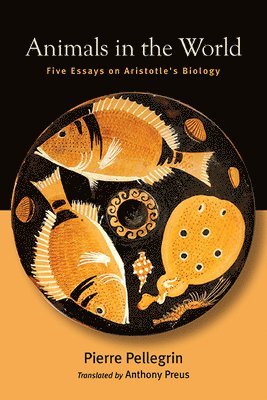
Animals in the World
Five Essays on Aristotle's Biology
472 kr
Beställningsvara. Skickas inom 5-8 vardagar. Fri frakt över 249 kr.
Du är på sajten för privatpersoner.
472 kr
Beställningsvara. Skickas inom 5-8 vardagar. Fri frakt över 249 kr.
Pierre Pellegrin is Director of Research at the National Center for Scientific Research in Paris, France. His books include Aristotle's Classification of Animals: Biology and the Conceptual Unity of the Aristotelian Corpus and Endangered Excellence: On the Political Philosophy of Aristotle, both translated by Anthony Preus. Anthony Preus is Distinguished Teaching Professor in Philosophy at Binghamton University, State University of New York. He is the author and editor of many books, including Historical Dictionary of Ancient Greek Philosophy.
"…a valuable addition to Aristotle's scholarship on the science of animals."— CHOICE"In this collection of five essays on topics he considers crucial, Pellegrin presents the results of decades of work on Aristotle's understanding of living things and on Aristotle's place in the history of biological and medical thought from antiquity to the present. With the biological works making up a quarter to a third of the corpus, Pellegrin's interpretations of the language, concepts, and arguments in these works turn out to enlighten the whole. The items covered range from final cause and necessity, in living things and in the cosmos at large—where Pellegrin argues that Aristotle rejects both intentional teleology of the Timaeus variety and an exclusive Presocratic mechanism as instruments for explaining cosmic order—to the relation of the abilities and organs of living things to one another, which Pellegrin finds in Aristotle's treatment of animal and plant life. While keeping the Aristotelian text clearly in focus, the author engages at length with other major figures who have contributed to the biological turn. Preus's readable translation of the author's recent Des animaux dans le monde brings an original and challenging statement of Pellegrin's views to the English-speaking public and will be informative for scholars in the histories of philosophy and science alike." — John J. Mulhern, University of Pennsylvania
Du är på sajten för privatpersoner.
472 kr
Beställningsvara. Skickas inom 5-8 vardagar. Fri frakt över 249 kr.
Pierre Pellegrin is Director of Research at the National Center for Scientific Research in Paris, France. His books include Aristotle's Classification of Animals: Biology and the Conceptual Unity of the Aristotelian Corpus and Endangered Excellence: On the Political Philosophy of Aristotle, both translated by Anthony Preus. Anthony Preus is Distinguished Teaching Professor in Philosophy at Binghamton University, State University of New York. He is the author and editor of many books, including Historical Dictionary of Ancient Greek Philosophy.
"…a valuable addition to Aristotle's scholarship on the science of animals."— CHOICE"In this collection of five essays on topics he considers crucial, Pellegrin presents the results of decades of work on Aristotle's understanding of living things and on Aristotle's place in the history of biological and medical thought from antiquity to the present. With the biological works making up a quarter to a third of the corpus, Pellegrin's interpretations of the language, concepts, and arguments in these works turn out to enlighten the whole. The items covered range from final cause and necessity, in living things and in the cosmos at large—where Pellegrin argues that Aristotle rejects both intentional teleology of the Timaeus variety and an exclusive Presocratic mechanism as instruments for explaining cosmic order—to the relation of the abilities and organs of living things to one another, which Pellegrin finds in Aristotle's treatment of animal and plant life. While keeping the Aristotelian text clearly in focus, the author engages at length with other major figures who have contributed to the biological turn. Preus's readable translation of the author's recent Des animaux dans le monde brings an original and challenging statement of Pellegrin's views to the English-speaking public and will be informative for scholars in the histories of philosophy and science alike." — John J. Mulhern, University of Pennsylvania