• Fri frakt över 249 kr
  • •
  • Snabba leveranser
  • •
  • Billiga böcker
Kundservice

Du är på sajten för privatpersoner.

Företag, bibliotek eller offentlig verksamhet?

Du handlar på classic.bokus.com, där alla dina funktioner finns intakta.
Till classic.bokus.com
Bokus logotyp. Gå till startsidan.
  • Erbjudanden
  • Nyheter
  • Student
  • Topplistor
  • Barn & ungdom
  • Bokus Play
  • E-böcker
  • Pocketböcker
  • Spel & pussel

10% rabatt på allt med kod NYSTART10 →

Sidfot

Mina sidor

    Hjälp

    • Kundservice
    • Vanliga frågor och svar
    • Frakt och leverans
    • Retur vid ångerrätt
    • Reklamera vara
    • Betalning
    • Köpvillkor
    • Allmänna villkor
    • Information om webbplatsens tillgänglighet

    Om Bokus

    • Om oss
    • Pressrum
    • För studenter
    • För företag
    • För bibliotek och offentlig verksamhet
    • För leverantörer
    • Hållbarhet

    Populärt

    • Aktuella erbjudanden
    • Presentkort
    • Studentlitteratur
    • Nya böcker
    • Topplistor
    • Signerade böcker
    • Engelska böcker

    Inspiration

    • Boktips
    • BookTok
    • Populära bokserier
    • Barnbokskaraktärer
    • Populära författare
    Logotyp för Bokus
    Följ oss på Facebook (extern länk)Följ oss på Instagram (extern länk)Följ oss på YouTube (extern länk)Följ oss på TikTok (extern länk)
    bokus @ CookiesAnpassa cookiesIntegritetspolicyKöpvillkor
    Till Citymail hemsida (extern länk)Till Budbee hemsida (extern länk)Till Postnord hemsida (extern länk)Till Schenker hemsida (extern länk)Till Early Bird hemsida (extern länk)Till Walleys hemsida (extern länk)
    1. Psykologi och pedagogik
    2. Psykologi
    3. Åldrandets psykologi

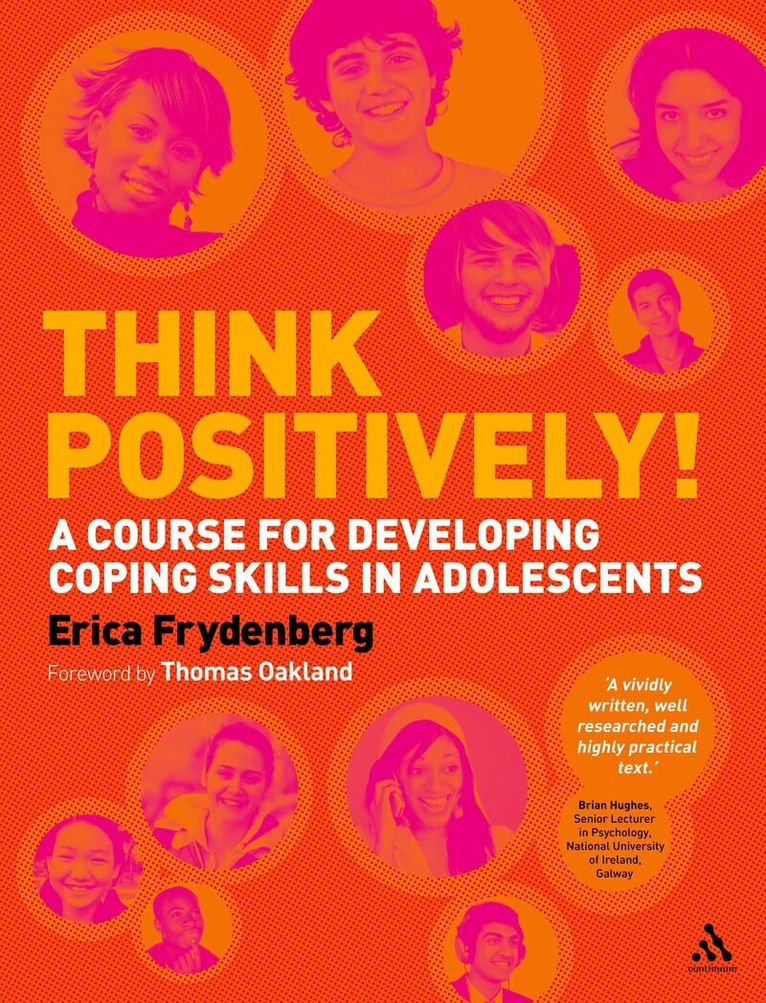
    Think Positively!

    A course for developing coping skills in adolescents

    AvErica Frydenberg

    Häftad, Engelska, 2010

    293 kr

    Beställningsvara. Skickas inom 10-15 vardagar. Fri frakt över 249 kr.

    Fler format och utgåvor

    E-bok

    382 kr

    Beskrivning

    Using photocopiable and electronic resources, Erica Frydenberg provides teachers with strategies that will enable students to combat stress and depression in the classroom. Depression is being experienced in epidemic proportions in many Western societies, and there is great concern over the number of young people who are suffering, sometimes to the extent of committing suicide. This book aims to help prevent stress and depression by taking a positive approach to the promotion of health and well being in young people, giving them the skills to cope with the problems of everyday life at school and at home. Erica Frydenberg introduces the theory behind a cognitive behavioural approach to coping skills and offers a program of modules that teachers or other professionals can use with young people to train them in coping skills. The principle that underscores this program is that we can all do what we do better. If we do not like how we cope in certain contexts we can learn new strategies. It is possible to enhance and develop one's coping if we have a framework within which to do that. The program is designed to have universal application and can be taught in any group or class setting.Nevertheless, instructors will be able to bring their own experience and adaptations to the sessions.

    Produktinformation

    • Utgivningsdatum:2010-05-03
    • Mått:189 x 246 x 19 mm
    • Vikt:498 g
    • Format:Häftad
    • Språk:Engelska
    • Antal sidor:240
    • Förlag:Continuum Publishing Corporation
    • ISBN:9781441124814

    Utforska kategorier

    • Åldrandets psykologi inom Psykologi och pedagogik
    • Skolväsen och utbildningssystem inom Psykologi och pedagogik
    • Sociala grupper och identitet inom Samhälle och politik

    Mer om författaren

    Erica Frydenberg is a clinical, organisational, counselling and educational psychologist. She practiced extensively in the Australian educational setting before joining the staff of the University of Melbourne, where she is an Associate Professor in Psychology in the Melbourne Graduate School of Education. She is a Fellow of the Australian Psychological Society and an elected member of its Board 2007-2009. She has authored over 100 academic journal articles and chapters in the field of coping, published psychological instruments to measure coping and developed programs to teach coping skills.

    Recensioner i media

    ‘...a vividly written, well researched, and highly practical text.' Brian Hughes, Senior Lecturer in Psychology, National University of Ireland, Galway

    Innehållsförteckning

    • Each module includes Group and Class Activities, Individual Instruction and Homework Activities, Resources, Coping Quiz and Further Reading; Section 1: Positive psychology, cognitive behavioural theory and the field of coping: What we know; Cognitive Behaviour Therapy; The Adolescent Brain; Social and Emotional Learning; The Challenge; From Stress to Coping; Definitions of Coping; So what is Coping; Measurement of Coping; What we know about Coping; Achievement; Wellbeing and Coping; Dysfunctional Behaviour and Coping; Learning to Cope'; How the 12 Modules can be used; Section 2: The modules of the program; Module 1: The Language of Coping; Module 2: Positive Thinking; Module 3: Strategies that don't help; Module 4: Getting Along with Others; Module 5: Asking for Help; Module 6: Coping with Conflict; Module 7: Problem Solving; Module 8: Social Problem Solving; Module 9: Decision Making; Module 10: Coping in the Cyberworld; Module 11: Goal Setting and Goal Getting; Module 12: Time Management; Section 3: Coping Skills for Particular Groups; Learning Disabled - Students who have SLD; Features of the Population; Adapting the Program; Evaluation; What learned Children who have experienced Divorce - The group; How adapted; What found; Dealing with Depression - What is Depression?; What are the effects of Depression?; Intervention; Helping a person with Depression Chronic Illness - Features of the Population; Adaptation of the program; Young people with Asperger's - Particular need of students who have Asperger's; Features of the population; Adaptation of the program; Working in small groups; Concluding remarks.