• Fri frakt över 249 kr
  • •
  • Snabba leveranser
  • •
  • Billiga böcker
Kundservice

Du är på sajten för privatpersoner.

Företag, bibliotek eller offentlig verksamhet?

Du handlar på classic.bokus.com, där alla dina funktioner finns intakta.
Till classic.bokus.com
Bokus logotyp. Gå till startsidan.
  • Erbjudanden
  • Nyheter
  • Student
  • Topplistor
  • Barn & ungdom
  • Bokus Play
  • E-böcker
  • Pocketböcker
  • Spel & pussel

10% rabatt på allt med kod: NYSTART10 →

Sidfot

Mina sidor

    Hjälp

    • Kundservice
    • Vanliga frågor och svar
    • Frakt och leverans
    • Retur vid ångerrätt
    • Reklamera vara
    • Betalning
    • Köpvillkor
    • Allmänna villkor
    • Information om webbplatsens tillgänglighet

    Om Bokus

    • Om oss
    • Pressrum
    • För studenter
    • För företag
    • För bibliotek och offentlig verksamhet
    • För leverantörer
    • Hållbarhet

    Populärt

    • Aktuella erbjudanden
    • Presentkort
    • Studentlitteratur
    • Nya böcker
    • Topplistor
    • Signerade böcker
    • Engelska böcker

    Inspiration

    • Boktips
    • BookTok
    • Populära bokserier
    • Barnbokskaraktärer
    • Populära författare
    Logotyp för Bokus
    Följ oss på Facebook (extern länk)Följ oss på Instagram (extern länk)Följ oss på YouTube (extern länk)Följ oss på TikTok (extern länk)
    bokus @ CookiesAnpassa cookiesIntegritetspolicyKöpvillkor
    Till Citymail hemsida (extern länk)Till Budbee hemsida (extern länk)Till Postnord hemsida (extern länk)Till Schenker hemsida (extern länk)Till Early Bird hemsida (extern länk)Till Walleys hemsida (extern länk)
    1. Medicin
    2. Medicin: allmänt

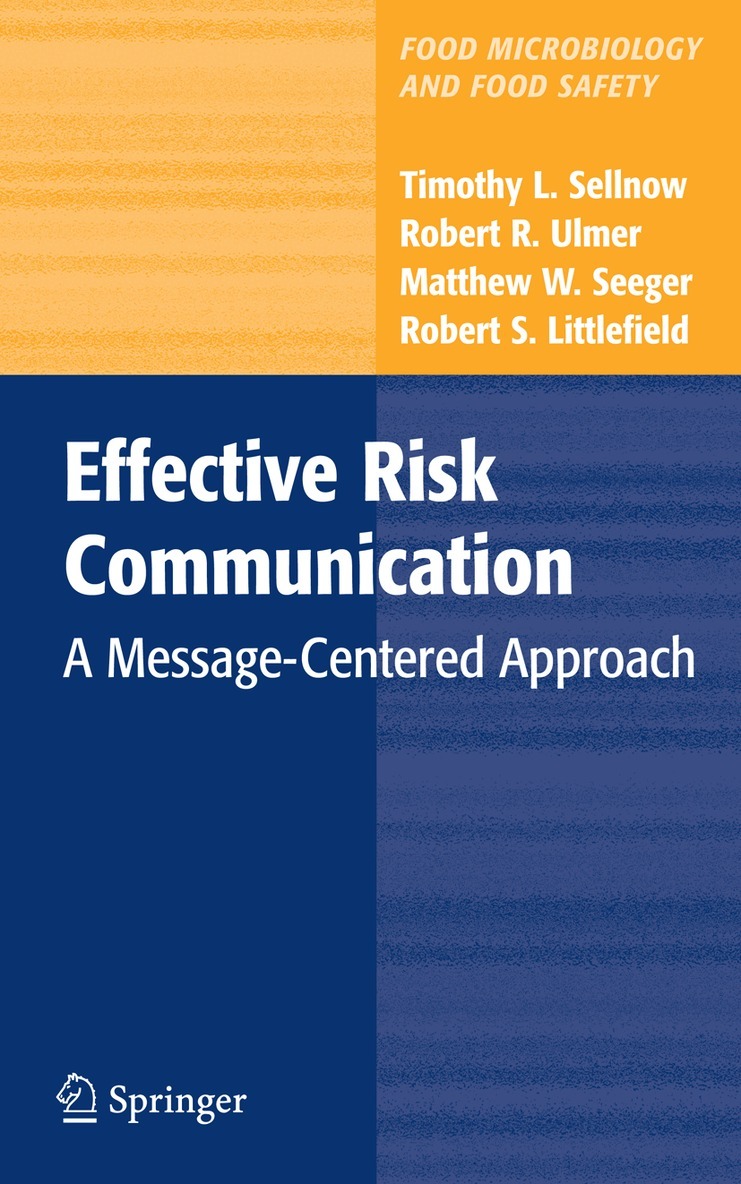
    Effective Risk Communication

    A Message-Centered Approach

    AvTimothy L. Sellnow,Robert R. Ulmer

    Häftad, Engelska, 2010

    Del i serien Food Microbiology and Food Safety

    563 kr

    Beställningsvara. Skickas inom 10-15 vardagar. Fri frakt över 249 kr.

    Fler format och utgåvor

    Inbunden

    563 kr

    Beskrivning

    Coordination of risk assessments and risk communication strategies requires information sharing and establishing networks of working relationships between groups and agencies. Establishing these relationships necessitates overcoming - stitutional, cultural, and political boundaries. Signi?cant barriers exist between r- ulatory agencies and industry groups. Traditionally, these groups have mistrusted one another, and cooperation and collaboration, including sharing information, c- respondingly has been limited. The adoption of radio frequency identi?cation te- nology for tracking livestock, for example, has been met with signi?cant resistance due in part to mistrust between regulatory agencies and producers (Veil, 2006). In the food industry, the need for coordination has been enhanced by industry in- gration and globalization of both markets and production. In the case of GM foods discussed earlier, disagreements between U. S. , European Union, and Canadian r- ulatory agencies fueled the debate over the safety of GM crops. Overcoming institutional and cultural barriers, and mistrust is necessary to create consistency in risk messages. Open communication and information sharing can help clarify where risk perceptions diverge and identify points of convergence. The outcome may not be universal agreement about risks, but convergence around the general parameters of risk. Summary These best practice strategies of risk communication are not designed to function as distinct steps or isolated approaches. Rather than being mutually exclusive, they serve to complement one another and create a coherent approach to confronting risk communication problems.

    Produktinformation

    • Utgivningsdatum:2010-11-19
    • Mått:155 x 235 x 12 mm
    • Vikt:312 g
    • Format:Häftad
    • Språk:Engelska
    • Serie:Food Microbiology and Food Safety
    • Antal sidor:185
    • Förlag:Springer-Verlag New York Inc.
    • ISBN:9781441927255

    Utforska kategorier

    • Medicin: allmänt inom Medicin
    • Kemi inom Naturvetenskap och teknik
    • Tillverkningsteknik inom Naturvetenskap och teknik

    Mer om författaren

    Timothy L. Sellnow is a Professor Risk Communication in the Department of Communication at the University of Kentucky, Lexington, Kentucky. Robert R. Ulmer is a Professor of Communication and Chair in the Department of Speech Communication at the University of Arkansas--Little Rock, Little Rock, Arkansas. Matthew Seeger is a Professor of Communication and Chair in the Department of Communication at Wayne State University, Detroit, Michigan. Robert S. Littlefield is a Professor Communication in he Department of Communication at North Dakota State University, Fargo, North Dakota.

    Innehållsförteckning

    • Conceptualizing a Message-Centered Approach to Risk Communication.- Introducing a Message-Centered Approach to Risk Communication.- Best Practices for Risk Communication.- Multiple Audiences for Risk Messages.- Cases in Risk Communication.- The Case Study Approach.- Cryptosporidium: Unanticipated Risk Factors.- Hurricane Katrina: Risk Communication in Response to a Natural Disaster.- New Zealand Beef Industry: Risk Communication in Response to a Terrorist Hoax.- Odwalla: The Long-Term Implications of Risk Communication.- ConAgra: Audience Complexity in Risk Communication.- Applications of a Message-Centered Approach to Risk Communication.- Toward a Practice of Mindfulness.- Ethical Considerations in Risk Communication.- Future Directions.