• Fri frakt över 249 kr
  • •
  • Snabba leveranser
  • •
  • Billiga böcker
Kundservice

Du är på sajten för privatpersoner.

Företag, bibliotek eller offentlig verksamhet?

Du handlar på classic.bokus.com, där alla dina funktioner finns intakta.
Till classic.bokus.com
Bokus logotyp. Gå till startsidan.
  • Erbjudanden
  • Nyheter
  • Student
  • Topplistor
  • Barn & ungdom
  • Bokus Play
  • E-böcker
  • Pocketböcker
  • Spel & pussel

10% rabatt på allt med kod: NYSTART10 →

Sidfot

Mina sidor

    Hjälp

    • Kundservice
    • Vanliga frågor och svar
    • Frakt och leverans
    • Retur vid ångerrätt
    • Reklamera vara
    • Betalning
    • Köpvillkor
    • Allmänna villkor
    • Information om webbplatsens tillgänglighet

    Om Bokus

    • Om oss
    • Pressrum
    • För studenter
    • För företag
    • För bibliotek och offentlig verksamhet
    • För leverantörer
    • Hållbarhet

    Populärt

    • Aktuella erbjudanden
    • Presentkort
    • Studentlitteratur
    • Nya böcker
    • Topplistor
    • Signerade böcker
    • Engelska böcker

    Inspiration

    • Boktips
    • BookTok
    • Populära bokserier
    • Barnbokskaraktärer
    • Populära författare
    Logotyp för Bokus
    Följ oss på Facebook (extern länk)Följ oss på Instagram (extern länk)Följ oss på YouTube (extern länk)Följ oss på TikTok (extern länk)
    bokus @ CookiesAnpassa cookiesIntegritetspolicyKöpvillkor
    Till Citymail hemsida (extern länk)Till Budbee hemsida (extern länk)Till Postnord hemsida (extern länk)Till Schenker hemsida (extern länk)Till Early Bird hemsida (extern länk)Till Walleys hemsida (extern länk)
    1. Naturvetenskap och teknik
    2. Matematik och naturvetenskap
    3. Biologi
    4. Biovetenskap

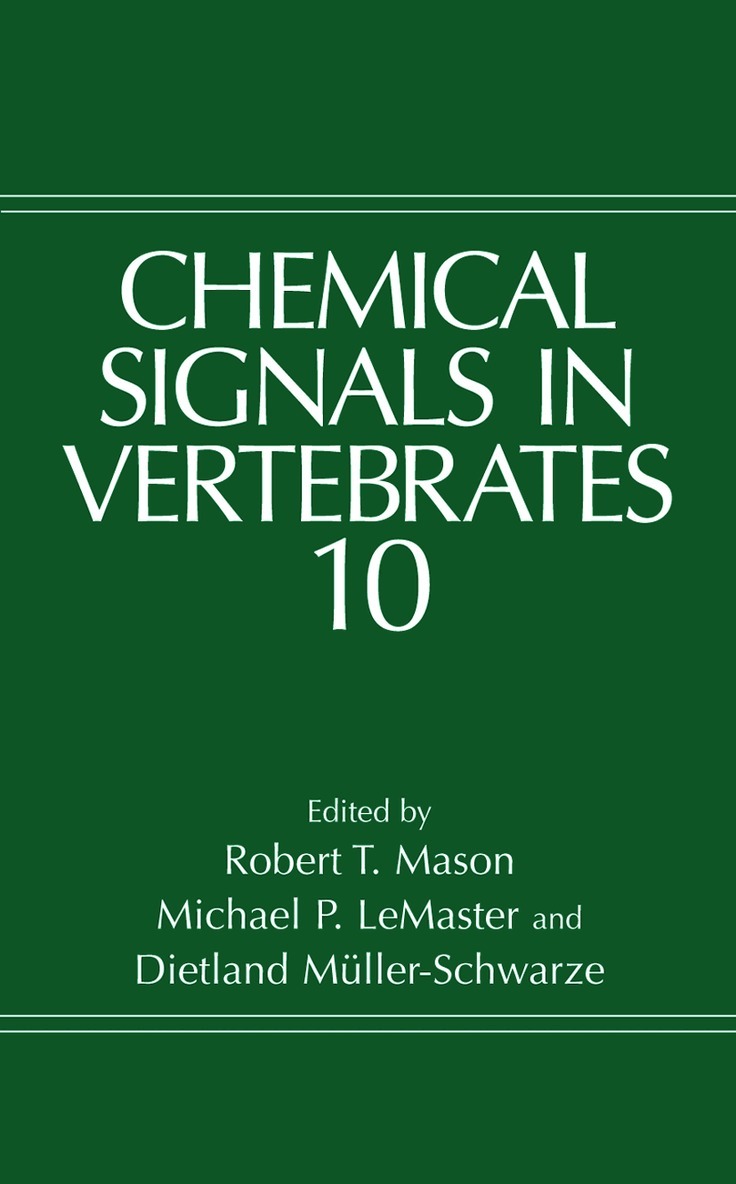
    Chemical Signals in Vertebrates 10

    AvR.T. Mason,Michael P. Lemaster

    Häftad, Engelska, 2010

    2 165 kr

    Beställningsvara. Skickas inom 10-15 vardagar. Fri frakt över 249 kr.

    Beskrivning

    The editors and contributors to this volume should be justifiably proud of their participation in the tenth triennial meeting of the Chemical Signals in Vertebrates International Symposium. This meeting was held 27 years after the initial gathering of participants in Saratoga Springs, New York from June 6* to 9*, 1976. Subsequent meetings have been held every three years in Syracuse, New York; Sarasota, Florida; Laramie, Wyoming; Oxford, England; Philadelphia, Pennsylvania; Tubingen, Germany; Ithaca, New York; and Krakow, Poland. This tenth aimiversary symposium was held from July 29* through August 1*' in Corvallis, Oregon and was hosted by the Zoology Department and Biology Programs of Oregon State University. This book also represents the tenth in a series of books on chemical communication, chemical ecology, olfactory and vomeronasal research in vertebrate species. The species covered in the chapters herein range from fish to mammals including humans. By taxonomic breakdown the mammals are the most represented in number of species and chapter contributions. However, the hosts of the meeting endeavored to have some representative contributions covering all of the major vertebrate taxa. As in past years, the meeting was well-represented with just over 100 participants from 13 different nations. Plenary talks focused on some of the non-mammalian groups that have tended to be less represented in these symposia. Thus, we had a very nice overview of comparisons and contrasts of invertebrate chemical commimication to vertebrate systems.

    Produktinformation

    • Utgivningsdatum:2010-10-29
    • Mått:155 x 235 x 24 mm
    • Vikt:668 g
    • Format:Häftad
    • Språk:Engelska
    • Antal sidor:430
    • Förlag:Springer-Verlag New York Inc.
    • ISBN:9781441937766

    Utforska kategorier

    • Biovetenskap inom Naturvetenskap och teknik
    • Zoologi inom Naturvetenskap och teknik
    • Djurböcker inom Djur och Natur

    Innehållsförteckning

    • Perspectives in Chemical Ecology.- Thirty years on the odor trail: From the first to the tenth international symposium on chemical signals in vertebrates.- Pheromones: Convergence and contrasts in insects and vertebrates.- Intraspecific Behavior.- The discovery and characterisation of splendipherin, the first anuran sex pheromone.- Chemically mediated mate recognition in the tailed frog (ascaphus truei).- Responses to sex- and species-specific chemical signals in allopatric and sympatric salamander species.- The pheromonal repelling response in red-spotted newts (Notophthalmus viridescens).- The effects of cloacal secretions on brown tree snake behavior.- Species and sub-species recognition in the North American beaver.- Self-grooming in meadow voles.- Protein content of male diet does not influence proceptive or receptive behavior in female meadow voles, Microtus pennsylvanicus.- The signalling of competitive ability by male house mice.- A possible function for female enurination in the mara, Dolichotis patagonum.- The evolution of perfume-blending and wing sacs in emballonurid bats.- Behavioral responsiveness of captive giant pandas (Ailuropoda melanoleuca) to substrate odors from conspecifics of the opposite sex.- Chemical signals in giant panda urine (Ailuropoda melanoleuca).- Chemical communication of musth in captive male asian elephants, Elephas maximus.- Chemical analysis of preovulatory female african elephant urine: A search for putative pheromones.- Assessing chemical communication in elephants.- The gland and the sac — the preorbital apparatus of muntjacs.- The chemistry of scent marking in two lemurs: Lemur catta and Propithecus verreauxi coquereli.- Soiled bedding from group-housed females exerts strong influence on male reproductive condition.- The roleof the major histocompatibility complex in scent communication.- Characterisation of proteins in scent marks: Proteomics meets semiochemistry.- The “scents” of ownership.- The role of scent in inter-male aggression in house mice & laboratory mice.- Chemical signals and vomeronasal system function in axolotls (Ambystoma mexicanum).- From the eye to the nose: Ancient orbital to vomeronasal communication in tetrapods?.- Prey chemical signal transduction in the vomeronasal system of garter snakes.- Mode of delivery of prey-derived chemoattractants to the olfactory and vomeronasal epithelia results in differential firing of mitral cells in the main and accessory olfactory bulbs of garter snakes.- Communication by mosaic signals: Individual recognition and underlying neural mechanisms.- Sexual dimorphism in the accessory olfactory bulb and vomeronasal organ of the gray short-tailed opossum, Monodelphis domestica.- The neurobiology of odor-based sexual preference the case of the golden hamster.- Retention of olfactory memories by newborn infants.- Human sweaty smell does not affect women’s menstrual cycle.- Interspecific Responses.- Local predation risk assessment based on low concentration chemical alarm cues in prey fishes: Evidence for threat-sensitivity.- Learned recognition of heterospecific alarm cues by prey fishes: A case study of minnows and stickleback.- The response of prey fishes to chemical alarm cues: What recent field experiments reveal about the old testing paradigm.- Response of juvenile goldfish (Carassius auratus) to chemical alarm cues: Relationship between response intensity, response duration, and the level of predation risk.- The effects of predation on phenotypic and life history variation in an aquatic vertebrate.- Nocturnal shift in theantipredator response to predator-diet cues in laboratory and field trials.- Long-term persistence of a salamander anti-predator cue.- Decline in avoidance of predator chemical cues: Habituation or biorhythm shift?.- Chemically mediated life-history shifts in embryonic amphibians.- Latent alarm signals: Are they present in vertebrates?.- Blood is not a cue for poststrike trailing in rattlesnakes.- Rattlesnakes can use airborne cues during post-strike prey relocation.- The sense of smell in procellariiforms: An overview and new directions.- Cottontails and gopherweed: Anti-feeding compounds from a spurge.