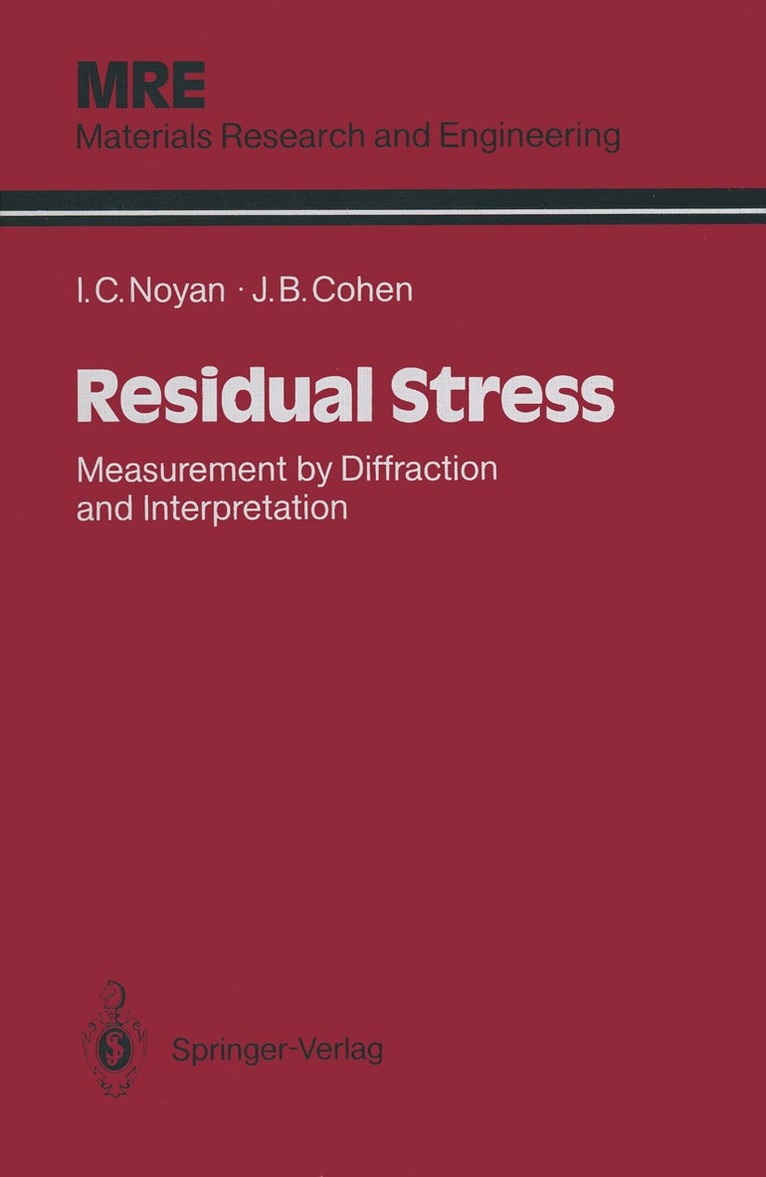
Residual Stress
Measurement by Diffraction and Interpretation
AvIsmail C. Noyan,Jerome B. Cohen
Häftad, Engelska, 2012
Del i serien Materials Research and Engineering
1 588 kr
Beställningsvara. Skickas inom 10-15 vardagar. Fri frakt över 249 kr.
Produktinformation
- Utgivningsdatum:2012-07-01
- Mått:170 x 244 x 16 mm
- Vikt:508 g
- Format:Häftad
- Språk:Engelska
- Serie:Materials Research and Engineering
- Antal sidor:276
- Upplaga:1987
- Förlag:Springer-Verlag New York Inc.
- ISBN:9781461395713
Utforska kategorier
Innehållsförteckning
- 1 Introduction.- 1.1 The Origin of Stresses.- 1.2 Methods of Measuring Residual Stresses.- 1.3 Some Examples of Residual Stresses.- References.- 2 Fundamental Concepts in Stress Analysis.- 2.1 Introduction.- 2.2 Definitions.- 2.3 Stress and Strain.- 2.4 Forces and Stresses.- 2.5 Displacements and Strains.- 2.6 Transformation of Axes and Tensor Notation.- 2.7 Elastic Stress-Strain Relations for Isotropic Materials.- 2.8 Structure of Single Crystals.- 2.9 Elastic Stress-Strain Relations in Single Crystals.- 2.10 Equations of Equilibrium.- 2.11 Conditions of Compatibility.- 2.12 Basic Definitions in Plastic Deformation.- 2.13 Plastic Deformation of Single Crystals.- 2.14 Deformation and Yielding in Inhomogeneous Materials.- Problems.- 3 Analysis of Residual Stress Fields Using Linear Elasticity Theory.- 3.1 Introduction.- 3.2 Macroresidual Stresses.- 3.3 Equations of Equilibrium for Macrostresses.- 3.4 Microstresses.- 3.5 Equations of Equilibrium for Micro- and Pseudo-Macrostresses.- 3.6 Calculation of Micro- and PM Stresses.- 3.7 The Total Stress State in Surface Deformed Multiphase Materials.- 3.8 Macroscopic Averages of Single Crystal Elastic Constants.- 3.9 The Voigt Average.- 3.10 The Reuss Average.- 3.11 Other Approaches to Elastic Constant Determination.- 3.12 Average Diffraction Elastic Constants.- Summary.- References.- 4 Fundamental Concepts in X-ray Diffraction.- 4.1 Introduction.- 4.2 Fundamentals of X-rays.- 4.3 Short-wavelength Limit and the Continuous Spectrum.- 4.4 Characteristic Radiation Lines.- 4.5 X-ray Sources.- 4.6 Absorption of X-rays.- 4.7 Filtering of X-rays.- 4.8 Scattering of X-rays.- 4.9 Scattering from Planes of Atoms.- 4.10 The Structure Factor of a Unit Cell.- 4.11 Experimental Utilization of Bragg’s Law.- 4.12 Monochromators.- 4.13Collimators and Slits.- 4.14 Diffraction Patterns from Single Crystals.- 4.15 Diffraction Patterns from Polycrystalline Specimens.- 4.16 Basic Diffractometer Geometry.- 4.17 Intensity of Diffracted Lines for Polycrystals.- 4.18 Multiplicity.- 4.19 Lorentz Factor.- 4.20 Absorption Factor.- 4.21 Temperature Factor.- 4.22 X-ray Detectors.- 4.23 Deadtime Correction for Detection Systems.- 4.24 Total Diffracted Intensity at a Given Angle 20.- 4.25 Depth of Penetration of X-rays.- 4.26 Fundamental Concepts in Neutron Diffraction.- 4.27 Scattering and Absorption of Neutrons.- Problems.- Bibliography and References.- 5 Determination of Strain and Stress Fields by Diffraction Methods.- 5.1 Introduction.- 5.2 Fundamental Equations of X-ray Strain Determination.- 5.3 Analysis of Regular “d” vs. sin2? Data.- 5.4 Determination of Stresses from Diffraction Data.- 5.5 Biaxial Stress Analysis.- 5.6 Triaxial Stress Analysis.- 5.7 Determination of the Unstressed Lattice Spacing.- 5.8 Effect of Homogeneity of the Strain Distribution and Specimen Anisotropy.- 5.9 Average Strain Data from Single Crystal Specimens.- 5.10 Interpretation of the Average X-ray Strain Data Measured from Polycrystalline Specimens.- 5.11 Interpretation of Average Stress States in Polycrystalline Specimens.- 5.12 Effect of Stress Gradients Normal to the Surface on d vs. sin2? Data.- 5.13 Experimental Determination of X-ray Elastic Constants.- 5.14 Determination of Stresses from Oscillatory Data.- 5.15 Stress Measurements with Neutron Diffraction.- 5.16 Effect of Composition Gradients with Depth.- 5.17 X-ray Determination of Yielding.- 5.18 Summary.- Problem.- References.- 6 Experimental Errors Associated with the X-ray Measurement of Residual Stress.- 6.1 Introduction.- 6.2 Selection of the Diffraction Peakfor Stress Measurements.- 6.3 Peak Location.- 6.4 Determination of Peak Position for Asymmetric Peaks.- 6.5 Statistical Errors Associated with the X-ray Measurement of Line Profiles.- 6.6 Statistical Errors in Stress.- 6.7 Instrumental Errors in Residual Stress Analysis.- 6.8 Corrections for Macrostress Gradients.- 6.9 Corrections for Layer Removal.- 6.10 Summary.- Problems.- References.- 7 The Practical Use of X-ray Techniques.- 7.1 Introduction.- 7.2 The Use of Ordinary Diffractometers.- 7.3 Software and Hardware Requirements.- 7.4 Available Instruments.- 7.5 Selected Applications of a Portable X-ray Residual Stress Unit (By W. P. Evans).- Reference.- 8 The Shape of Diffraction Peaks — X-ray Line Broadening.- 8.1 Introduction.- 8.2 Slit Corrections.- 8.3 Fourier Analysis of Peak Broadening.- Problem.- References.- Appendix A: Solutions to Problems.- Appendix B.- B.1 Introduction.- B.2 The Marion-Cohen Method.- B.3 Dölle-Hauk Method (Oscillation-free Reflections).- B.4 Methods of Peiter and Lode.- B.5 Use of High Multiplicity Peaks.- References.- Appendix C: Fourier Analysis.- Appendix D: Location of Useful Information in “International Tables for Crystallography”.- Appendix F: A Compilation of X-ray Elastic Constants (By Dr. M. James).- References.
Hoppa över listan


Mer från samma serie
Physical and Mathematical Modeling of Tundish Operations
Julian Szekely, Olusegun J. Ilegbusi
Häftad
534 kr
Process Modelling of Metal Forming and Thermomechanical Treatment
Claudio R. Boer, Nuno M.R.S. Rebelo, Hans A.B. Rydstad, Günther Schröder
Häftad
1 061 kr
Hoppa över listan


Du kanske också är intresserad av
Physical and Mathematical Modeling of Tundish Operations
Julian Szekely, Olusegun J. Ilegbusi
Häftad
534 kr
Process Modelling of Metal Forming and Thermomechanical Treatment
Claudio R. Boer, Nuno M.R.S. Rebelo, Hans A.B. Rydstad, Günther Schröder
Häftad
1 061 kr
Thermal-Mechanical Modelling of the Flat Rolling Process
Maciej Pietrzyk, John G. Lenard
Häftad
1 061 kr