• Fri frakt över 249 kr
  • •
  • Snabba leveranser
  • •
  • Billiga böcker
Kundservice

Du är på sajten för privatpersoner.

Företag, bibliotek eller offentlig verksamhet?

Du handlar på classic.bokus.com, där alla dina funktioner finns intakta.
Till classic.bokus.com
Bokus logotyp. Gå till startsidan.
  • Erbjudanden
  • Student
  • Topplistor
  • Barn & ungdom
  • Bokus Play
  • E-böcker
  • Ljudböcker
  • Pocketböcker
  • Spel och pussel

Pocketfynda! Hundratals böcker för 49 kr/st →

Sidfot

Mina sidor

    Hjälp

    • Kundservice
    • Vanliga frågor och svar
    • Frakt och leverans
    • Retur vid ångerrätt
    • Reklamera vara
    • Betalning
    • Köpvillkor
    • Allmänna villkor
    • Information om webbplatsens tillgänglighet

    Om Bokus

    • Om oss
    • Pressrum
    • För studenter
    • För företag
    • För bibliotek och offentlig verksamhet
    • För leverantörer
    • Hållbarhet

    Populärt

    • Aktuella erbjudanden
    • Presentkort
    • Studentlitteratur
    • Nya böcker
    • Topplistor
    • Signerade böcker
    • Engelska böcker

    Inspiration

    • Boktips
    • BookTok
    • Barnbokskaraktärer
    • Populära författare
    Logotyp för Bokus
    Följ oss på Facebook (extern länk)Följ oss på Instagram (extern länk)Följ oss på YouTube (extern länk)Följ oss på TikTok (extern länk)
    bokus @ CookiesAnpassa cookiesIntegritetspolicyKöpvillkor
    Till Citymail hemsida (extern länk)Till Budbee hemsida (extern länk)Till Postnord hemsida (extern länk)Till Schenker hemsida (extern länk)Till Early Bird hemsida (extern länk)Till Walleys hemsida (extern länk)
    1. Naturvetenskap och teknik
    2. Teknik och industri
    3. Övrig teknik och tillämpad vetenskap

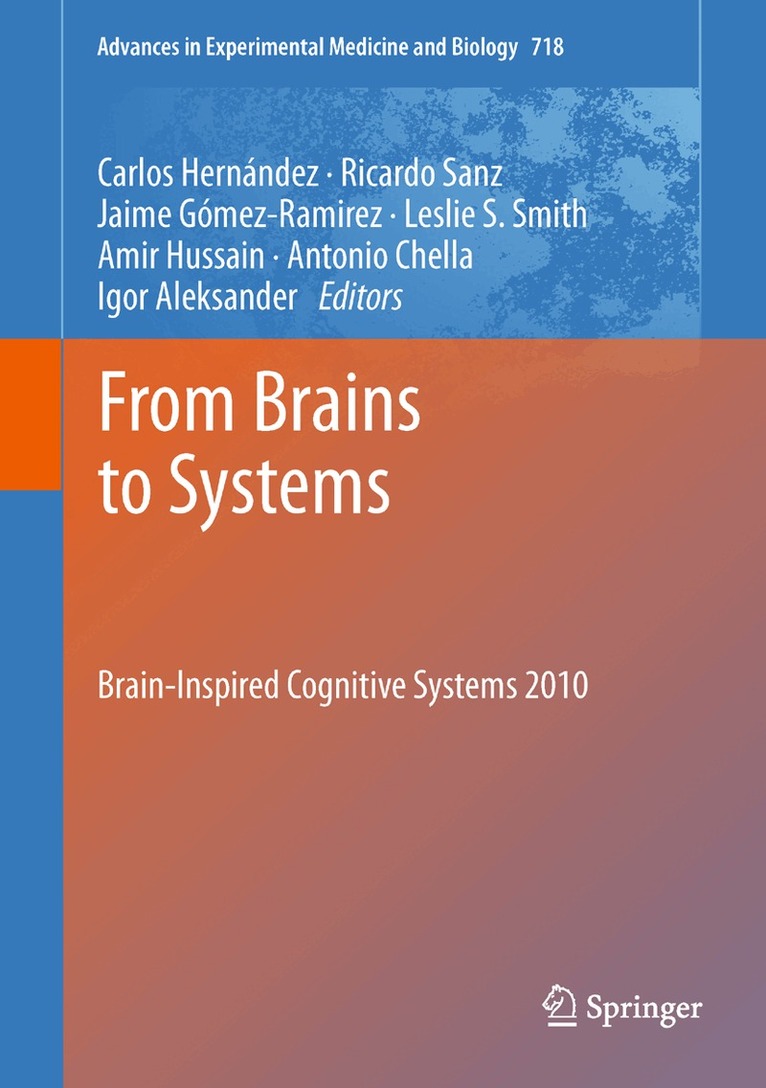
    From Brains to Systems

    Brain-Inspired Cognitive Systems 2010

    AvCarlos Hernández,Ricardo Sanz

    Inbunden, Engelska, 2011

    Del i serien Advances in Experimental Medicine and Biology

    2 149 kr

    Beställningsvara. Skickas inom 10-15 vardagar. Fri frakt över 249 kr.

    Beskrivning

    Brain Inspired Cognitive Systems - BICS 2010 aims to bring together leading scientists and engineers who use analytic and synthetic methods both to understand the astonishing processing properties of biological systems and specifically of the brain, and to exploit such knowledge to advance engineering methods to build artificial systems with higher levels of cognitive competence.BICS is a meeting point of brain scientists and cognitive systems engineers where cross-domain ideas are fostered in the hope of getting emerging insights on the nature, operation and extractable capabilities of brains. This multiple approach is necessary because the progressively more accurate data about the brain is producing a growing need of a quantitative understanding and an associated capacity to manipulate this data and translate it into engineering applications rooted in sound theories.BICS 2010 is intended for both researchers that aim to build brain inspired systems with higher cognitive competences, and for life scientists who use and develop mathematical and engineering approaches for a better understanding of complex biological systems like the brain.Four major interlaced focal symposia are planned for this conference and these are organized into patterns that encourage cross-fertilization across the symposia topics. This emphasizes the role of BICS as a major meeting point for researchers and practitioners in the areas of biological and artificial cognitive systems. Debates across disciplines will enrich researchers with complementary perspectives from diverse scientific fields.BICS 2010 will take place July 14-16, 2010, in Madrid, Spain.

    Produktinformation

    • Utgivningsdatum:2011-07-12
    • Mått:178 x 254 x 20 mm
    • Vikt:714 g
    • Format:Inbunden
    • Språk:Engelska
    • Serie:Advances in Experimental Medicine and Biology
    • Antal sidor:253
    • Upplaga:2011
    • Förlag:Springer-Verlag New York Inc.
    • ISBN:9781461401636

    Utforska kategorier

    • Övrig teknik och tillämpad vetenskap inom Naturvetenskap och teknik
    • Databaser inom Data och IT
    • Artificiell intelligens inom Data och IT

    Innehållsförteckning

    • Chapter 1. Introduction- Ricardo Sanz , Carlos Hern´andez and Jaime G´omez.- Chapter 2. Emergent feature sensitivity in a model of the auditory thalamocortical System- Martin Coath, Robert Mill, Susan Denham, and Thomas Wennekers.- Chapter 3. STDP Pattern Onset Learning Depends on Background Activity Introduction 5- James Humble, Steve Furber, Susan Denham and Thomas Wennekers.- Chapter 4. Emergence of small-world structure in networks of spiking neurons through STDP1 plasticity- Gleb Basalyga, Pablo M. Gleiser, and ThomasWennekers.- Chapter 5. Coupling BCM and neural fields for the emergence of selforganization consensus— Mathieu Lefort and Yann Boniface and Bernard Girau.- Chapter 6. Alpha and theta rhythm abnormality in Alzheimer’s Disease: a study using a computational model- Basabdatta Sen Bhattacharya, Damien Coyle and Liam P. Maguire.- Chapter 7. Oscillatory Neural Network for Image Segmentation with Biased Competition for Attention- Tapani Raiko and Harri Valpola.-Chapter 8. Internal Simulation of Perceptions and Actions- Magnus Johnsson and David Gil.- Chapter 9. Building Neurocognitive Networks with a Distributed Functional Architecture- Marmaduke Woodman, Dionysios Perdikis, Ajay S Pillai, Silke Dodel, Raoul Huys, Steven Bressler, and Viktor Jirsa.- Chapter 10: Reverse Engineering for Biologically Inspired Cognitive Architectures: A Critical Analysis¬- Andreas Schierwagen.- Chapter 11. Competition in high dimensional spaces using a sparse approximation of neural fields- Jean-Charles Quinton, Bernard Girau and Mathieu Lefort.- Chapter 12. Informational Theories of Consciousness: A Review and Extension- Igor Aleksander and David Gamez.- Chapter 13. Hippocampal Categories: a mathematical foundation fornavigation and memory- Jaime G´omez and Ricardo Sanz.- Chapter 14.The role of feedback in a hierarchical model of object perception- Salvador Dura-Bernal, Thomas Wennekers and Susan L. Denham.- Chapter 15. Machine Free Will: Is Free Will a NecessaryIngredient of MachineConsciousness?- Riccardo Manzotti.- Chapter 16. Natural Evolution of Neural Support Vector Machines- Magnus Jandel.- Chapter 17. Self-Conscious Robotic System Design Process - from Analysisto Implementation- Antonio Chella and Massimo Cossentino and Valeria Seidita.- Chapter 18. Simulating Visual Qualia in the CERA-CRANIUM Cognitive Architecture- Raúl Arrabales, Agapito Ledezma, and Araceli Sanchis.- Chapter 19. The Ouroboros Model, Selected Facets- Knud Thomsen.