• Fri frakt över 249 kr
  • •
  • Snabba leveranser
  • •
  • Billiga böcker
Kundservice

Du är på sajten för privatpersoner.

Företag, bibliotek eller offentlig verksamhet?

Du handlar på classic.bokus.com, där alla dina funktioner finns intakta.
Till classic.bokus.com
Bokus logotyp. Gå till startsidan.
  • Erbjudanden
  • Nyheter
  • Student
  • Topplistor
  • Barn & ungdom
  • Bokus Play
  • E-böcker
  • Pocketböcker
  • Spel & pussel

10% rabatt på allt med kod: NYSTART10 →

Sidfot

Mina sidor

    Hjälp

    • Kundservice
    • Vanliga frågor och svar
    • Frakt och leverans
    • Retur vid ångerrätt
    • Reklamera vara
    • Betalning
    • Köpvillkor
    • Allmänna villkor
    • Information om webbplatsens tillgänglighet

    Om Bokus

    • Om oss
    • Pressrum
    • För studenter
    • För företag
    • För bibliotek och offentlig verksamhet
    • För leverantörer
    • Hållbarhet

    Populärt

    • Aktuella erbjudanden
    • Presentkort
    • Studentlitteratur
    • Nya böcker
    • Topplistor
    • Signerade böcker
    • Engelska böcker

    Inspiration

    • Boktips
    • BookTok
    • Populära bokserier
    • Barnbokskaraktärer
    • Populära författare
    Logotyp för Bokus
    Följ oss på Facebook (extern länk)Följ oss på Instagram (extern länk)Följ oss på YouTube (extern länk)Följ oss på TikTok (extern länk)
    bokus @ CookiesAnpassa cookiesIntegritetspolicyKöpvillkor
    Till Citymail hemsida (extern länk)Till Budbee hemsida (extern länk)Till Postnord hemsida (extern länk)Till Schenker hemsida (extern länk)Till Early Bird hemsida (extern länk)Till Walleys hemsida (extern länk)
    1. Naturvetenskap och teknik
    2. Matematik och naturvetenskap
    3. Biologi
    4. Biovetenskap

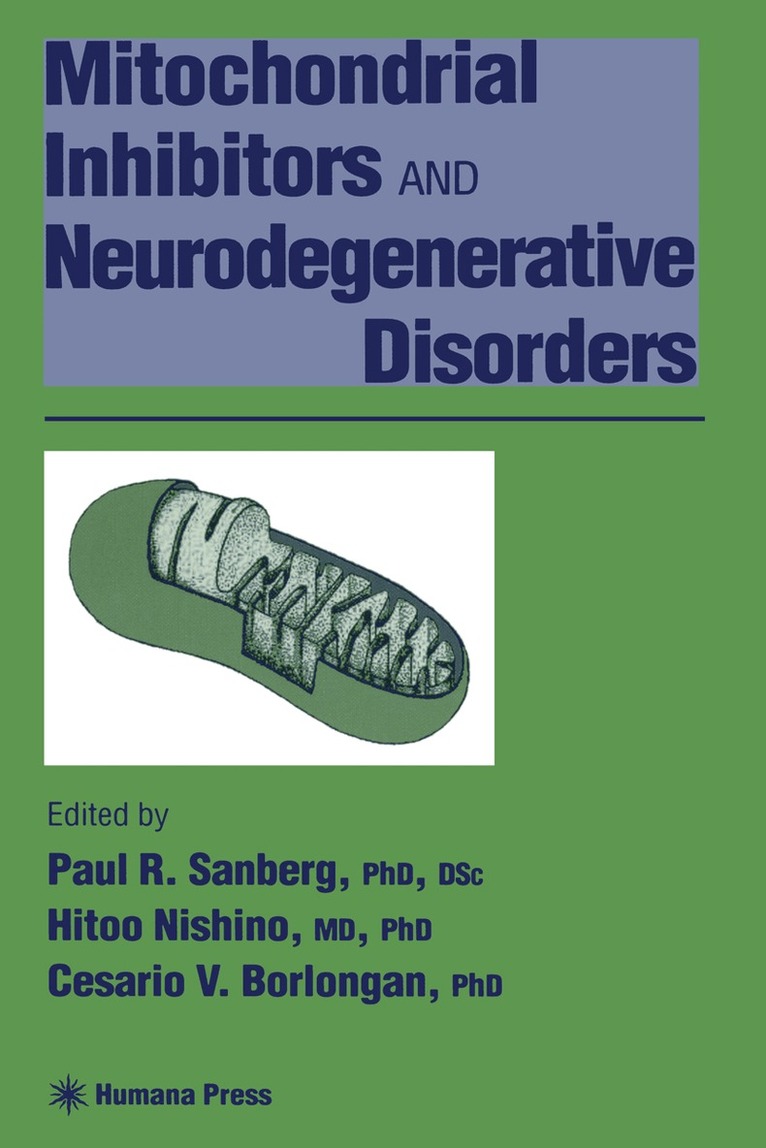
    Mitochondrial Inhibitors and Neurodegenerative Disorders

    AvPaul R. Sanberg,Hitoo Nishino

    Häftad, Engelska, 2012

    Del i serien Contemporary Neuroscience

    1 626 kr

    Beställningsvara. Skickas inom 10-15 vardagar. Fri frakt över 249 kr.

    Beskrivning

    Mitochondria have long been the Rodney Dangerfield of cellular organelles. Believed to be the remnants of bacterial infection of eukaryotic cells eons ago, the mitochondrion evolved a symbiotic relationship in which it dutifully served as the efficient source of A TP for cell function. The extraordinary dependence of cells on the energy provided by mito­ chondrial oxidative metabolism of glucose, especially through critical organs such as the heart and brain, is underlined by the fatal consequences of toxins that interfere with the mitochondrial electron transport system. Consistent with their ancestry, the mitochondria have their own DNA that encodes many but not all of their proteins. The mitochon­ dria and their genes come from the mother via the ovum since sperm do not possess mitochondria. This extranuclear form of inheritance derived exclusively from the female side has proven to be a powerful tool for tracing the evolution by the number of base substitutions in mtDNA. That mitochondrial gene mutations might be a source of human dis­ ease became evident a decade ago with the characterization of a group of multisystem disorders, typically involving the nervous system, which are transmitted from mother to child. Specific point mutations in mtDNA have been associated with the different syndromes.

    Produktinformation

    • Utgivningsdatum:2012-07-27
    • Mått:152 x 229 x 19 mm
    • Vikt:482 g
    • Format:Häftad
    • Språk:Engelska
    • Serie:Contemporary Neuroscience
    • Antal sidor:314
    • Förlag:Humana Press Inc.
    • ISBN:9781468498219

    Utforska kategorier

    • Biovetenskap inom Naturvetenskap och teknik

    Recensioner i media

    "...is a concise summary of the present state of research in the area of mitochondrial toxins and their role in animal models of neurodegenerative disease."-J Neuropsychiatry Clin Neurosci

    Innehållsförteckning

    • I. Mitochondrial Toxins: Symptomatology, Origin, and Chemistry.- 1 • Clinical Manifestations and Mechanisms of Action of Environmental Mitochondrial Toxins.- 2 • History of 3-Nitropropionic Acid: Occurrence and Role in Human and Animal Disease.- 3 • The Neurochemistry of 3-Nitropropionic Acid.- II. Mitochondrial Dysfunctions: Models of Neurodegeneration and Mechanisms of Action.- 4 • In Vitro Studies of 3-Nitropropionic Acid.- 5 • Cognitive and Motor Deficits Produced by Acute and Chronic Administration of 3-Nitropropionic Acid in Rats.- 6 • Comparative Study on 3-Nitropropionic Acid Neurotoxicity.- 7 • Mechanisms of 3-Nitropropionic Acid Neurotoxicity.- 8 • Gender-Related Difference of the Effect of 3-Nitropropionic Acid on Striatal Artery.- 9 • Variable Susceptibility to Neurotoxicity of Systemic 3-Nitropropionic Acid.- 10 • The 3-Nitropropionic Acid Model of Huntington’s Disease: Do Alterations in the Expression of Metabolic mRNAs Predict the Development of Striatal Pathology?.- 11 • Mechanisms of Action of 3-Nitropropionic Acid: Dopamine Overflow and Vulnerability of the Lateral Striatal Artery.- 12 • Mitochondrial Inhibition and Neuronal Death in Huntington’s Disease.- 13 • Effects of Brain Mitochondrial Metabolism, Aging, and Caloric Restriction on Membrance Lipids and Proteins: An Electron Paramagnetic Resonance Investigation.- 14 • Malonate: Profile and Mechanisms of Striatal Toxicity.- 15 • Malonic Acid and the Chronic Administration Model of Excitotoxicity.- 16 • Sodium Azide-Induced Neurotoxicity.- III. Treatment Interventions for Mitochondrial-Induced Neurotoxicity.- 17 • Neuroprotective Strategies Against Cellular Hypoxia.- 18 • Neuroprotective Effect of Perinatal Hypoxia Against 3-Nitropropionic Acid Neurotoxicity.-19 • Neural Transplantation and Huntington’s Disease: What Can We Learn from the 3-Nitropropionic Acid Model?.- 20 • Neuroprotective Strategies in Parkinson’s Disease and Huntington’s Chorea: MPTP- and 3-NPA-Induced Neurodegeneration as Models.