• Fri frakt över 249 kr
  • •
  • Snabba leveranser
  • •
  • Billiga böcker
Kundservice

Du är på sajten för privatpersoner.

Företag, bibliotek eller offentlig verksamhet?

Du handlar på classic.bokus.com, där alla dina funktioner finns intakta.
Till classic.bokus.com
Bokus logotyp. Gå till startsidan.
  • Erbjudanden
  • Nyheter
  • Student
  • Topplistor
  • Barn & ungdom
  • Bokus Play
  • E-böcker
  • Pocketböcker
  • Spel & pussel

10% rabatt på allt med kod: NYSTART10 →

Sidfot

Mina sidor

    Hjälp

    • Kundservice
    • Vanliga frågor och svar
    • Frakt och leverans
    • Retur vid ångerrätt
    • Reklamera vara
    • Betalning
    • Köpvillkor
    • Allmänna villkor
    • Information om webbplatsens tillgänglighet

    Om Bokus

    • Om oss
    • Pressrum
    • För studenter
    • För företag
    • För bibliotek och offentlig verksamhet
    • För leverantörer
    • Hållbarhet

    Populärt

    • Aktuella erbjudanden
    • Presentkort
    • Studentlitteratur
    • Nya böcker
    • Topplistor
    • Signerade böcker
    • Engelska böcker

    Inspiration

    • Boktips
    • BookTok
    • Populära bokserier
    • Barnbokskaraktärer
    • Populära författare
    Logotyp för Bokus
    Följ oss på Facebook (extern länk)Följ oss på Instagram (extern länk)Följ oss på YouTube (extern länk)Följ oss på TikTok (extern länk)
    bokus @ CookiesAnpassa cookiesIntegritetspolicyKöpvillkor
    Till Citymail hemsida (extern länk)Till Budbee hemsida (extern länk)Till Postnord hemsida (extern länk)Till Schenker hemsida (extern länk)Till Early Bird hemsida (extern länk)Till Walleys hemsida (extern länk)
    1. Skönlitteratur
    2. Litteraturvetenskap
    3. Litteraturteori

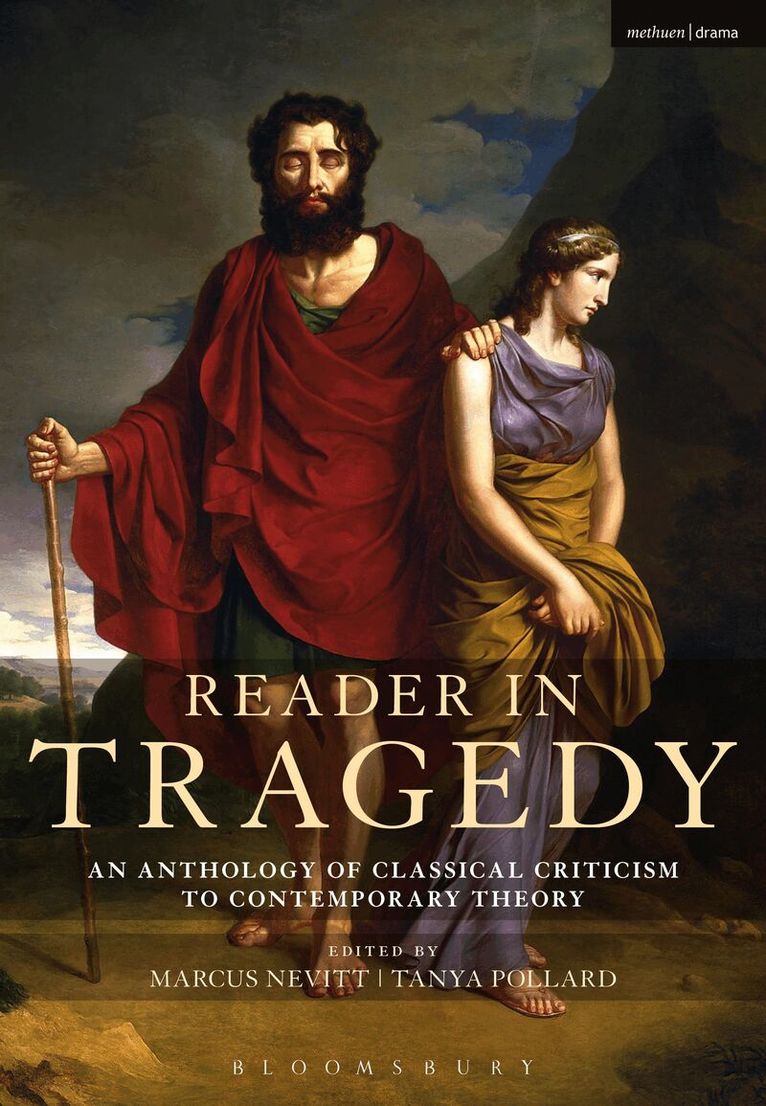
    Reader in Tragedy

    An Anthology of Classical Criticism to Contemporary Theory

    AvMarcus Nevitt,Tanya Pollard

    Häftad, Engelska, 2019

    583 kr

    Beställningsvara. Skickas inom 10-15 vardagar. Fri frakt över 249 kr.

    Beskrivning

    This unique anthology presents the important historical essays on tragedy, ranging from antiquity to the present, divided into historical periods and arranged chronologically. Across its span, it traces the development of theories and philosophies of tragedy, enabling readers to consider the ways in which different varieties of environmentalist, feminist, leftist and postcolonial thought have transformed the status of tragedy, and the idea of the tragic, for recent generations of artists, critics and thinkers. Students of literature and theatre will find this collection an invaluable and accessible guide to writing from Plato and Aristotle through to Freud, Nietzsche, Schopenhauer and 21st century theorists.Ideas of tragedy and the tragic have been central to the understanding of culture for the past two millennia. Writers and thinkers from Plato through to Martha Nussbaum have analyzed the genre of tragedy to probe the most fundamental of questions about ethics, pleasure and responsibility in the world. Does tragedy demand that we enjoy witnessing the pain of others? Does it suggest that suffering is inevitable? Is human sexuality tragic? Is tragedy even possible in a world of rolling news on a digitally connected planet, where atrocity and trauma from around the globe are matters of daily information? In order to illustrate the different ways that writers have approached the answers to such questions, this Reader collects together a comprehensive selection of canonical writings on tragedy from antiquity to the present day arranged in six sections, each featuring an introduction providing concise and informed historical and theoretical frameworks for the texts.

    Produktinformation

    • Utgivningsdatum:2019-02-07
    • Mått:170 x 244 x 20 mm
    • Vikt:620 g
    • Format:Häftad
    • Språk:Engelska
    • Antal sidor:360
    • Förlag:Bloomsbury Publishing PLC
    • ISBN:9781474270427

    Utforska kategorier

    • Litteraturteori inom Skönlitteratur
    • Teater inom Kultur

    Mer om författaren

    Marcus Nevitt is Senior Lecturer in English Literature at the University of Sheffield, UK. He is the author of Women and the Pamphlet Culture of Revolutionary England, 1640-1660 (2006) and is a contributing editor to the Cambridge Edition of the Works of Aphra Behn (2019).Tanya Pollard is Professor of English at Brooklyn College and the Graduate Center, City University of New York, USA. Her books include Greek Tragic Women on Shakespearean Stages (2017), Drugs and Theater in Early Modern England (2005), and Shakespeare’s Theater: A Sourcebook (2003).

    Innehållsförteckning

    • AcknowledgementsNotes on the TextsGeneral IntroductionChapter One: Antiquity and the Middle AgesIntroduction1.1. Plato, The Republic1.2. Aristotle, On The Art Of Poetry1.3. Horace, The Art of Poetry1.4. Longinus, On the Sublime1.5. Evanthius, “On Drama”1.6. Augustine, “On Stage-plays”Chapter Two: The Early Modern PeriodIntroduction2.1. Giovan Battista Giraldi Cinthio, Discourse or Letter on the Composition of Comedies and Tragedies2.2. Lodovico Castelvetro, The Poetics of Aristotle2.3. Stephen Gosson, Plays Confuted in Five Actions2.4. Philip Sidney, Defense of Poetry2.5. Thomas Heywood, The Apology for Actors2.6. Pierre Corneille, from Three Discourses on Dramatic Poetry2.7. John Milton, “Of That Sort of Dramatic Poem Which is Called Tragedy”2.8. René Rapin, Reflections on Aristotle’s Treatise of Poesie2.9. John Dryden, “The Grounds of Criticism in Tragedy”Chapter Three: The Eighteenth CenturyIntroduction3.1. Joseph Addison and Richard Steele, The Spectator3.2. George Lillo, “The Dedication” and “Prologue” to The London Merchant3.3. David Hume, “Of Tragedy”3.4. Edmund Burke, “Sympathy,” “Of the Effects of Tragedy” and “The Sublime”3.5. Jean-Jacques Rousseau, Letter to M. D’Alembert On the Theatre3.6. Samuel Johnson, “Preface to Shakespeare”3.7. Voltaire, "Letter XVIII. On Tragedy"3.8. Elizabeth Montagu, An Essay on the Writings and Genius of Shakespear3.9 Joanna Baillie, “Introductory Discourse”Chapter Four: The Nineteenth CenturyIntroduction4.1. August Wilhelm Schlegel, A Course of Lectures on Dramatic Art and Literature4.2. Charles Lamb, “On the Tragedies of Shakespeare Considered with Reference for Their Fitness for Stage Representation”4.3. William Hazlitt, Characters of Shakespeare’s Plays4.4. Percy Bysshe Shelley, A Defence of Poetry4.5. Arthur Schopenhauer, The World as Will and Representation4.6. G.W.F. Hegel, Aesthetics: Lectures on Fine Art4.7. George Eliot, “The Antigone and its Moral”4.8. Friedrich Nietzsche, The Birth of TragedyChapter Five: 1900 to 1968Introduction5.1. Sigmund Freud, from The Interpretation of Dreams5.2. A.C. Bradley, Shakespearean Tragedy5.3. William Butler Yeats, “The Tragic Theatre”5.4. Virginia Woolf, “On Not Knowing Greek”5.5. Bertolt Brecht, “A Short Organum for the Theatre”5.6. Robert Warshow, “The Gangster as Tragic Hero”5.7. George Steiner, Death of Tragedy5.8. Raymond Williams, “Tragedy and Revolution”5.9. Athol Fugard, “On A View from the Bridge”Chapter Six: Post-1968Introduction6.1 Augusto Boal, from The Theatre of the Oppressed6.2. René Girard, “The Sacrificial Crisis”6.3. Joseph Meeker, “Literary Tragedy and Ecological Catastrophe”6.4. Catherine Belsey, The Subject of Tragedy6.5. Biodun Jeyifo, “Tragedy, History and Ideology”6.6. Nicole Loraux, The Rope and the Sword6.7. Hélène Cixous, “Enter the Theatre (in between)”6.8. Judith Butler, “Promiscuous Obedience”6.9. Martha Nussbaum, “The ‘Morality of Pity’”6.10. David Scott, Conscripts of ModernityPermissions Acknowledgements Supplementary ReadingIndex