• Fri frakt över 249 kr
  • •
  • Snabba leveranser
  • •
  • Billiga böcker
Kundservice

Du är på sajten för privatpersoner.

Företag, bibliotek eller offentlig verksamhet?

Du handlar på classic.bokus.com, där alla dina funktioner finns intakta.
Till classic.bokus.com
Bokus logotyp. Gå till startsidan.
  • Erbjudanden
  • Nyheter
  • Student
  • Topplistor
  • Barn & ungdom
  • Bokus Play
  • E-böcker
  • Pocketböcker
  • Spel & pussel

10% rabatt på allt med kod: NYSTART10 →

Sidfot

Mina sidor

    Hjälp

    • Kundservice
    • Vanliga frågor och svar
    • Frakt och leverans
    • Retur vid ångerrätt
    • Reklamera vara
    • Betalning
    • Köpvillkor
    • Allmänna villkor
    • Information om webbplatsens tillgänglighet

    Om Bokus

    • Om oss
    • Pressrum
    • För studenter
    • För företag
    • För bibliotek och offentlig verksamhet
    • För leverantörer
    • Hållbarhet

    Populärt

    • Aktuella erbjudanden
    • Presentkort
    • Studentlitteratur
    • Nya böcker
    • Topplistor
    • Signerade böcker
    • Engelska böcker

    Inspiration

    • Boktips
    • BookTok
    • Populära bokserier
    • Barnbokskaraktärer
    • Populära författare
    Logotyp för Bokus
    Följ oss på Facebook (extern länk)Följ oss på Instagram (extern länk)Följ oss på YouTube (extern länk)Följ oss på TikTok (extern länk)
    bokus @ CookiesAnpassa cookiesIntegritetspolicyKöpvillkor
    Till Citymail hemsida (extern länk)Till Budbee hemsida (extern länk)Till Postnord hemsida (extern länk)Till Schenker hemsida (extern länk)Till Early Bird hemsida (extern länk)Till Walleys hemsida (extern länk)
    1. Ekonomi och Ledarskap
    2. Ledarskapsböcker
    3. Ledarskap och motivation

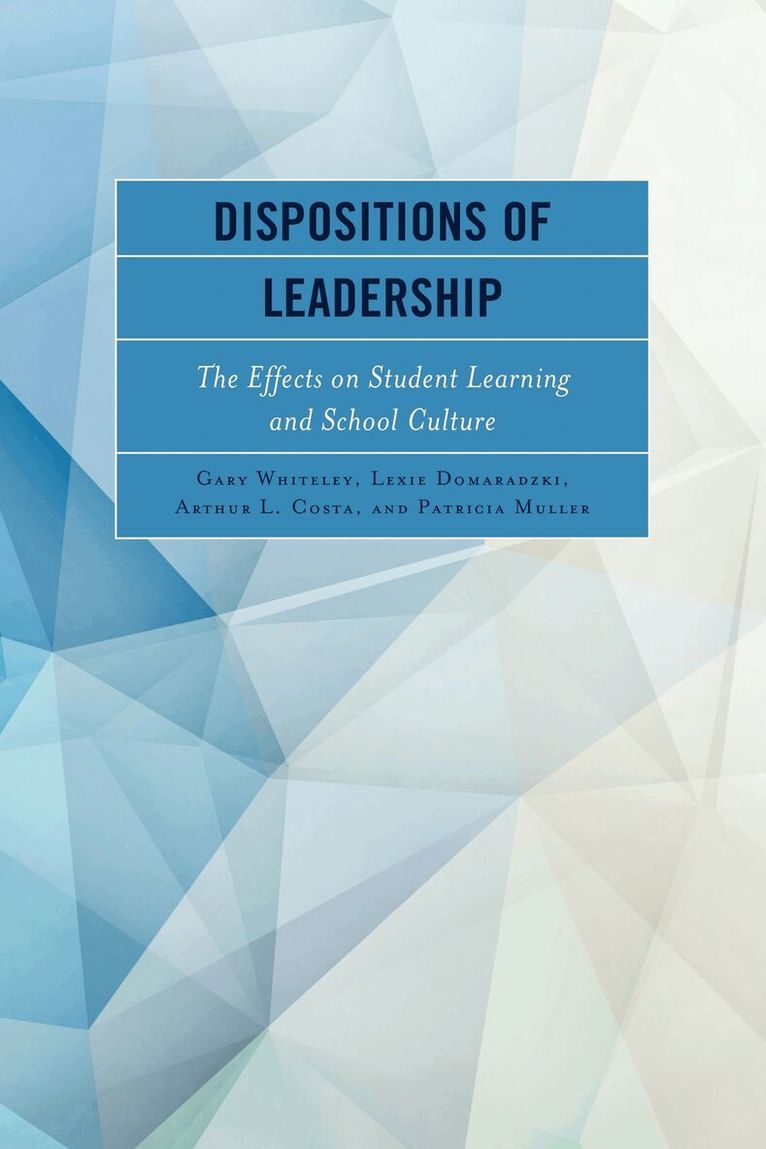
    Dispositions of Leadership

    The Effects on Student Learning and School Culture

    AvGary Whiteley,Lexie Domaradzki

    Inbunden, Engelska, 2017

    1 086 kr

    Beställningsvara. Skickas inom 10-15 vardagar. Fri frakt över 249 kr.

    Fler format och utgåvor

    Häftad

    573 kr

    Beskrivning

    Dispositions of Leadership: The Effects on Student Learning and School Culture stands alone as an approach for developing leaders who are adaptive and can thrive in unpredictable settings. Educational leadership is a domain of its own, apart from business and industry, combining an effective learning environment for students and adults.Dispositions are acquired in the interactions between skillful thinking and circumstances that defy simplistic solutions. The five dispositions, as illustrated in the book, provide educational leaders with maps of the territory and examples of habits for intelligent responses to complex problems. Educational leaders must develop adaptive competence, the capability of applying prior leaning to a novel setting, while assessing the impact of potential solutions. This book challenges the utility of traditional command-and-control models that are no longer capable of supporting school leaders. Grounded in extensive research and review of leadership literature. Dispositions of Leadership: The Effects on Student Learning and School Culture describes how an effective educational leader in the Information Age applies dispositional thinking in order to be adaptive, self-aware and responsive to others.

    Produktinformation

    • Utgivningsdatum:2017-08-15
    • Mått:159 x 238 x 22 mm
    • Vikt:499 g
    • Format:Inbunden
    • Språk:Engelska
    • Antal sidor:208
    • Förlag:Bloomsbury Publishing Plc
    • ISBN:9781475836257

    Utforska kategorier

    • Ledarskap och motivation inom Ekonomi och Ledarskap
    • Utbildningsstrategier och utbildningspolitik inom Psykologi och pedagogik

    Mer om författaren

    Gary Whiteley’s passion for understanding the nature and implication of effective school leadership spans four decades. His leadership journey continues to be enhanced by thoughtful colleagues who co-authored this book.Lexie Domaradzki has dedicated her professional career to supporting high needs schools. She is honored to have the privilege of assisting educators in developing the leadership capabilities and practices that assist them in solving complex problems.Art Costa has devoted his career to improving education through self-directed learning and more thought-full instruction and assessment. He is noted for his many publications and the development of the Habits of Mind and Cognitive Coaching. He is a past president of ASCD.Patricia Muller provides schools, districts, departments of education, non-profit organizations and foundations with evaluation support, capacity- building and technical assistance. In her two decades with the Center for Evaluation and Education Policy at Indiana University, some of her most rewarding work has been with school leadership programs.

    Recensioner i media

    Dispositions of Leadership: The Effects on Student Learning and School Cultureis a treasure trove of insights for experienced and aspiring school leaders alike. The brilliance is in how the information is shared. It is not a “how to book” but rather a “can do book.” The dispositions are presented as a framework for thinking and learning, and it is up to the reader to transform this information into action. The research is rich and the supporting stories based on real experience are compelling. This book exemplifies potential and promise for today’s school leaders.

    Innehållsförteckning

    • DedicationList of FiguresList of TablesForeword PrefaceAcknowledgementsIntroductionComplexity of the Contemporary Educational SystemWhy Are New Understandings of Educational Leadership Needed?Learning Environments and the Need for Adaptive CompetenceHabits of Mind or DispositionsEducational Leadership in the Information AgeOverview of the BookQuestions to Engage your Thinking and Discussion with ColleaguesReferencesChapter One: What Effect Does Educational Leadership Have on Student Learning?The Century-Long Evolution of Educational LeadershipTwenty-five Important Works in Five TablesEfficiency, Bureaucracy, and the Heroic Leader - 1911-1967Transformational Leadership and the Learning Organization - 1978-1990Adaptive Leadership a Response for Addressing Complexity - 1993-2003The Agile Organization and Adaptive Leadership - 2005-2009A Home of Our Own Emerges: Leading Linked with Student Learning – 2011- 2013Summary of the Five Tables and 25 Important Books for Leadership and LearningA New Era of Leadership with Student Learning as the Pervasive FocusLeadership Dimensions and Core Leadership Practices: Broader-Grained WorkThe Three Capabilities and Four Pathways: Finer-Grained Leadership WorkSummaryQuestions to Engage Your Thinking and Discussion with ColleaguesReferencesChapter Two: How Does an Agile Organization Support Contemporary School Leadership?The Formal Organization: An OverviewFormal Organization: Routine Analytical and Routine Cognitive Problem SolvingAgile Organizations: Adapting the Formal Organization to Meet 21st Century NeedsAgile Organizations: Non-Routine Analytical and Interactive Problem SolvingAsserting Focus Amidst Complexity: A Challenge in the Information AgeAgility: Identifying the Type of Problem or ChallengeTechnical Problems, Adaptive Challenges, and Polarity ManagementNetwork-centric Collaborative Groups, Agility, and Decision-makingHigh-Performing Principal Teams and School-based Leadership TeamsSummaryQuestions to Engage your Thinking and Discussion with ColleaguesReferencesChapter Three: What Are the Dispositions of Contemporary Educational Leadership?What are Dispositions?Why Dispositions?Dispositions for Educational LeadershipWhat Roles Do Dispositions Serve in Leadership?How are Dispositions Acquired?Why Consider Utilizing Thinking Dispositions with Educators?Dispositions Build the School CultureThe Five Dispositions of LeadershipDispositions, Capabilities, and Practices: Ways of Thinking, Being, DoingThe Balcony and the Dance FloorSummaryQuestions to Engage your Thinking and Discussion with Colleagues:ReferencesChapter Four: Disposition: Thinking and Acting InterdependentlyCapability One: Establishing and Maintaining an Environment of Trust that Includes Predictable Values and Predictable SkillsCapability Two: Identifying, Articulating, and Aligning with a Shared Vision that Addresses a Pervasive Focus on Student and Adult LearningCapability Three: Promote a Group of Diverse Individuals to Access and Utilize Resources and Expertise Across a Broader CommunityCapability Four: Setting Aside Your Own Preferences for the Benefit of AllCapability Five: Having the Capacity to Look at Things from Others’ Point of ViewCapability Six: Anticipating Ways to Support Others in the Collaborative ProcessSummaryMiddle School VignetteQuestions to Engage your Thinking and Discussion with ColleaguesReferencesChapter Five: Communicating to InfluenceCapability One: Developing the Capabilities within Others to Interact SuccessfullyDiscussionDialogueCapability Two: Developing Personal PresenceCapability Three: Knowing When and Why to Integrate and Knowing When to Insert OneselfCapability Four: Use Interpersonal Skills to Cultivate Working Relationships and to Motivate and Mobilize Others (Individuals and Groups)SummaryMiddle-school VignetteQuestions to Engage your Thinking and Discussion with ColleaguesReferencesChapter Six: Gathering and Applying Information for ChangeCapability One: Systematically and Intentionally Gathering and Organizing Needed DataAcademic Content and Measures of SchoolingStudent Engagement in the Behavior, Emotional, And Cognitive DimensionsInformation Collected for Evaluating Implementation TopicsCapability Two: Using data to inform actionsCapability Three: Developing and Nurturing an Environment of Inquiry and Innovation Grounded in Reflection and Continuous ImprovementSummaryMiddle School VignetteQuestions to Engage Your Thinking and Discussion with ColleaguesReferencesChapter Seven: Seeking Support for Feedback and LearningCapability One: Developing Self-Knowledge, Self-Awareness and Self-Efficacy While Maintaining a Sense of HumilityCapability Two: Frequently Seeking Feedback Focused on Learning and Professional Growth Capability Three: Engaging in a Collegial Networked Leadership Community of High-Performing Teams of Principals Problems of Practice Versus Practice-Based EvidenceEffective Networked Leadership CommunitiesRelationship Between Support, Resiliency, Feedback and ExcellenceProfessional Goal SettingCapability Four: Creating Feedback Spirals for Continuous Individual and Organizational Self-Learning Receiving FeedbackGiving FeedbackSummaryMiddle School VignetteQuestions to Engage Your Thinking and Discussion with ColleaguesChapter Eight: Pursuing Adaptive Competence What is Adaptive Competence?Pursuing Adaptive Competence in Ambiguous EnvironmentsCapability One: Using Self-Managing, Self-Monitoring, and Self-Modifying Skills to Inform Behaviors and ActionsCapability Two: Engaging Flexibly in Thinking and BehaviorsCapability Three: Solving Complex Problems and Addressing Adaptive ChallengesSummaryMiddle School Vignette: Three Middle School PrincipalsQuestions to Engage Your Thinking and Discussion with Colleagues:ReferencesChapter Nine: Discovering Leadership Potential in an Agile OrganizationFive Dispositions of Leadership:Thinking and Acting Interdependently: Promoting a positive, collaborative learning culture through distributed leadership.Communicating to Influence: Developing the interpersonal skills to influence, mobilize and motivate individuals and groups.Gathering and Appling Information for Change: Utilizing data-based evidence to make decisions and provide formative feedback for setting direction and planning change.Seeking Support and Feedback for Learning: Fostering personal/professional growth and resiliency. Pursuing Adaptive Competence (Keystone Disposition): Incorporating into practice metacognition and cognitive flexibility to effectively plan, reflect, diagnose, and solve complex problems. Feedback: A Networked Leadership Community VignetteQuestions for Reflection