• Fri frakt över 249 kr
  • •
  • Snabba leveranser
  • •
  • Billiga böcker
Kundservice

Du är på sajten för privatpersoner.

Företag, bibliotek eller offentlig verksamhet?

Du handlar på classic.bokus.com, där alla dina funktioner finns intakta.
Till classic.bokus.com
Bokus logotyp. Gå till startsidan.
  • Erbjudanden
  • Nyheter
  • Student
  • Topplistor
  • Barn & ungdom
  • Bokus Play
  • E-böcker
  • Pocketböcker
  • Spel & pussel

10% rabatt på allt med kod: NYSTART10 →

Sidfot

Mina sidor

    Hjälp

    • Kundservice
    • Vanliga frågor och svar
    • Frakt och leverans
    • Retur vid ångerrätt
    • Reklamera vara
    • Betalning
    • Köpvillkor
    • Allmänna villkor
    • Information om webbplatsens tillgänglighet

    Om Bokus

    • Om oss
    • Pressrum
    • För studenter
    • För företag
    • För bibliotek och offentlig verksamhet
    • För leverantörer
    • Hållbarhet

    Populärt

    • Aktuella erbjudanden
    • Presentkort
    • Studentlitteratur
    • Nya böcker
    • Topplistor
    • Signerade böcker
    • Engelska böcker

    Inspiration

    • Boktips
    • BookTok
    • Populära bokserier
    • Barnbokskaraktärer
    • Populära författare
    Logotyp för Bokus
    Följ oss på Facebook (extern länk)Följ oss på Instagram (extern länk)Följ oss på YouTube (extern länk)Följ oss på TikTok (extern länk)
    bokus @ CookiesAnpassa cookiesIntegritetspolicyKöpvillkor
    Till Citymail hemsida (extern länk)Till Budbee hemsida (extern länk)Till Postnord hemsida (extern länk)Till Schenker hemsida (extern länk)Till Early Bird hemsida (extern länk)Till Walleys hemsida (extern länk)
    1. Psykologi och pedagogik
    2. Pedagogik
    3. Pedagogisk teori och filosofi

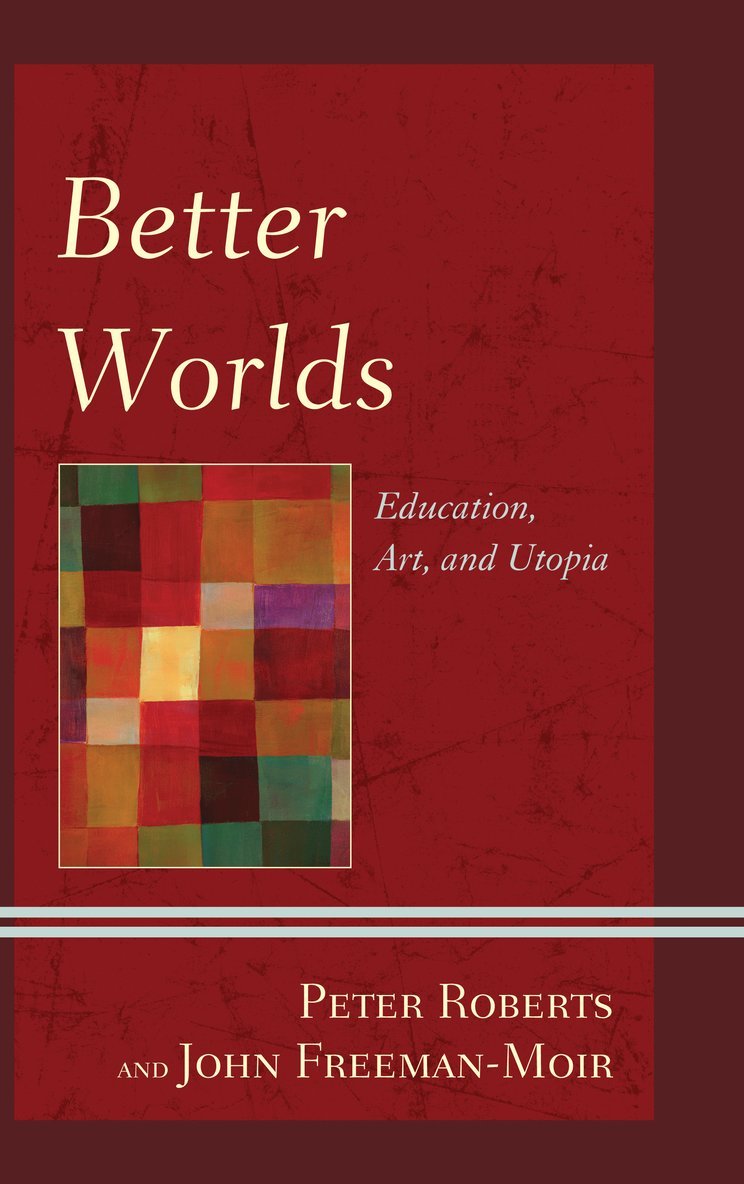
    Better Worlds

    Education, Art, and Utopia

    AvPeter Roberts,John Freeman-Moir

    Häftad, Engelska, 2015

    Del i serien Critical Education Policy and Politics

    614 kr

    Beställningsvara. Skickas inom 10-15 vardagar. Fri frakt över 249 kr.

    Beskrivning

    Better Worlds: Education, Art, and Utopia provides a fresh examination of utopia and education. Adopting an interdisciplinary approach and drawing on literature and the visual arts as well as traditional non-fiction sources, the authors explore utopia not as a model of social perfection but as the active, imaginative building of better worlds. Utopian questions, they argue, lie at the heart of education, and addressing such questions demands attention not just to matters of theoretical principle but to the particulars of everyday life and experience. Taking utopia seriously in educational thought also involves a consideration of that which is dystopian. Utopia, this book suggests, is not something that is fixed, final, or ever fully realized; instead, it must be constantly recreated, and education, as an ongoing process of reflection, action, and transformation, has a central role to play in this process.

    Produktinformation

    • Utgivningsdatum:2015-03-02
    • Mått:148 x 230 x 12 mm
    • Vikt:318 g
    • Format:Häftad
    • Språk:Engelska
    • Serie:Critical Education Policy and Politics
    • Antal sidor:196
    • Förlag:Bloomsbury Publishing Plc
    • ISBN:9781498510851

    Utforska kategorier

    • Pedagogisk teori och filosofi inom Psykologi och pedagogik
    • Utbildningsstrategier och utbildningspolitik inom Psykologi och pedagogik

    Mer om författaren

    Peter Roberts is professor of Education at the University of Canterbury in New Zealand. He teaches philosophy of education and educational policy studies. John Freeman-Moir is senior lecturer in the College of Education at the University of Canterbury, New Zealand, where he teaches utopian social theory, sociology of education, and philosophy of education.

    Recensioner i media

    Roberts and Freeman-Moir (both, Univ. of Canterbury, New Zealand) resist the typical notion of utopia as a perfect world. Their central claim is that utopia is a space in which to imagine better worlds. In chapter 1, the authors provide the reader with a substantial foundation from which to understand their central claim and provide examples within education and educational policy to further understand why utopia is important. Subsequent chapters provide examples in art, literature, and, more broadly, aesthetics in order to demonstrate how the notion of utopia can be understood as an important quest for the possible as opposed to the perfect when considering education and policy. A strength of the book is the wide range of examples used to develop the ideas presented. For instance, the authors use works of fiction (e.g., books by Hermann Hesse and Fyodor Dostoevsky), as well as authors often considered more "academic" (e.g., Iris Murdoch and Paulo Freire) to explain the range of possibilities in their claims about utopia. These entry points and various examples are helpful to the reader less familiar with the ideas and provide multiple opportunities to imagine how utopia could lead to the construction of better worlds. Summing Up: Recommended. General readers, upper-division undergraduate students, graduate students, research faculty.

    Innehållsförteckning

    • Introduction: Utopia, Dystopia, and EducationChapter 1: Crafting Experience: William Morris, John Dewey, and UtopiaChapter 2: Art for Dishonour, Utopian Inflection, Sympathy’s EducationChapter 3: Utopia, Dystopia, and the Struggle for Redemption: Iris Murdoch and Educative AttentionChapter 4: Pictures and Particularities: The Uncertain Creativity of ActionChapter 5: Education and the Dream of a Better World: The Pedagogy of Paulo FreireChapter 6: A Golden Age? Dostoevsky, Taoism, and UtopiaChapter 7: Technology, Utopia, and Scholarly Life: Ideals and Realities in the Work of Hermann Hesse