• Fri frakt över 249 kr
  • •
  • Snabba leveranser
  • •
  • Billiga böcker
Kundservice

Du är på sajten för privatpersoner.

Företag, bibliotek eller offentlig verksamhet?

Du handlar på classic.bokus.com, där alla dina funktioner finns intakta.
Till classic.bokus.com
Bokus logotyp. Gå till startsidan.
  • Erbjudanden
  • Nyheter
  • Student
  • Topplistor
  • Barn & ungdom
  • Bokus Play
  • E-böcker
  • Pocketböcker
  • Spel & pussel

10% rabatt på allt med kod NYSTART10 →

Sidfot

Mina sidor

    Hjälp

    • Kundservice
    • Vanliga frågor och svar
    • Frakt och leverans
    • Retur vid ångerrätt
    • Reklamera vara
    • Betalning
    • Köpvillkor
    • Allmänna villkor
    • Information om webbplatsens tillgänglighet

    Om Bokus

    • Om oss
    • Pressrum
    • För studenter
    • För företag
    • För bibliotek och offentlig verksamhet
    • För leverantörer
    • Hållbarhet

    Populärt

    • Aktuella erbjudanden
    • Presentkort
    • Studentlitteratur
    • Nya böcker
    • Topplistor
    • Signerade böcker
    • Engelska böcker

    Inspiration

    • Boktips
    • BookTok
    • Populära bokserier
    • Barnbokskaraktärer
    • Populära författare
    Logotyp för Bokus
    Följ oss på Facebook (extern länk)Följ oss på Instagram (extern länk)Följ oss på YouTube (extern länk)Följ oss på TikTok (extern länk)
    bokus @ CookiesAnpassa cookiesIntegritetspolicyKöpvillkor
    Till Citymail hemsida (extern länk)Till Budbee hemsida (extern länk)Till Postnord hemsida (extern länk)Till Schenker hemsida (extern länk)Till Early Bird hemsida (extern länk)Till Walleys hemsida (extern länk)
    1. Samhälle och politik
    2. Politik och statsskick
    3. Centralt styre och förvaltning

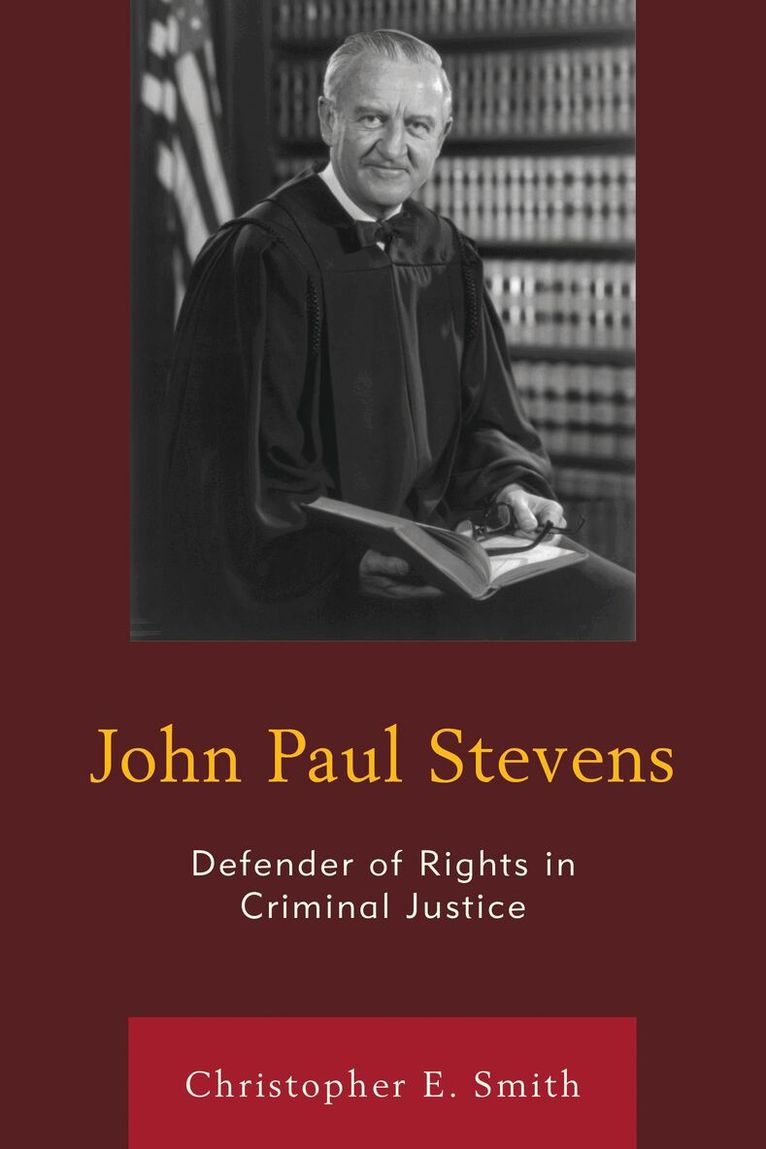
    John Paul Stevens

    Defender of Rights in Criminal Justice

    AvChristopher E. Smith

    Häftad, Engelska, 2017

    645 kr

    Beställningsvara. Skickas inom 10-15 vardagar. Fri frakt över 249 kr.

    Beskrivning

    This book examines the judicial opinions and criminal justice policy impact of Justice John Paul Stevens, the U.S. Supreme Court’s most prolific opinion author during his 35-year career on the nation’s highest court. Although Justice Stevens, a Republican appointee of President Gerald Ford, had a professional reputation as a corporate antitrust law attorney, he immediately asserted himself as the Court’s foremost advocate of prisoners’ rights and Miranda rights when he arrived at the Court in 1975. In examining Justice Stevens’s opinions on these topics as well as others, including capital punishment and right to counsel, the chapters of the book connect his prior experiences with the development of his views on rights in criminal justice. In particular, the book examines his relevant experiences as a law clerk to Justice Wiley Rutledge in the Supreme Court’s 1947 term, a volunteer attorney handling criminal cases in Illinois, and a judge on the U.S. court of appeals to explore how these experiences shaped his understanding of the importance of rights in criminal justice. For many issues, such as those affecting imprisoned offenders, Justice Stevens was a strong defender of rights throughout his career. For other issues, such as capital punishment, there is evidence that he became increasingly protective of rights over the course of his Supreme Court career. The book also examines how Justice Stevens became increasingly important as a leading dissenter against the diminution of rights in criminal justice as the Supreme Court’s composition became increasingly conservative in the 1980s and thereafter. Because of the nature and complexity of Justice Stevens’s numerous and varied opinions over the course of his lengthy career, scholars find it difficult to characterize his judicial philosophy and impact with simple labels. Yet in the realm of criminal justice, close examination of his work reveals that he earned a reputation and an enduring legacy as an exceptionally important defender of constitutional rights.

    Produktinformation

    • Utgivningsdatum:2017-07-28
    • Mått:150 x 232 x 24 mm
    • Vikt:454 g
    • Format:Häftad
    • Språk:Engelska
    • Antal sidor:326
    • Förlag:Bloomsbury Publishing Plc
    • ISBN:9781498523752

    Utforska kategorier

    • Centralt styre och förvaltning inom Samhälle och politik
    • Statsvetenskap och politisk teori inom Samhälle och politik
    • Rättshistoria inom Juridik

    Mer om författaren

    Christopher E. Smith is professor of criminal justice at Michigan State University and is editor of The Rehnquist Court and Criminal Justice (Lexington, 2011).

    Recensioner i media

    For far too long, scholarship on the Supreme Court of the United States has lacked a systematic assessment of the jurisprudence and impact of Justice Stevens across a range of legal issues. Fortunately, Professor Smith not only answers this call, he does so with an engaging style that does not sacrifice nuance or intellectual rigor. Smith employs multiple lenses to reveal Stevens’s fact-based, case-by-case approach to considering questions regarding Miranda rights, jury trials, search and seizure protections, and capital punishment. The author’s informative, personal interviews with the justice complement illuminating discussions of Stevens’s earlier experiences and detailed analyses of the jurist’s later opinions on the Supreme Court. The result is a rich depiction of Stevens’s criminal justice jurisprudence as complex and consistent, without being ideologically reflexive. As the definitive examination of one of the Court’s most influential members in cases addressing the rights of prisoners and of the criminally accused, John Paul Stevens: Defender of Rights in Criminal Justice deserves a prominent place on the bookshelf for those interested in criminal justice, constitutional interpretation, or public law.

    Innehållsförteckning

    • Chapter 1Introduction Chapter 2Family Background and Life Experiences Chapter 3Judge Stevens on the U.S. Court of Appeals Chapter 4Prisoners’ RightsChapter 5Miranda and Right to CounselChapter 6Trial by JuryChapter 7Search and SeizureChapter 8Capital PunishmentChapter 9Conclusion