• Fri frakt över 249 kr
  • •
  • Snabba leveranser
  • •
  • Billiga böcker
Kundservice

Du är på sajten för privatpersoner.

Företag, bibliotek eller offentlig verksamhet?

Du handlar på classic.bokus.com, där alla dina funktioner finns intakta.
Till classic.bokus.com
Bokus logotyp. Gå till startsidan.
  • Erbjudanden
  • Nyheter
  • Student
  • Topplistor
  • Barn & ungdom
  • Bokus Play
  • E-böcker
  • Pocketböcker
  • Spel & pussel

10% rabatt på allt med kod: NYSTART10 →

Sidfot

Mina sidor

    Hjälp

    • Kundservice
    • Vanliga frågor och svar
    • Frakt och leverans
    • Retur vid ångerrätt
    • Reklamera vara
    • Betalning
    • Köpvillkor
    • Allmänna villkor
    • Information om webbplatsens tillgänglighet

    Om Bokus

    • Om oss
    • Pressrum
    • För studenter
    • För företag
    • För bibliotek och offentlig verksamhet
    • För leverantörer
    • Hållbarhet

    Populärt

    • Aktuella erbjudanden
    • Presentkort
    • Studentlitteratur
    • Nya böcker
    • Topplistor
    • Signerade böcker
    • Engelska böcker

    Inspiration

    • Boktips
    • BookTok
    • Populära bokserier
    • Barnbokskaraktärer
    • Populära författare
    Logotyp för Bokus
    Följ oss på Facebook (extern länk)Följ oss på Instagram (extern länk)Följ oss på YouTube (extern länk)Följ oss på TikTok (extern länk)
    bokus @ CookiesAnpassa cookiesIntegritetspolicyKöpvillkor
    Till Citymail hemsida (extern länk)Till Budbee hemsida (extern länk)Till Postnord hemsida (extern länk)Till Schenker hemsida (extern länk)Till Early Bird hemsida (extern länk)Till Walleys hemsida (extern länk)
    1. Samhälle och politik
    2. Politik och statsskick
    3. Politiska ideologier och rörelser
    4. Högerradikalism och högerextremism

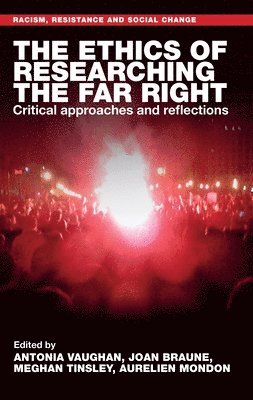
    Ethics of Researching the Far Right

    Critical Approaches and Reflections

    AvAntonia Vaughan,Joan Braune

    Häftad, Engelska, 2025

    Del i serien Racism, Resistance and Social Change

    498 kr

    Beställningsvara. Skickas inom 5-8 vardagar. Fri frakt över 249 kr.

    Beskrivning

    At a time when far, radical, and extreme-right politics are becoming increasingly mainstream globally – sometimes with deadly consequences – research in these fields is essential to understand the most effective ways to combat these dangerous ideologies. Yet engaging with texts and movements that do physical and verbal violence raises a number of urgent ethical issues. Until recently, this has remained understudied, as scholarship on the far right rarely delves explicitly and critically into the ethics of research. This book seeks to remedy this significant gap in an otherwise extensive and growing literature. Originating from a workshop series in 2020, in which an international group of academics at various career stages shared the ethical challenges and best practices they had developed in their research, this edited collection draws together insights from these ongoing conversations, offering urgent critical reflections on key ethical issues.

    Produktinformation

    • Utgivningsdatum:2025-04-01
    • Mått:156 x 234 x 23 mm
    • Vikt:635 g
    • Format:Häftad
    • Språk:Engelska
    • Serie:Racism, Resistance and Social Change
    • Antal sidor:424
    • Förlag:Manchester University Press
    • ISBN:9781526173881

    Utforska kategorier

    • Högerradikalism och högerextremism inom Samhälle och politik
    • Sociologi inom Samhälle och politik
    • Etiska frågor och debatter inom Samhälle och politik

    Mer om författaren

    Antonia Vaughan is a researcher in Politics at the University of BathJoan Braune is Lecturer in Philosophy at Gonzaga UniversityMeghan Tinsley is Senior Lecturer in Sociology at the University of ManchesterAurelien Mondon is Senior Lecturer in Politics at the University of Bath

    Recensioner i media

    'The ethics of researching the Far Right is perhaps the first investigation into the moral responsibility we have in documenting the threat that fascism presents. This expertly edited volume is one of the most important interventions ever made into this field and should be required reading for anyone documenting the far-right.'Shane Burley, author of Safety Through Solidarity: A Radical Guide to Fighting Antisemitism'A timely and much needed collection. It highlights the ongoing necessity - as well as the huge complexity - of reflective and critical research on the contemporary far right, especially as it becomes increasingly normalised and mainstreamed. A fantastic resource for scholars and students conducting systematic research on the far right across a wide range of social science disciplines.'Professor Michal Krzyzanowski, Uppsala University, Sweden'At last! A straight-on discussion of ethical quagmires in studies of the far-right, and a guide to navigating issues of political impact, safety, terminology, and more. A must-read for scholars and students.'Kathleen Blee, co-author of Out of Hiding: Extremist White Supremacy and How It Can Be Stopped (2024)

    Innehållsförteckning

    • IntroductionPart I: What’s in a name1. What the far right is(n’t) – Omran Shroufi2. Race, racism, and the far right: critical reflections for the field – Kurt Sengul3. When racism seems to be the hardest word: critical reflections from studying the Lega (Nord) – George Newth4. When the far right experiences violence: our ethical duty to the othered – Ryan Switzer5. Ecofascism, far-right ecologism and neo-Malthusianism – Miranda Jeanne Marie IossifidisPart II: Positionality, standpoint, and intersectionality6. ‘Far right studies’ and the unbearable whiteness of being – Aurelien Mondon7. Safety and silence: oral history, far right research and the paradox of the ‘vocal minority’ – Imo Kaufman8. On the incompleteness of ethnography: embracing and navigating failure as a principle in research on the far right – Balša Lubarda9. Ethnographic empathy and research ethics as methodological whiteness – Catherine Tebaldi and Rae Jereza10. Emotions in methodology: resisting violent ideological structures in the knowledge-production of extremisms – Elsa Bengtsson Meuller11. Reflections on researching armed Nazis as an unarmed left-wing Jew: politics, privilege, and practical concerns – Aaron WinterPart III: The haunting past: memory and far right studies12. Heritage, archaeology, ancestry, and the far right – David Farrell-Banks and Lorna-Jane Richardson13. Another way to do ethics: uses of the landscape in the far-right cultural milieu and the ethics of researching them – Andrew Fergus Wilson14. Researching memory and heritage during a culture war – Meghan Tinsley, Ruth Ramsden-Karelse, Chloe Peacock, and Sadia Habib15. Archiving the extreme: ethical challenges in sharing, researching, and teaching – Daniel Jones16. Researching racism in racist times - Jean BeamanPart IV: Care and safety17. How do you respond when you feel under threat? A reflective exploration into my experience with the far right online – Alice Sibley18. Community building as a response to care in studying the far right – Kayla Preston19. Negotiating contradiction in success and safety: a consideration of environmental constraints on risk management – Antonia Vaughan20. Spectre: covert research in digital far-right ‘red zones’ – Jackson Wood21. Navigating a feminist ethics of care, ethnographic methods, and academic activism in researching men’s rights and the far right: a researcher’s struggles – Luc CousineauPart V: Complications of engaging far-right participants and formers22. Ethics of listening: between criticism and empathy in oral history interviews and politically charged research contexts - Vanessa Tautter23. Harms of the compassion narrative: ethical considerations regarding stories of disengagement from white supremacist movements – Joan Braune24. Voices from the past: a psychosocial reflection on interacting with a far-right activist - Yutaka Yoshida25. Interviewing the ‘unlovable’: on the challenges of conducting feminist research on far-right women – Katherine Williams26. Examining far-right empowerment experiences using Youtube and Parler data: managing researcher safety and ethical and methodological requirements – Carina Hoerst and John DruryPart VI: Activism and dissemination27. Critically examining the role of the scholar in policymaking on the far right – Richard McNeil-Willson, Michael Vaughan, and Michael Zeller28. Critical reflexivity and research on state responses to the far right – Anna A. Meier29. An anti-racist scholar-activist ethic: working in service to racial justice – Remi Joseph-Salisbury, Laura Connelly, and Aurelien Mondon30. The far right from the underside of history: decolonising far right studies – Isis Giraldo31. How should journalists engage with the far right? – Gary Younge32. Researching the far right: towards an ethics of talking ‘about’ – Katy Brown