• Fri frakt över 249 kr
  • •
  • Snabba leveranser
  • •
  • Billiga böcker
Kundservice

Du är på sajten för privatpersoner.

Företag, bibliotek eller offentlig verksamhet?

Du handlar på classic.bokus.com, där alla dina funktioner finns intakta.
Till classic.bokus.com
Bokus logotyp. Gå till startsidan.
  • Erbjudanden
  • Nyheter
  • Student
  • Topplistor
  • Barn & ungdom
  • Bokus Play
  • E-böcker
  • Pocketböcker
  • Spel & pussel

10% rabatt på allt med kod: NYSTART10 →

Sidfot

Mina sidor

    Hjälp

    • Kundservice
    • Vanliga frågor och svar
    • Frakt och leverans
    • Retur vid ångerrätt
    • Reklamera vara
    • Betalning
    • Köpvillkor
    • Allmänna villkor
    • Information om webbplatsens tillgänglighet

    Om Bokus

    • Om oss
    • Pressrum
    • För studenter
    • För företag
    • För bibliotek och offentlig verksamhet
    • För leverantörer
    • Hållbarhet

    Populärt

    • Aktuella erbjudanden
    • Presentkort
    • Studentlitteratur
    • Nya böcker
    • Topplistor
    • Signerade böcker
    • Engelska böcker

    Inspiration

    • Boktips
    • BookTok
    • Populära bokserier
    • Barnbokskaraktärer
    • Populära författare
    Logotyp för Bokus
    Följ oss på Facebook (extern länk)Följ oss på Instagram (extern länk)Följ oss på YouTube (extern länk)Följ oss på TikTok (extern länk)
    bokus @ CookiesAnpassa cookiesIntegritetspolicyKöpvillkor
    Till Citymail hemsida (extern länk)Till Budbee hemsida (extern länk)Till Postnord hemsida (extern länk)Till Schenker hemsida (extern länk)Till Early Bird hemsida (extern länk)Till Walleys hemsida (extern länk)
    1. Samhälle och politik
    2. Sociologi och antropologi
    3. Antropologi

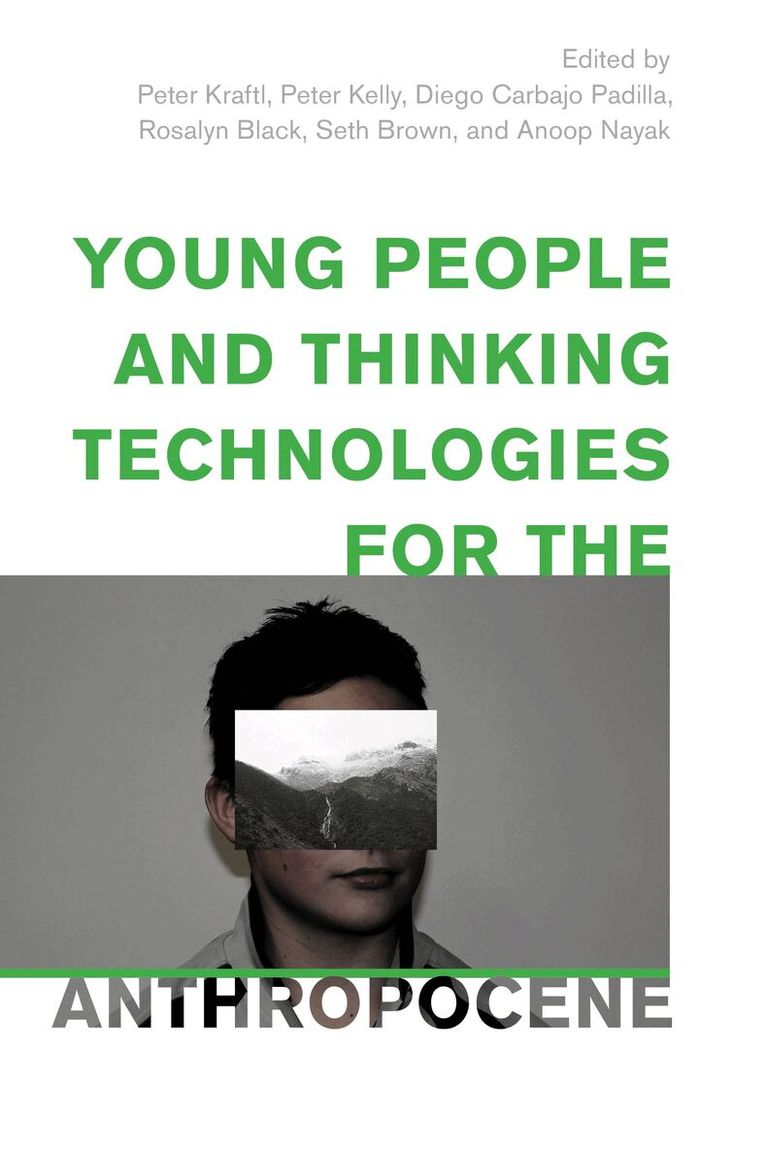
    Young People and Thinking Technologies for the Anthropocene

    AvPeter Kraftl,Peter Kelly

    Inbunden, Engelska, 2022

    Del i serien Children and Young People in the Anthropocene

    1 186 kr

    Beställningsvara. Skickas inom 10-15 vardagar. Fri frakt över 249 kr.

    Beskrivning

    This collection, which is a companion volume to Young People and Stories for the Anthropocene (Kelly et al., 2022), aims to find, to explore, and to co-produce ways of ‘staying with the trouble’ (Haraway 2016) that are disruptive of orthodoxies in childhood and youth studies, and productive of new ways of thinking, and of being and becoming, in the circumstances that we (young and old) find ourselves in. Circumstances that have, problematically, been identified as the Anthropocene, and which have been characterised as being situated at the convergence of the climate crisis, the 6th mass extinction, and the ongoing crises of global capitalism as ‘earth system’ (Braidotti 2019, Moore 2015).The collection emerges, in part, and among other things, around three key challenges. First, how can childhood and youth studies tell stories about the less obviously-bounded, obviously-crafted, obviously-engineered material stuff that humans create and that circulates – stuff like plastics, chemicals, and the scattered remnants of past industrial endeavour. Second, the need to experiment with diverse modes of representation: with differently-mediated technologies and modes of telling that, from digital film platforms to children’s non-fiction writing, expand our lexicon in terms of how it might become possible to narrate young people in/and the Anthropocene. Third, the need to articulate different ‘tools’ for working with young people in the Anthropocene. ‘Tools’ and ‘technologies’, understood in this manner, are modes of becoming-attuned to, and of making, new configurations of human and non-human, new and pressing threats that weigh upon young people in visceral, affective ways, and new modes of speculating about and becoming-responsible for futures – human and more-than-human. In this sense, the contributions to the collection, from scholars from the Anglo and non-Anglosphere, are framed by an urgency to develop and deploy innovative, critical and disruptive theoretical and methodological tools and technologies to identify and explore the material, temporal and conceptual challenges for children and young people, and those who research in childhood and youth studies, at this convergence.

    Produktinformation

    • Utgivningsdatum:2022-09-26
    • Mått:158 x 237 x 22 mm
    • Vikt:494 g
    • Format:Inbunden
    • Språk:Engelska
    • Serie:Children and Young People in the Anthropocene
    • Antal sidor:206
    • Förlag:Bloomsbury Publishing Plc
    • ISBN:9781538153628

    Utforska kategorier

    • Antropologi inom Samhälle och politik
    • Sociologi inom Samhälle och politik
    • Geografi inom Naturvetenskap och teknik

    Mer om författaren

    Peter Kraftl is Professor of Human Geography at the University of Birmingham, UK. His research looks at the intersection between children, young people and the environment, with a particular interest in urban and education spaces. He has published ten books (most recently, After Childhood, Routledge) and over 100 journal articles and book chapters on these topics. Peter has been an Editor of the journals Children’s Geographies and Area and is a Fellow of the Academy of Social Sciences (UK).Peter Kelly is a Professor of Education in the School of Education at Deakin University. Peter’s current research interests include a critical engagement with young people, their well-being, resilience and enterprise, and the challenges associated with the emergence of the Anthropocene. In the context of the COVID-19 pandemic, these interests are framing the development of a research agenda titled: COVID-19 and Young People’s Well-being, Education, Training and Employment Pathways: Scenarios for Young People’s Sustainable Futures.Diego Carbajo Padilla is an assistant professor and researcher of the Department of Sociology and Social Work at the University of the Basque Country UPV/EHU (Spain). His main research interests articulate concepts such as youth, precarity and/or entrepreneurship. These interests are concretised in publications around the concept of global grammars of entreprise, young people’s residential transitions and the squatter social movement in the Basque Country.Rosalyn Black is a Senior Lecturer within the School of Education at Deakin University, Australia. Her research interests meet at the intersection of the sociologies of education and youth. It draws on poststructuralist perspectives to critically analyse young people’s relationship to democratic systems; the role of schools and universities in constructing young people as citizens; and the geographies of young people’s lived experiences of citizenship, especially in contexts of social inequality.Seth Brown is a Lecturer in the School of Education at RMIT University, Australia. His research interest is in the socio-cultural studies of education and youth in the context of wider social and cultural change. He is Head of UNEVOC@RMIT University and a member of Co-Lab SDGs and the Young People’s Sustainable Futures Lab. His most recent jointly written book includes Belonging, Identity, Time and Young People’s Engagement in the Middle Years of School with co-authors Peter Kelly and Scott Phillips (Palgrave Macmillan 2020).Anoop Nayak is Professor in Social and Cultural Geography at Newcastle University, UK. His research interests include race, ethnicity and migration; youth cultures and social class inequalities; masculinities and global transformations. His current research explores young people, diversity and belonging in a post-Brexit age (Research Excellence Academy) and an ESRC co-production award seeking to develop new templates for masculinities in primary schools.

    Recensioner i media

    Youth Studies has developed a robust body of knowledge on young people’s trajectories as they struggle to make a life in increasingly precarious social, political and economic circumstances. What we have called youth transitions are usually considered though the simplified binary of agency and structure. This wide ranging and ambitious collection invites Youth Studies researchers to trouble these types of binaries as they cannot account for a world where current business as usual practices are selling out the very future of the current generation of young people and those not yet born, right in front of our eyes. By bringing the concept of Anthropocene to the centre of youth research, this collection makes an important intervention to establish more-than-human and ecological phenomena as vital objects of study in considering the everyday lives of young people, the means to which they strategise towards their ambitions and aspirations, and how the future itself is a deeply affective absent-presence that we need to urgently fight for so young people actually have one.

    Innehållsförteckning

    • Part 1Plastics, Soils, Water, Weather and Waste: The Materialities of Childhoods in the AnthropoceneChapter 1: Plastic childhoods (and more): visceralities, vortices, vectors, virtualities Peter KraftlChapter 2: Resilience as more-than-human Mindy Blaise, Jo Pollitt, Jane Merewether, and Veronica Pacini-KetchabawChapter 3: Soil as Kin: Unearthing Old Ways Aviva ReedChapter 4: Living in the Anthropocene Adrianne Bacelar de Castro and Sarah HennessyPart 2Temporalities and Spaces: Young People’s AnthropocenesChapter 5: Blasted Places: Smog, Steel and Stigma in a Post-industrial Town Anoop NayakChapter 6: The net of heaven is vast, vast…’: Rethinking a philosophy for youth work in the Anthropocene Kerry MonteroChapter 7: The Anthropocene and the two-faced responsibility of young people in the European welfare regimes Kari Paakkunainen, Juhani Saari, and Juri MykkanenChapter 8: Young People and the Anthropocene: Futures, Past and Present? Peter KellyPart 3Knowing and Naming Young People a